Category: History

  • Stepping Stones Then, Stepping Stones Now

    Say the word “Pilgrims,” and my mind immediately goes to tall hats, big buckles, and Stove Top Stuffing.  Our modern history books have so diminished our conception of the Pilgrims that we often tend to think of them mainly in terms of the “first Thanksgiving.”  But in all the 350 pages of William Bradford’s Of Plymouth Plantation, he devotes less than one paragraph to a “small harvest” in the fall of 1621, noting that they would be “plentifully provisioned for the winter.”  He makes no mention at all of a celebratory dinner. 

    Bradford’s book, though, does give an incredible insight into the passion that this group of people had for Jesus Christ and His Gospel.  What would motivate a group of hard-working, intelligent, middle-class, family-oriented Christians to sell essentially everything they had in order to charter a ship to a wilderness where they had no claim to land, no housing, no doctors, no one to go ahead and make it safe or comfortable for them?  What were they thinking?  Bradford gives a notable answer to that question as he described the motivation of his fellow ‘pilgrims’:

    They cherished a great hope and inward zeal of laying good foundations, or at least of making some way towards it, for the propagation and advance of the Gospel of the Kingdom of Christ in the remote parts of the world, even though they should be but stepping stones to others in performance of so great a work.

    This group of Christians had a grand vision.  They saw themselves as part of God’s unfolding narrative of history.  They were not the beginning, nor would they be the end.  The Pilgrims understood that their life was not all about them.  They were Kingdom-minded and their actions prove it.  They were willing to be stepping stones.  And we must recognize that we stand on their shoulders today when we gather to worship freely, without government control.  The Pilgrims didn’t come to a wilderness just so they could worship freely.  They came so we could worship freely, too.  They came so we could go… and take the Gospel to others.

    Some 360 years later, another group of Christians with a grand vision gathered to advance God’s Kingdom on a new frontier – that being home education. 

    Members of this group eventually founded the Christian Home Educators of West Virginia.  What had motivated these hard-working, intelligent, middle-class families to risk legal harassment, jail, or even loss of the custody of their children – when they had no clear legal claim to homeschool, no professional advisors, no online curriculum for higher math, no one to go ahead and make it safe or comfortable for them?  These “homeschooling pilgrims,” too, cherished a great hope and inward zeal of laying good foundations:

    We seek to promote homeschooling as a valuable means to strengthen families, as well as an environment that facilitates discipleship of children in the Christian faith.  We strive to impart a vision of family life which inspires Christian families to disciple their children, and to assist those families in accomplishing their vision with excellence. 

    Like the Pilgrims in Plymouth, these “homeschooling pilgrims” truly understood that their life was not all about them.  They were Kingdom-minded and their actions prove it.  They were willing to be stepping stones.  And we must recognize that we stand on their shoulders today when we gather to teach our children at home – freely, without government control.  They gained our legal freedom so that we would be free not just to teach our children, but to train them up in the Christian faith.

    So, how about you – are you willing to be a stepping stone for others to find their way to Jesus Christ?  Do you want to leave a legacy that benefits both the present and future generations?  Here are four ideas:

    • Add an age-appropriate Bible study to your home education curriculum.
    • Take a younger homeschool family under your wing to share the vision of family discipleship.
    • Teach the true story of the Plymouth Pilgrims to your children before the inevitable history revisionist movie comes out from Hollywood next year.

    Donate to CHEWV to help us continue to serving homeschool families across West Virginia.

  • A Brief Look at Legislation

    A Brief Look at Legislation

    by John and Edie Carey
    The Careys served on the CHEWV board for several years.

    When John began working for CHEWV at the State Capitol in 1999, advancing homeschool freedoms meant gaining the freedom to homeschool a child past the eighth grade even if the parents did not have formal education past high school graduation.  It took three bills, four sessions and the involvement of hundreds of homeschool families to gain this right.

    Previous to 1999, homeschool families were fighting to prevent moms and dads from going to jail for simply choosing to educate their children at home.  Dr. Phil Suiter played a big part in that effort.  As a former assistant state superintendent, he brought credibility to our movement and helped to shape the first homeschool law, which granted an exemption from the compulsory attendance law and made homeschooling legal for the first time in West Virginia.

    Today advancing homeschool freedoms is more about the removal of burdensome regulations, because since those early years, homeschooling has been proven to work.  Cases in point, Ivy League Universities and the United States military changed their policies as home education was validated. Although the Charleston battles are still not always easy, homeschooling is on much better legislative footing now. We applaud the West Virginia Senate and House leadership for passing all three of our homeschool bills last session. Unfortunately, the Governor chose to stand in the way of progress and vetoed two of these bills.

    Now with gay marriage declared a basic civil right by the US Supreme Court, future battles are expected to be about who is ultimately in control of educational content.  For example, Canada’s Human Rights Commission attempted to prevent homeschool parents from teaching that traditional marriage is the only valid form of marriage.  While this law was eventually defeated, it demonstrates the natural outcome of governments that decide to legalize and protect ideas and definitions that many of their citizens cannot accept with a clear conscience.

    Please pray for the 2016 regular session. It is because of the prayers and sacrifice of many that our freedom has advanced over the years as our merciful, kind, and gracious God works on behalf of His people.  Thanks be to God who is worthy to be praised!

  • Support Groups in the Early Years

    Support Groups in the Early Years

    by Coleen Bumgarner

    During CHEWV’s first fifteen years, Coleen Bumgarner worked to establish support groups and contacts throughout the state of WV.  Here she recounts a little bit of what it was like to be a “pioneer” in those early years of homeschooling!

    When CHEWV began in 1990 there were few homeschooling families, and the few that existed were scattered across the state.  Finding others committed to homeschooling or interested in homeschooling happened by “word of mouth” or by meeting at events.  Remember, social media and internet blogs weren’t available back then!  So the task of building bridges throughout the state was rather daunting.

    My husband and I served as support group liaisons for CHEWV and occasionally a name or phone number would come our way, but with little other information.  It was definitely a challenge finding other homeschoolers in the hills and hollers of our Mountain State!  In fact, due to the geographical shape of WV, some families had already connected with neighbors in Ohio, Pennsylvania, or Virginia.  To complicate matters, the families we found were often secretive or elusive about educating their children, fearing for their freedom and parenting rights.  Understandably, it was hard to convince them to associate openly with other families. It often felt like they were playing the children’s game – Catch me if you can!

    CHEWV responded by sponsoring regional meetings and workshops (with free food, of course!) for those who were willing to take on leadership roles and other responsibilities.  We knew homeschooling needed to be a viable and accessible option across our state!

    In the early years, most support groups published hard copy newsletters and sent them out by mail monthly.  I tried to get on all the mailing lists so that I could, in turn, share information from group to group. My passion was to connect these random groups, so every month I sent out packets (large manila envelopes!) to the folks I knew.  I collected articles from magazines, made copies, stuffed envelopes, and sent them out to any contacts I had – along with a prayer that someone might benefit.  Bridges were slowly being built in the homeschooling community scattered across our mountainous state.

    Today, we can’t even imagine what it was like in those early years – like having only ONE homeschooling magazine and only TWO curriculum choices (yes, just two!).  Then the arrival of the internet changed everything!  The need to connect homeschoolers also changed overnight.  It was suddenly easy to find help, get a question answered, and discover other homeschooling families.  Support group dynamics also changed drastically.  Those early support groups gradually morphed into mega groups able to offer dance, theater, athletics, and all manner of activities.  Yes, the changes that have occurred since those early years have been staggering.

    CHEWV’s early quest of finding support groups has changed as well.  As the labor-intensive monthly mailings became a relic of the past, we turned to our website, email, and Facebook page to connect families.  These avenues provide instant and more accurate information for our members and friends.  Yes, our state is still geographically challenged and there are still some pockets where homeschooling families feel isolated, but CHEWV continues to seek out these families and offer support through our expanded outlets in the media.

    Phil and Coleen Bumgarner served on the CHEWV board from its founding until 2005 when the last of their three graduated.  They count CHEWV friendships as “tried and true,” remaining precious and dear through the years. 

  • 1994: Portfolio Review

    1994: Portfolio Review

    The First Decade and the Portfolio Option

    by Mike Hutchison, former Executive Director of CHEWV

    With a vision to serve the homeschooling community, CHEWV commenced its service in 1990.  Starting with a board of ten couples, the first real invitation to join CHEWV came with the invitation to the first conference, with nationally-known speaker Gregg Harris.  From there, the service and membership began growing; within the first ten years, membership grew from 40 families to over 600 families!    

    During CHEWV’s first three years, homeschooling became more popular all across the country.  While attracting the attention of more parents, however, it drew increasing antagonism from teachers’ unions and legislators.  In 1994, U.S. Congressional Bill HR 6  threatened to derail homeschooling nationwide.  It was during the HR6 campaign that CHEWV’s phone trees and statewide communication system was set up.  The voice of our homeschooling community, heard loud and clear in the halls of Congress, made an indelible impression on our representatives in Washington!  While primitive by today’s technology, that system would serve CHEWV for many years until replaced by email and electronic communication.   

    West Virginia legislative pressures heightened as the state’s teachers unions sought more control over homeschooling families.  At the same time more families with special needs children began to consider homeschooling as an option to help their children flourish with more one-on-one, personally tailored instruction.  CHEWV, in concert with HSLDA, decided to seek legislation in the 1994 session to add a portfolio evaluation assessment option to the annual standardized testing requirement.  It seemed reasonable to seek a legislative remedy for the discriminatory provision of the law which made it impossible for special needs children to be homeschooled.

    While a portfolio assessment option seemed straightforward and reasonable, the 1994 legislative campaign became very difficult as the state teachers unions and state Department of Education became adamant that parents were not qualified to teach special needs children and, in fact, should not be teaching any children at home unless they were state-certified teachers.  God favored us with a sympathetic chairman of the House Education Committee, but the Senate Education Committee chairwoman, a school psychologist, was adamantly opposed to any more parental freedom than the law already allowed.  As this was before CHEWV had a formal lobbying presence at the Capitol, the CHEWV Board asked homeschooling families from all around the state to advocate face-to-face with their own delegates and state senators.  Families responded by flooding the Capitol, many bringing cookies as they sought individual meetings with their district legislators to lobby for passage.

    As had been experienced in 1986, it was only by the grace of God that the portfolio option was passed that year.  At one point near the middle of the session, the Senate Education Committee chairwoman told CHEWV that the House Bill would certainly not make it through her committee.  What did God use to change her mind?  God used our children!  Conversations with our children and their respectful behavior softened her heart over the last four weeks of the session.  In one of the many trips to the committee meetings and just three days before the end of the session, she shocked us when she asked the committee to report the bill to the Senate Floor – albeit with no recommendation for passage.  On the next-to-last day of the session, when we were again at the Capitol, she called us aside and told one of our children not to worry about the bill – that it would be okay!  The Senate passed the House Bill unanimously on the last day of the session – and it became law!  The heart of the king (in this case the committee chairwoman) was still in God’s hand!  Nowhere is it more evident than when Exemption B (b) of the West Virginia Code was liberalized to allow more freedom to West Virginia’s homeschooling families.  Like David, we are small and have no legislative power on our own.  But as with Goliath, God takes down seemingly insurmountable obstacles through the active faith of His people!

  • 1986 Homeschooling Law

    1986 Homeschooling Law

    The Birth of Legal Homeschooling: Not to be Taken Lightly

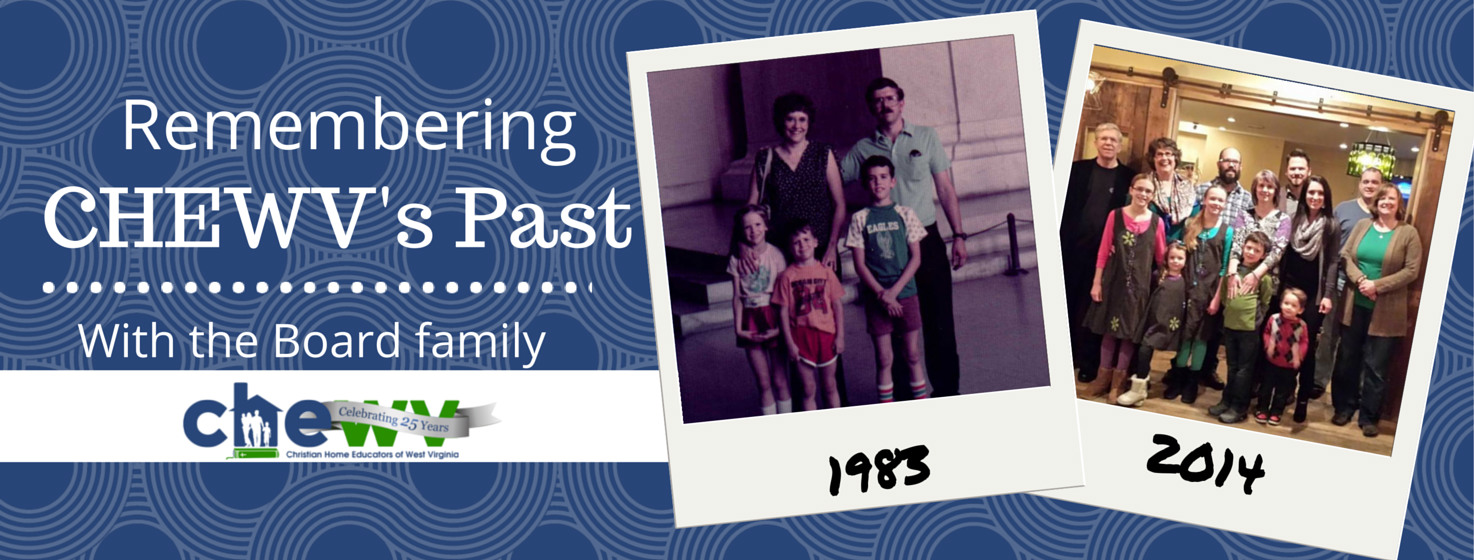
    by Gene and Jan Board, one of CHEWV’s founding board couples.

    It has been thirty years since we started homeschooling–a generation has passed and many things have changed.

    When our family started homeschooling in the 1980’s, we used exemption K, the Parochial School exemption.  In our zeal, we named our little school, had letterhead stationery, assigned a boys’ and girls’ bathroom, and even had a school newspaper (with a very plucky reporter). We already owned a yellow vehicle, so, as our children remarked, we even boasted a “yellow school bus.” It was novel and exciting.

    Until it became evident that we could no longer use exemption K and things began to collapse. Should we move to another state that allowed homeschooling? Or should we band together with other families (if we could find them) who would start a Christian School? Doing so would require a huge expense for a building, staff, and materials.  Plus, we felt compelled by God to teach our own children at home. Yet to continue homeschooling under the old exemption K would be breaking the law, and the consequences of that were frightening.  We could go to jail and our children put into foster care. A lengthy and expensive litigation process would be required to get our lives back if we survived such an ordeal.

    We spent much time in prayer and research and felt that our only logical choice was to seek a new law that would allow all families like us the freedom to homeschool their children.  Less than a week later we received a call from a stranger, Don Fox, who asked us to meet with a small group concerning the possibility of creating a new homeschool law.

    I was so naive about the entire process.  I thought our little group would make a quick trip to Charleston, give an impassioned speech, shake some hands, and presto, a bill would become law. That was not what happened!

    When we first met in Charleston as a group, the sponsoring delegates sent a legal clerk to write the bill that would be submitted.  We knew what we wanted the bill to say and do, but the legal wording was a different matter.  I called a homeschool mom in Virginia who read their state’s brand new homeschooling law to me as I copied it down. We made changes and were on our way.

    This was before email, cell phones or social networking. We had home phones, fax machines, phone trees and letters (the kind that require stamps). When a hearing was scheduled, usually only hours in advance, it would take a while for us to get the message. These various committee meetings – Education, Finance, Judiciary, etc – were often bright and early, so by the time we got the message, packed, and drove down to a motel, it was the wee hours of the morning. It required planning to jump up, park and get into the Capital by 8am.

    When we got to the meeting, we could only speak if called upon, and only for an allotted time. If someone from the other side of the issue reported something wrongly, we could not correct the information unless we were called upon.  At the first Education Committee meeting of the House, the chief lobbyist of the teacher’s unions pointed out that homeschoolers had made recent news because they were in a show down with State and Federal Marshals in another state. Obviously, these were not the role models we were hoping for, and they were using a very broad brush to define homeschoolers. So we compiled reams of information and dutifully put it on the desk of the delegates and senators. We then watched from the gallery as many on the floor below looked briefly at our cover sheet only to immediately throw it in the waste basket by their desks.

    We needed to make them aware of a constituency that they never knew existed.  One way to do this was to take our children to Charleston as living examples of what we wanted to achieve.  They went with us when we talked one on one with our representatives.  They were grilled and observed and questioned.  We would do “school” in the cafeteria and several legislators would stop by the table to see what the kids were doing.  The kind ones would sit and talk with the children and even help them with math problems.  Others used the opportunity to tell us why they didn’t think this was a good idea. Gene and I had to register as lobbyists because we were talking to more that just our own representatives. We were welcomed in some offices and told to leave in others.

    We learned the importance of having homeschoolers from all districts talking with their own representatives. It makes a difference when we can directly affect their re-election! But at this time, there was only a handful of homeschoolers in the entire state…  

    These committee meetings were scattered throughout the 60 days the legislature was in session, and we never knew how long we would be needed in Charleston. Our senator, who was sponsoring the bill in the Senate, had been allotted two motel rooms.  One was used by him to house constituents who were visiting him.  If no one asked for the room by eight in the evening, he would allow us to stay there.  We were not always able to stay free, but we were so thankful for those times when we could. At one point, I found myself doing laundry in a laundromat while the children sat in a warm car in their underwear and winter coats! Eating out all meals proved expensive, so when I could I would bring food from home. Gene ran his business long distance via the phone and his business partner. Those trips to Charleston became our “vacation” for the year, but what an educational trip it turned out to be!

    Probably the most defeating moment came toward the end of the session.  It was clear that the homeschool bill had enough backing in the House of Delegates to pass and then move on to the Senate. But in various meetings with the Speaker of the House, it became evident that he would not bring our bill up for a vote because the public school teachers had a real problem with children being taught by parents at home, and they had his ear.  Without intervention the bill would die. A compromise was struck that would put qualifiers on both children and parents. As horribly restrictive as this was, it did allow the bill to become law and, for the first time since the nineteenth century, it was definitely legal to homeschool.  While this WV law was the most restrictive of all the states’ homeschooling laws at the time, subsequent legislative action made it more lenient. An even better law is still needed today.

    Our family did make large sacrifices for that first homeschool bill, but all praise belongs to God. We were just obeying what we felt God had called us to do. Had we chosen not to get involved, God would have used someone else to carry out His goals, but we would have missed so much! Through all the hassle and fear and discouragement, we learned that God is able to do abundantly more than we ever ask or dream! It was so encouraging to see what a few amazingly determined and persistent people could do when they felt led by God to do something bold for the benefit of others.

    In the end, we spent 22 days of that session in Charleston and were asked to be present when the bill was signed into law. Finally the question of “Who owns the child? The state or the parents?” was answered as legal homeschooling in WV was birthed.