Tag: Homeschool Testing

  • Assessment Considerations

    Assessment Considerations

    [et_pb_section fb_built=”1″ admin_label=”section” _builder_version=”4.16″ global_colors_info=”{}” theme_builder_area=”post_content”][et_pb_row admin_label=”row” _builder_version=”4.16″ background_size=”initial” background_position=”top_left” background_repeat=”repeat” global_colors_info=”{}” theme_builder_area=”post_content”][et_pb_column type=”4_4″ _builder_version=”4.16″ custom_padding=”|||” global_colors_info=”{}” custom_padding__hover=”|||” theme_builder_area=”post_content”][et_pb_text admin_label=”Text” _builder_version=”4.19.4″ background_size=”initial” background_position=”top_left” background_repeat=”repeat” hover_enabled=”0″ global_colors_info=”{}” theme_builder_area=”post_content” sticky_enabled=”0″]

    Hmm…portfolio review or standardized testing? While a homeschool assessment must be done EVERY YEAR for students of compulsory age, which assessment option is best? 

    The portfolio review option was hard-won back in 1994 to help special needs students and others for whom testing is less appropriate, such as students with test anxiety or pre-readers. For example, there are disadvantages to using standardized testing prior to 2nd or 3rd grade.  We recommend becoming educated about the level of reading required for early-level testing.  If your student is not yet ready for that reading level, you might consider a different assessment.

    As you consider your choices, this article about reading-readiness prior to age seven should be helpful.  If you decide that testing is your best choice this year, another of our articles gives prep ideas, many of which need implemented several weeks before testing.

    Keep in mind that testing environment matters.  While students who are good testers (usually those who easily sit still for book work) do well in almost any testing environment, most students do better when the environment is familiar.  That serves well when testing with co-op buddies or homeschool friends, but for those who are heading to an unfamiliar test center, prepare your child by helping them relax and not feel pressured from the stress of the new social situation. 

    Private testing in your own home is an option that allows a young student to test in an un-rushed manner in a familiar environment. Short attention spans might also benefit from private testing, as a parent could make arrangements with a private administrator to span the testing over additional days.  

    Using the same assessment option year to year isn’t necessary, as both testing and portfolio review have their own benefits.  While portfolio review is designed to compare the student with his or her own abilities, testing does give credible and useful information about how your student compares with other students.  Standardized tests are also good practice for testing environments down the line, such as college prep exams and dual enrollment classes.  Many parents who use portfolio review in the early years switch to testing by mid-elementary. 

    Hover over the “Assessments” menu option to peruse all your assessment options.  Still have questions?  Email testing@chewv.org.

    [/et_pb_text][/et_pb_column][/et_pb_row][/et_pb_section]

  • The State of 2020 Assessments

    The State of 2020 Assessments

    Do we still have to do them?

    Yesterday the WV State DOE issued a statement strongly encouraging counties to accept homeschool testing results through December 31.  This should be a relief to any homeschool instructors who have 3rd, 5th, 8th or 11th graders and who are worried about meeting the June 30th deadline for submission. 

    Still, CHEWV encourages you to turn in results as close to June 30th as possible.  While we are grateful for the support of the State DOE and Dr. Burch, they only provide guidance to counties. 

    Homeschool requirements are legislated.  We homeschool according to the WV code, not according to the standards of the public school. The only way to change the homeschool code’s requirements is to have a new law passed in one of the legislative sessions.  That is why we all have the privilege of talking with our legislators and weighing in before any changes can happen to the hard-earned homeschool statute.  What a blessing that things can’t change willy-nilly! 

    Remember, the fact that we homeschool according to state code is why you don’t have to wait for the school’s approval before homeschooling.  As long as you follow the requirements of the code, you are good. 

    It’s also why the requirements of the school system don’t apply to you.  You don’t have to school 180 days.  You don’t have to take summers off.  You don’t have to be vaccinated in order to educate your children.  And you can take Bible for a full credit if you want – and educate through a Biblical worldview. 

    But, in this case, it also means that the public schools’ testing requirements (or lack thereof this year) don’t affect us directly.  In and of itself, they are superfluous. State code requires that we complete an annual assessment and submit the results for 3rd, 5th, 8th and 11th grades by June 30th.

    The only real way to change that requirement is for the legislature to change the law, even if temporarily.  We have considered whether it’s legally feasible or possible to get a waiver or extension from the governor.  However, homeschooling leadership, under advisement from our attorneys, have determined that the longterm risks of such a waiver outweigh any perceived benefit. 

    Although the legal requirements, including the June 30th deadline, remain intact, the statement from the State DOE will help prepare the way for grace should families have difficulty meeting the deadline.

    CHEWV, WVHEA and HSLDA continue to encourage you to pursue your annual assessments as always, taking advantage of the many alternatives that are now available. 

    Who is Affected by the June 30th Deadline?

    First, the deadline only applies to 3rd, 5th, 8th, and 11th graders.  The deadline is for when those grades must be submitted.

    But for all other grades, assessments just need to be completed before the next school year begins.  Assessments are year-specific.  It’s an annual assessment for each school year.

  • Assessment Considerations

    Assessment Considerations

    [et_pb_section fb_built=”1″ admin_label=”section” _builder_version=”4.16″ global_colors_info=”{}”][et_pb_row admin_label=”row” _builder_version=”4.16″ background_size=”initial” background_position=”top_left” background_repeat=”repeat” global_colors_info=”{}”][et_pb_column type=”4_4″ _builder_version=”4.16″ custom_padding=”|||” global_colors_info=”{}” custom_padding__hover=”|||”][et_pb_text admin_label=”Text” _builder_version=”4.16″ background_size=”initial” background_position=”top_left” background_repeat=”repeat” global_colors_info=”{}”]

    While a homeschool assessment must be done every year for students of compulsory age, there are two main options to choose from: testing and portfolio review.  The portfolio review option was hard-won in 1994 to help special needs students and others for whom testing is less appropriate, such as students with test anxiety or pre-readers. For example, there are disadvantages to using standardized testing prior to 2nd or 3rd grade.  We recommend becoming educated about the level of reading required for early-level testing.  If your student is not yet ready for that reading level, you might consider an alternative assessment.

    As you consider your choices, this article about reading-readiness prior to age seven should be helpful.  If you decide that testing is your best choice this year, another of our articles gives prep ideas, many of which need implemented several weeks before testing.

    Keep in mind that testing environment matters.  While students who are good testers (usually those who easily sit still for book work) do well in almost any testing environment, most students gain an advantage when the environment is familiar.  That serves well when testing with co-op buddies or homeschool friends.  But for those who are heading to an unfamiliar test center, prepare your child by helping them relax and not feel pressured from the stress of the new social situation. 

    Private testing in your own home is an option that allows a young student to test in an un-rushed manner in a familiar environment. Short attention spans might also benefit from private testing, as a parent could make arrangements with a private administrator to span the testing over additional days.  

    Using the same assessment option year to year isn’t necessary, as both testing and portfolio review have their own benefits.  While portfolio review is designed to compare the student with his or her own abilities, testing does give credible and useful information about how your student compares with other students.  Standardized tests are also good practice for testing environments down the line, such as college prep exams and dual enrollment classes.  Many parents who use portfolio review in the early years switch to testing by mid-elementary. 

    Hover over the “Assessments” menu option to peruse all your assessment options.  Still have questions?  Email testing@chewv.org.

    [/et_pb_text][/et_pb_column][/et_pb_row][/et_pb_section]

  • Wait!  Does That Test Meet WV Code?

    Wait! Does That Test Meet WV Code?

    While the myriad of testing choices available to parents may offer more flexibility, they come with an equal dose of responsibility.  Recent ads to WV families have promoted online and traditional versions of the Stanford test – some of which do not meet state code.  The Comprehensive Testing Program (CTP) is also advertised, but appears not to offer the five required subjects.

    The testing assessment option in the state code requires a nationally-normed standardized test published or normed within the previous 10 years.  It must provide scores for five subjects:  reading, language, mathematics, science and social studies.  Further, it must be administered under the standardized instructions given by the publisher.

    Though it is the parent’s responsibility to ensure that any assessment they use meets WV code, CHEWV is here to help!  Not only do we provide a testing service and do all the work to ensure the tests meet WV requirements, but we’re also here to answer questions about other assessment options. 

    Our testing program is  a non-profit service, so we have no reason to discourage you from using other options. However, we do have an interest in educating families to ensure they choose tests that meet state code – both to protect individual families and to protect the homeschool freedom of all.

    Even if a county does not notice the first year a test doesn’t meet code, it’s still a hazard to all homeschoolers if families mistakenly test using outdated materials.  When a test’s obsolescence becomes known, it immediately casts negative attention on homeschooling and is fodder to call for greater regulation.  Please help us pass the word so that everyone is compliant!

    Remember that your state organizations exist to serve homeschoolers and help them meet the legal requirements to homeschool in WV.  Contact testing@chewv.org with any questions.  Click to read about assessment options or to read over the WV code.  To support CHEWV by joining, click here.

    Defending freedom, serving families…together.

  • Special Needs: Charly’s Story

    Special Needs: Charly’s Story

    by Charly Shreves

    Our eight-year-old son, Brody, had been struggling for quite a while. He confused letters and numbers, made grammatical and spelling errors that weren’t age-appropriate, and completed any work at an excruciatingly slow pace. It wasn’t a behavior issue; despite obvious difficulty, he persevered patiently and compliantly, and I found myself respecting his persistence in the face of obvious difficulties. But something wasn’t right, and I was determined to find answers.

    After endless hours of praying, researching his symptoms, and referring back to my college classes in Special Education, my husband and I decided to seek professional help from a psychologist.

    Extensive testing revealed a substantially low Visual Memory and Processing Speed on Brody’s IQ profile. The timed area on Achievement Tests was also below grade level. Neither result was surprising; he had always struggled to complete anything timely. But what the psychologist said next was truly alarming:

    “If Brody were in public school,” she said, “I would diagnose him with ADD-NOS.”

    ADD-NOS means “Attention Deficit Disorder – Not Otherwise Specified.”  She would diagnose him so he would be eligible to receive services under a 504 plan.  She explained that he also had dysgraphia and recommended OT (Occupational Therapy). I suspected that if Brody indeed were in school, they would recommend medication because, if we’re honest, that’s how these diagnoses are typically remedied.

    I left her office feeling helpless, frustrated, and heartbroken. The dysgraphia made sense. The ADD-NOS, however, wasn’t only not what I wanted to hear, but more importantly didn’t make sense to me. Over the following months, we continued to homeschool, but I began seeking counsel from those whose opinions I valued, and I prayed harder. I knew I had to dig deeper if I was going to really help Brody be successful in school.

    Finally, in late November, we wound up two hours away from home seeing an optometrist who specializes in Developmental Vision Therapy.  It was a shot in the dark.  But within the first five minutes of that first appointment, I knew we were exactly where we needed to be.  Early in the session, the doctor politely excused himself for what seemed like forever, then came back and continued with us. Later I learned that he had cleared his entire waiting room in order to be with us for nearly three hours! Little did I know we were beginning a process that would be a pivotal point in Brody’s life.

    The optometrist diagnosed Brody with five things: farsightedness and astigmatism (pretty common), convergence insufficiency (constant double vision 24″ from his face), accommodative dysfunction (inability to focus) and oculomotor dysfunction (uncontrollable eye movements). Wow! Poor kid! No wonder seemingly simple tasks, like kicking and catching a ball or going up and down steps, was so difficult for him.  In hindsight, I hadn’t even realized these were issues for Brody. As a parent, I had naturally embraced his weaknesses and had tried to foster his strengths.

    The doctor ordered glasses with prisms to be worn for two months along with continued OT, followed by an intensive vision therapy program which would be home-based.  It was all starting to make sense to our entire family, including Brody. The diagnosis fit what we had been experiencing. It also explained the low drop in his IQ profile Vision and Processing Speed as well as the timed area on his Achievement Tests. Finally we were moving in the right direction with a diagnosis we knew was far more accurate.

    None of these problems had been detected at the three separate eye appointments Brody had had prior to this. All three said he was slightly farsighted, but no glasses were recommended because “his eyes were young and strong.”  Brody was trying to tell us that something wasn’t quite right and that he saw double vision, but even professionals overlooked it.

    Brody’s case shows that much too often, children are incorrectly assigned diagnoses like ADD-NOS in hopes of finding quick and easy answers. Sometimes, the answers aren’t so black and white. We, as educators of our children, have to seek and exhaust all options.

    I’m so thrilled to say that Brody recently had a follow-up and is now seeing 20/20 with his glasses, only seeing double vision 6″ from his face rather than 24″, the prism and cover test improved from 16 to 2, and he can now see 3-D. He is just beginning his vision therapy and we will return for a follow-up in five weeks.  The doctor foresees that Brody will soon be able to wear glasses without prisms.  The future is looking much brighter and I feel so blessed that we have found the resources that he needs to succeed. 

    Homeschooling isn’t always easy, but it’s the most beautiful, crazy adventure in life we’ll ever take.  Our family is so thankful for the continued support from our extended family, homeschool group, and church, and we feel blessed to be witnesses of God’s amazing work!

  • Time for a New Test Report Sheet!

    Time for a New Test Report Sheet!

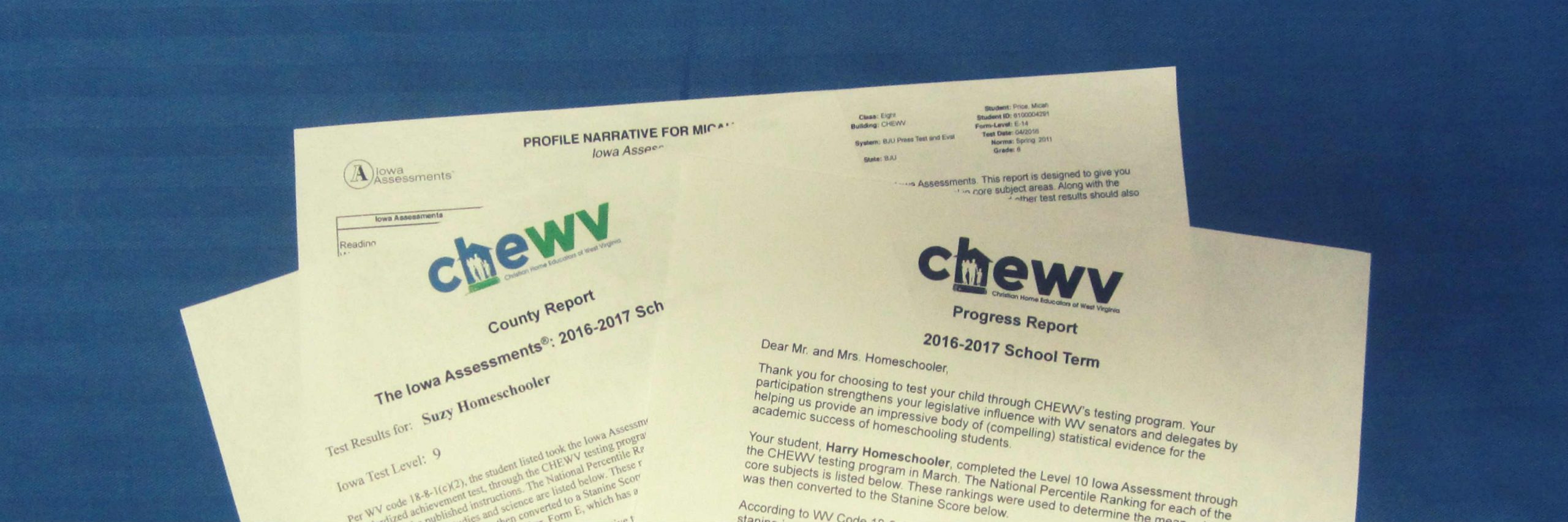
    CHEWV is introducing a new Report Sheet option for CHEWV testing families!  This year we are unveiling our new Progress Report in response to recent changes in the law. 

    The revised homeschooling law requires that assessment results be submitted to the county when students are in grades 3, 5, 8 and 11.  For those students, our County Report (formerly called Report to the Superintendent) is appropriate.  But ALL STUDENTS must still be assessed annually and must meet acceptable progress standards.  Our new Progress Report is designed to help parents know if their student has met the requirements for “acceptable progress” in years when the results are not submitted. 

    Both the County Report and the Progress Report are WV-specific.  Both reflect the necessary calculations to determine how the child’s test scores compare with WV law requirements. 

    Just like the previous law, the revised law requires that students annually make acceptable progress – as defined in the law.  If not, remediation is required.  The second consecutive year that acceptable progress is not made, additional evidence of appropriate instruction must be submitted to the county.  This is applicable for ALL STUDENTS IN ALL GRADES, just like before.

    At the time of registration, parents will choose between the two reports.  If their student is in 3rd, 5th, 8th, or 11th grades, they should choose the County Report – which is designed to be turned in to the county by June 30.  If not, they should choose the Progress Report so that they can easily determine if they owe “additional evidence” to their county. 

    In all cases, annual assessment results must be kept on file for three years.  Questions?  Email testing@chewv.org.

  • Stanines, Percentiles, and Freedom

    Stanines, Percentiles, and Freedom

    Learning. It’s not just for our students!  There is certainly a learning curve for the newly revised law.  This is a good thing, however, for through this law we have gained freedom!  Nevertheless, with freedom comes responsibility – the responsibility to learn.

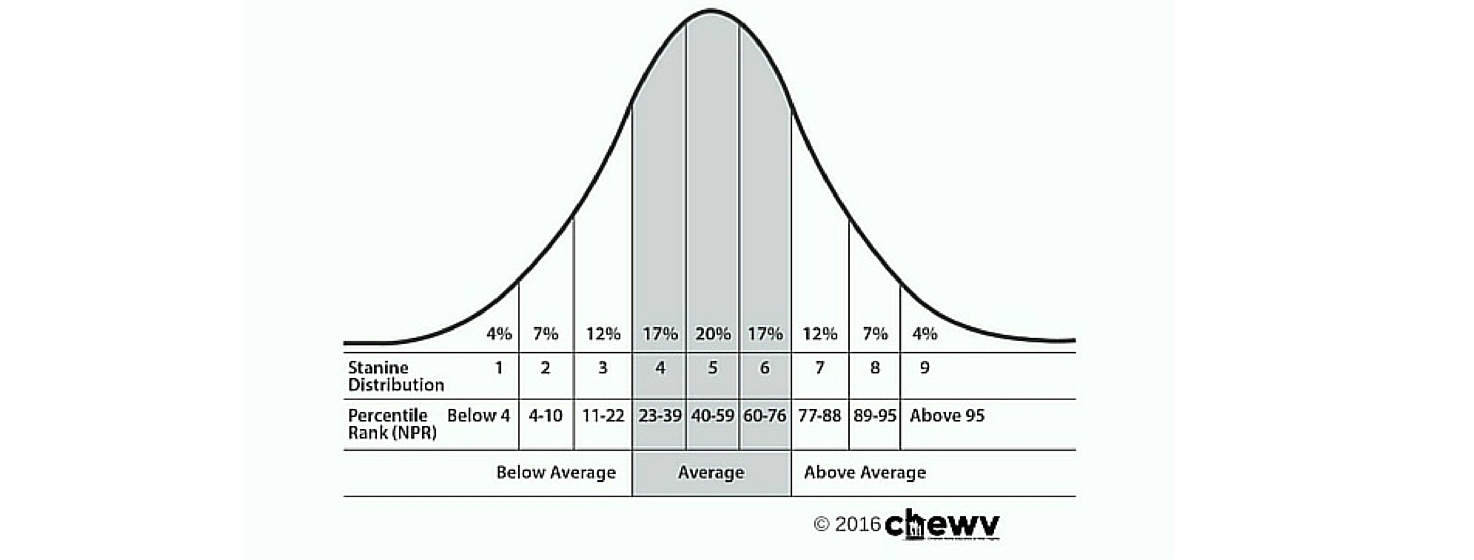
    Those parents who have chosen testing for the annual assessment are beginning to realize that stanines are quite different from percentiles.  Although stanines are less precise than percentiles, in many ways they reflect the bell curve much more.  If you recall, the purpose of a standardized test’s norm group is to plot the scores on a bell curve and then draw comparison scores thereafter.  The normal bell curve with its distribution can be referenced above.

    Looking closely at the bell curve distribution, you will notice that the 4th, 5th and 6th stanines include a large range of percentile scores.  This reflects the fact that the bell curve is tallest in that middle range:  that those ranges represent the most students.  The 5th stanine contains the most scores – from the 40th to the 59th NPR (Normed Percentile Rank).  A stanine score of 5 is not very precise, but reflects that the student falls right where the largest group of other students do.

    In comparison, the 9th stanine includes only 4 NPR scores: 96-99. The 9th stanine is much more discriminating than any other except the 1st. Only 4% of students are expected to score in that stanine distribution.

    Be cautious that you don’t assume that the 1st digit of an NPR is reflected in the corresponding stanine rank because that just isn’t true. For example, an NPR of 93 falls in the 8th, not 9th, stanine rank. A 23 percentile rank falls in the 4th stanine, not the 2nd. For those with high scoring students, you’ll want to realize that both the 8th and 9th stanines cover NPR’s in the 90’s: the 8th stanine for scores from 89 to 95 and the 9th stanine for scores from 96 to 99.

    Conversely, scores in the 1st or 2nd stanines are particularly low. Only 11% of the student population scores as low. This is why the articles in the scoring section of our website have been changed to help parents whose children are scoring in those low ranges. We highly recommend that parents identify why their students are struggling and search for strategies to help them reach their full potential.

    Perhaps you’ve never aspired to understand statistics or bell curves, and you shudder when you see a percent sign! Although we want to help you understand these things, what is truly important is educating our children. The law is definitely a hoop we must jump through to get that privilege, and CHEWV is here, in part, to help you make that jump as painlessly as possible. You must know how to satisfy the law’s requirements and to do so with integrity. While a rudimentary understanding of stanines and percentiles is needful, understanding our own children and educating them to their God-given potential is the higher goal!