Tag: parenting

  • Homeschooling: Getting Started Part 1

    Homeschooling: Getting Started Part 1

    Choosing to homeschool is a major decision.  Although homeschooling has been around for many years, it is still not as familiar as “going to school”.  Families contemplating homeschooling can experience apprehension. Questions arise from doubts within and  individuals without. This article is designed to answer some of those questions and give parents the confidence and encouragement they need to train their children at home.

    What about socialization?

    The word socialization has its roots in the word social.  Socialization is commonly understood to be the ability to relate to others of varying ages and interests in an amiable manner.  

    When children are placed in a public school setting, they relate to only a fraction of the population – their peer age group. Exposure to other age groups is quite limited and thus socialization is narrow.  We have all seen examples of children who cannot answer a simple question from an adult or do not know how to enjoy and play with someone younger. Children who are schooled at home, however, are not bound by rooms and peer age groups.  Homeschoolers tend to be able to experience life outside the confines of age and place where their awareness of others and others’ needs is awakened.

    The mail carrier, who would normally go unnoticed, becomes a friend to look forward to seeing each day.  Likewise, the clerk at the store becomes someone to greet with courtesy.  Not only does research show homeschoolers are often more appropriately socialized than their public school counterparts, but people who know homeschool families can generally attest these children interact very well with others.

    Will my child learn everything he/she needs to know?

    Today, there is a  multitude of curriculum choices available for homeschooling families.  This, coupled with the parents’ desire and commitment to provide a quality education, adds up to a successful formula.  Excellent books and resources, such as Robin Scarlata’s book entitled What Your Child Needs to Know When, the WVDE website lists the state’s grade level standard, and a browse through some curriculums can  help establish learning points for each grade level.

    Am I qualified to do this?

    According to WV state law, anyone with a high school diploma or equivalent may legally teach their children at home. Current research indicates that the parent’s level of education has a negligible effect on the education level of a homeschooled student.  God can accomplish wonderful things through dedicated and committed parents who are set on having their child succeed.

    Is it legal?

    Homeschooling has been legal in WV since 1986. CHEWV encourages you to know and understand the WV State law.  For your convenience, visit the WV Homeschool Law page on our website for the full text of the law.

    How do I do begin?

    If you are investigating homeschooling for the first time or not sure how to begin, CHEWV has developed the following steps to get started.  These steps are not necessarily meant to be sequential, although some steps may best be accomplished before others.

    1. Investigate the Legality
    • Know the requirements of the WV Homeschool Law
    • Submit a one-time Notice of Intent (NOI) including all children of compulsory age (age 6 as of July 1).  If another child is added later, another NOI will need to be submitted for that child only.
    • An annual assessment must be completed annually for every grade level.   Assessment reports are only submitted to the county in  grades 3, 5, 8, and 11.  The deadline for an assessment report to the county school board  is  June 30.  Assessments for all other grades are to be completed annually and kept in your records for at least 3 years.
    *It is recommended that all notices and reports be sent via registered/certified mail to alleviate any question about when documentation arrived.
    2. Prepare Your Child to Learn

    How does your child learn?  Just as we all possess individual personalities, we also have different learning styles.

    There are 3 basic learning styles.

      1. Auditory – by hearing
      2. Visual – by seeing
      3. Kinesthetic – by doing

    While each person may have a bent or preference, that does not mean all learning should be focused toward this bent.  Learning should be built upon all three methods, so each style or ability is developed fully within the child.

    It is helpful to know your child’s learning style in choosing what kind of curriculum to use in homeschooling.  For example, if you have a kinesthetic learner, he will become frustrated with a curriculum that consists primarily of workbooks (visual).

    Many have found the three following basic tips are helpful in making your day more enjoyable and successful:

      • Teach Obedience – A child needs to understand that he/she must carry out Mom’s instructions. Many child training books and good blogs are available if help is needed.
      • Develop Listening Skills – Teach your child to be attentive and listen completely to all instructions given before acting upon them.
      • Develop an Excitement for Learning – Be enthusiastic, not apprehensive about learning together.  Ask questions; pique interest; read extensively
    3.  Set Priorities and Goals

    Goals give you a road map, so you know where you are headed and don’t get side-tracked. Homeschooling brings an added responsibility in your life.  Prioritizing your day’s activities and events and developing a schedule will help in fulfilling your goals.  

    What goals do you want to accomplish by the end of the year?

          • Subjects to cover
          • Character issues to address
          • Mastery of subjects to achieve

    Keep your goals simple and tangible, so you can see your accomplishment each time you reach a milestone.  On my first day, my goal was simply to move through each subject and make it to the end of the day!  I am now nearing the time when my goals are more long term.  When I begin a year now, I try to keep my goals and priorities pointed toward the end of high school and what will need to be accomplished by then.

    Our ultimate goal is to raise children who will love the Lord their God with all their heart, soul, and mind and love their neighbors.  We strive to train up children who will be able to stand – with us and without us.

    Continue Getting Started: Part II

  • Educating Your Kids –

    Educating Your Kids –

    4 Things You Can’t Afford to Miss

    By Kevin Swanson

    How do I fit everything into my schedule?

    This is one of the biggest challenges Christian homeschooling parents face. Fitting in parenting, academics, work, family, church, etc. into one person’s schedule, and doing them all well, is not easy (some would ask if it’s even possible).

    In a nutshell though, here is the answer to the question:

    You don’t fit everything into your schedule. You can’t. It ís not possible. God has only given us 24 hours in a day, so that means we have to make choices on how we spend time.

    So here’s the more important question to be asking: Am I spending time where it REALLY counts when it comes to the education and discipleship of my children?

    A tragic thought

    As a parent, what if one day you woke up to realize that all the time and effort you had put into the education of your children was focused on the wrong things? And now your kids are grown up, aren’t ready to engage in real life, and aren’t heading towards an eternity with Jesus Christ in Heaven? It gets worse…this is actually happening for many Christian parents. The Barna Group reports that 95% of teens from American, Christian homes abandon a biblical worldview.1 Considering that America is labeled as a Christian nation, this is quite an alarming statistic. Are your kids going to be ready to persevere in the faith? What can you do as a parent to help them?

    If you’re getting disturbed…good! Now is when we get to the good part.

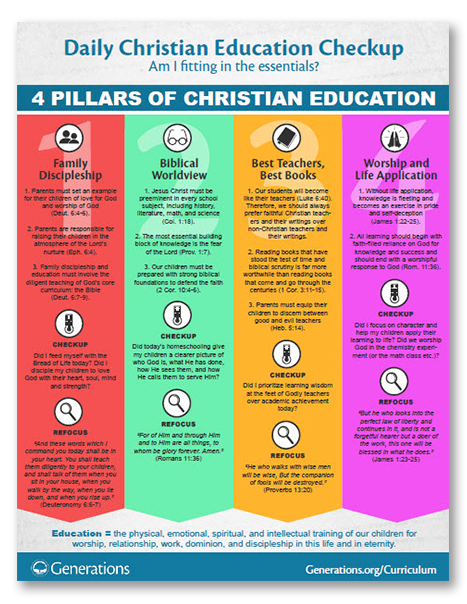
    Preparing our kids for life and eternity is more than we can accomplish as parents. It ís a miracle. It ís an act of God. The first step to seeing your kids become a counter-statistic is to cry out to God to do what He ís so good at…working miracles. But God has also called you as a parent to be purposeful in the education of your children. That means we need to ask, “How can I get on board with what He is doing and make sure that I’m focusing on what’s truly the most important every day?” Below I’ve outlined four “pillars” of a Christian education, based on the Word of God, that I believe are keys to successful kids. If these pillars aren’t in place, the whole thing comes down. (If you’d like a way to get a fast refresher of these four pillars every day and stay on track with what ís most important, download this 1-page, PDF summary,. perfect for posting on your fridge.)

    Pillar #1 – Family Discipleship

    “And you, fathers, do not provoke your children to wrath, but bring them up in the training and admonition of the Lord.” (Ephesians 6:4) Fathers and mothers are responsible for raising their children in the atmosphere of the Lord’s nurture (Deuteronomy 6:7, Ephesians 6:4). Fathers and mothers should teach God’s words in the context of daily life. God calls fathers as leaders of their homes, to be involved in this discipleship at key, strategic points. Family discipleship must involve the consistent and diligent teaching of God’s recommended curriculum: the Bible. Teaching your children the Psalms, Proverbs, and Gospels is essential and basic to a Christian education. Fathers and mothers must keep a careful eye on their children’s spiritual condition, faith, and character.

    Pillar #2 – Biblical Worldview

    “The fear of the Lord is the beginning of knowledge, But fools despise wisdom and instruction.” (Proverbs 1:7) What will it look like to teach your children with a biblical worldview? First, Jesus Christ must be preeminent in history, literature, and science (Colossians 1:18). Christ’s kingdom and His church must become more important in the student’s mind than the work of men’s hands in building their own kingdoms. Secondly, the most essential building block of knowledge (above and beyond every other component) is the fear of God (Proverbs 1:7). The materialism and anti-supernaturalism assumed in modern evolutionary science cannot be tolerated by any Christian family. Thirdly, our children must be prepared with strong biblical foundations and a robust apologetics methodology (2 Corinthians 10:4-6).

    Pillar #3 – Best Teachers, Best Books

    “A disciple is not above his teacher, but everyone who is perfectly trained will be like his teacher.” (Luke 6:40) Our students will become like their teachers (Luke 6:40). Therefore, we should always prefer faithful Christian teachers and their writings over non-Christian teachers and their writings. The great Christian writings are the compendium of the pastors and teachers God has given the church over 2000 years (Ephesians 4:11). These are the teachers that God has given us. Abiding and enduring books are a thousand times worth reading over the books that come and go through the centuries. The pagan teachers and writers have become one of the most influential tools of the devil to cause Christian students to stumble. It is wise to set your children at the feet of the best teachers by reading the greatest Christian books.

    Pillar #4 – Worship and Life Application

    “But be doers of the word, and not hearers only, deceiving yourselves. For if anyone is a hearer of the word and not a doer, he is like a man observing his natural face in a mirror; for he observes himself, goes away, and immediately forgets what kind of man he was.” (James 1:22-24) Without life application, knowledge is fleeting and becomes an exercise in pride and self-deception. Discipleship and mentorship must include life application. The fear of God is the beginning of wisdom, and real reverence will result in worship. Our children must be trained to praise and worship God in the chemistry laboratory. Worship is the great purpose and end of all of life for the Christian.

    Post these pillars on your refrigerator

    Here is a downloadable summary version of these 4 pillars that you can print off and post on your fridge so you can review these on a daily basis. Click here to download.

    The bottom line.

    At then end of the day, the key to godly family discipleship and education is heeding Jesus instructions and promise in Matthew 7: Whoever hears these sayings of Mine, and does them, I will liken him to a wise man who built his house on the rock: and the rain descended, the floods came, and it did not fall, for it was founded on the rock. e the Bible in every area of your family life.   1. http://www.christianitytoday.com/edstetzer/2009/march/barna-how-many-have-biblical-worldview.html,https://www.barna.com/research/barna-survey-examines-changes-in-worldview-among-christians-over-the-past-13-years/


    Kevin Swanson speaks across the nation about homeschooling.  Homeschooled himself in the 1960’s-70’s, he and his wife Brenda now homeschool their five children. Kevin has 43 years of experience in the homeschooling movement and serves as the Director of Generations– a ministry he founded to strengthen homeschool families. He also serves as Executive Director of Christian Home Educators of Colorado.

  • Am I A Nag?

    Am I A Nag?

    by Lorrie Young

    As mothers, there are many ways in which we hope our children will remember us after they are grown and gone. Perhaps they’ll recall us being the best neighborhood mom because we passed out popsicles to their friends and had Band-Aids for everyone’s boo-boos. Maybe they’ll remember the cold snowy mornings when they snuggled with us in bed, or the cinnamon rolls we made on Saturday mornings. Possibly, they’ll reminisce about the great birthday parties we threw, or the sweet notes that filled their lunchboxes.  Our children might recollect our love of literature and learning, or the forts we made and the fun we had. One day they might tell their children how our home was a warm and safe haven during tough times.

    As varied and unique mothers, we will all leave different legacies behind us one day. However, I’d wager that we all want to be remembered and cherished by our children for the way we loved them fully and gave all that we had to the best of our abilities. We hope that whatever mistakes we’ve made will be covered with a big dose of grace, right?

    But not one of us would want the legacy of being considered a Nag.

    Yet, in all honesty, sometimes that’s what I feel I am – a nag of the worst kind. There are days when I annoy myself!

    Don’t forget to clean your room, return your books and hang up your bath towel.”

    “Don’t eat too much junk food!”

    “Quit fighting with your brother, and close your mouth when you chew!”

    “Why can’t you pick up the French fries on the floor of the mini-van instead of stepping on them?”

    “Did you notice the basket of clothes in the middle of the steps that you almost killed yourself to avoid?”

    “How much TV have you watched today?  Have you started writing the paper that was due yesterday?”

    “I noticed you didn’t say thank you when you opened that gift!”

    Is it just me, or does it seem sometimes that all we mothers do is nag our children? We don’t necessarily mean to, but then again, if we didn’t help them grow in responsibility, character, and behavior, then who would?  Furthermore, is it really nagging or is it training?  Where is the fine line between the two, and how do we know if we have crossed it? I frequently find myself asking that question—not wanting to let everything go, but not wanting to make a big deal out of everything either.

    I’ve found this general rule of thumb: Nagging is for our good, to get what we want…

    Training is for their good, letting them know we are on their side, with a desire to help them grow.

    While they may sound the same at times, the defining line between training and nagging lies in our heart motivation. Here are some pointers as we walk that fine line.

    Two or three: Chances are there are dozens of things we could harp on in a day, but to avoid nagging, pick just two or three per child at a time, such as responsibility with chores and respect toward siblings. Sit down with each child and explain that these are the things to work on this month. Identify offenses in these areas along with the measured consequences for crossing the line. This doesn’t mean you will ignore everything else, but that other things will be dealt with at a later time.

    Isolate: This is admittedly the most difficult for me. Multiple children sharing close quarters makes it difficult to isolate a child in order to discipline him in private. Having a heart-to-heart discussion pays dividends, though. I, too, know how different it is when a friend gently and privately brings an offense to my attention rather than sharing it in front of others. Instead of embarrassment leading to defensive anger, my heart is primed for repentance and growth.  How much more so for our children?

    Meaningful and measurable goals: Our oldest was having issues leaving his water bottle, jacket, and ball at gym class and soccer practice. Often, we would be half-way home when he would remember that he had left his belongings. It was becoming a bad habit, so for a few weeks we disciplined EVERY SINGLE INCIDENT. The most meaningful consequence was to take away the thing he loved most, which was nicely tied to the area that needed addressed.  He had to sit on the sidelines during gym class, practices, or games for every item left behind. I admit this was painful to carry out and at first seemed futile. But after about six weeks, he finally figured out if he was going to play, he needed to behave differently. He began to put steps in place to help him remember to take the time to think through what he brought and ensure it all came home with him. I am proud to say he is 95% better than he was a few months ago!

    Encouragement: Celebrate the wins. Notice when your child improves, even in the slightest, on a goal you set together. Leave him a note, take her for ice cream, and publicly praise them when they can hear you (even if it’s just at the dinner table).

    Notice that the acronym spells TIME. Learning to become a trainer of our kids is more difficult than being a NAG. It takes TIME to be consistent and intentional. But it pays off. One day our kids just might thank us for taking the time to help them become better citizens, students, spouses, siblings, and friends. And what a legacy that will be!


    Lorrie Young is a former nurse turned homeschooling mom of three busy kids! She adamantly declares that the two best decisions she has ever made were accepting the Lord as her Savior and marrying her best friend and husband Ben. She is passionate about writing, family, flowers and Jesus.  She primarily spends her time teaching and managing the home, but in her spare moments you might find her scouring garage sales for good deals, reading a book on the porch, or enjoying a long walk with a friend.  She is a volunteer leader at her local co-op, and blogs about her life at  lifeandlessonslearned.blogspot.com.