Category: Legislative

  • New Book Has Exciting Possibilities

    New Book Has Exciting Possibilities

    West Virginia State Delegate Mike Azinger recently collaborated with the Providence Foundation to create The Bible: America’s Source of Law and Liberty, an exciting new project with the potential to impact thousands of state legislators and voters.  Inspired by Stephen McDowell, Azinger wanted to share McDowell’s nation-changing ideas with his fellow-legislators, each of whom received a copy of the book at the end of the 2016 session.

    The book was so well received by members of the WV House and Senate that efforts are underway to put it into the hands of every state legislator in the U.S.  In fact, every American citizen who reads it can participate more effectively in choosing good and godly leaders.  Hard copies are available from the Providence Foundation, as well as a Kindle version on Amazon.  Both the Foreword and Introduction are free online.

    CHEWV’s Legislative Liaison, John Carey, urges CHEWV families to not only read the book, but to consider sharing its contents. 

    “With the revisionist view of American history dominating so much of the academic landscape, McDowell’s extensively researched work does an admirable job sorting the wheat from the chaff of historical confusion,” writes Robert Karnes, homeschool dad and CHEWV member, and WV Senator from the 11th District.  “He demonstrates how biblical lessons were incorporated into public thought, resulting in the unique American perspective that embraces God as the source of civil liberty.  From the founding of the colonies, to the drafting of the Declaration of Independence, and finally to the ratification of the U.S. Constitution, there can be no doubt:  American ideals were drawn from biblical principles by godly men.”

    Donna Boley, WV State Senator from the 3rd District, concurs.  “It’s crucial for America to know its history.  How else are we to know who we are and the direction we are to take?  Stephen McDowell’s book is a well-spring of facts answering both of these questions.  He teaches our Christian history in its purest form.  I sincerely hope you will read it!” 

  • Following in Jefferson’s Footsteps

    To Protect our Religious Freedom

    By John Carey, CHEWV’s Legislative Liaison

    In my last article, I discussed the words of Thomas Jefferson that are embedded in the WV Constitution:

    “No man shall be compelled to frequent or support any religious worship, place or ministry whatsoever; nor shall any man be enforced, restrained, molested or burthened, in his body or goods, or otherwise suffer, on account of his religious opinions or belief, but all men shall be free to profess and by argument, to maintain their opinions in matters of religion; and the same shall, in nowise, affect, diminish or enlarge their civil capacities.”

    Jefferson had an undying passion for religious liberty, a passion that I share.  Why?  Because our freedom to do what our conscience dictates forms the underlying liberty Americans have to serve God without state reprisal.  “Freedom of Religion” was so valued by our Forefathers that they embedded it into the Bill of Rights. 

    Religious freedom is also foundational to many of our other freedoms – like Christian homeschooling!  We can teach our children from a Christian worldview because of our religious liberty.  Yet, even Jefferson knew that creating laws and constitutions was insufficient to protect liberty.

    The price of liberty is eternal vigilance.”

    Vigilance is exactly what is needed right now to protect our religious liberties.  The Religious Freedom Restoration Act (RFRA) is sorely needed to shore up our religious freedom.  But many of our state legislators have said that no action is needed in West Virginia because of Jefferson’s words in our Constitution. 

    Consider Virginia, the state that West Virginians’ freedoms were drawn from.  Virginia boasts a history of religious liberty tracing back more than 200 years.  Yet in 2007 they still took the step to protect those freedoms by passing the Religious Freedom Restoration Act.  Virginia did not claim that Jefferson’s words were enough when faced with the threats to religious freedom evident across our great nation.  Instead they acted, and Governor Tim Kaine signed the Virginia RFRA into law.

    A proliferation of Sexual Orientation Gender Identity (SOGI) laws have recently emerged in local municipalities across West Virginia.  These laws are being passed by town councils for the noble purpose of preventing discrimination against one select group.  Unfortunately, they have the tragic effect of causing discrimination against another.  What they seek to prevent for one group, they end up causing for another.

    What is needed is for a discussion to occur so that these conflicting needs can be resolved, something the RFRA enables through the “Compelling State Interest Test.”  The SOGI’s seek to validate the notion that gender is a choice to be made by individuals, and that government and businesses are obliged to endorse those choices. It is hoped that local governments will revisit SOGI decisions and realign their thinking with what is expressed in the West Virginia State Constitution – that “all men shall be free to profess…and maintain their opinions in matters of religion.”

    In the face of contentious debate, the West Virginia House of Delegates has passed the RFRA twice in the last four years by overwhelming margins, both when Democrats and Republicans were in control.  Each time, however, the Senate has refused to take up the bill or has gutted it so that it was not worth passing.  How can this happen when it was reported in the last session that 93 percent of West Virginians want the RFRA passed to protect their freedoms?

    While it can be said that vocal proponents on both sides of the issue have encouraged unfair assumptions about the intent of their adversaries in order to inflame the dialogue, excellent testimony in the House and the Senate in support of the RFRA also brought clarity to this issue.  Such testimony, particularly that of Judiciary Chairman John Shott and Senator Ed Gaunch, can serve as a basis of understanding as we seek to move forward.  Let’s earnestly pray that God will enable an HONEST dialogue to make clear to the West Virginia Senate and local governments that the issue is not about hatred, but about embracing the fundamental freedoms for which Jefferson fought.  Simply said, the issue is to ensure that individual rights of conscience are protected – for “all men.”

    It is not yet clear what the Legislature will do regarding RFRA in the 2017 session.  But it is clear that this issue cannot easily be dismissed, for the threats to our religious freedom persist.  WV Christian families should stay informed and prepared for action against any potential threat to our liberty to educate our children as we see fit.  After all, Mountaineers must remain as tenacious and committed to religious liberty as Thomas Jefferson himself!

    If you want to learn more about the RFRA, click here!

  • Thank you, Mr. Jefferson!

    Thank you, Mr. Jefferson!

    by John Carey, CHEWV’s Legislative Liaison

    We hold these truths to be self-evident, that all men are created equal, that they are endowed by their Creator with certain unalienable Rights, that among these are Life, Liberty and the pursuit of Happiness.

    The Declaration of Independence

    When the Founders of our nation claimed our rights to be inalienable, they thought it was settled.  After all, what is bigger than nature and nature’s God?  Clearly the Founders embraced the idea that transcendent, or absolute, truth can be known and lived out in the world.  They were not cultural relativists. They knew that all theories of government did not take us to the same place nor have equal value.  They had over 1000 years of English history to know that this was true.  They constantly made it their mission to seek out the best ideas – and, boy!  Did they make a difference!  They created the Bill of Rights, the U.S. Constitution, and nearly 200 years of freedom – a track record never equaled in the world.

    It’s important that we remember that Thomas Jefferson was not a relativist, either.  He did not believe in the equal validity of all ideas.  Whatever else you believe about him, this fact cannot be denied.  His efforts to embrace the best ideas eventually led to what he believed were the three greatest achievements of his life:  the establishment of the University of Virginia, the Declaration of Independence, and the Statute of Virginia for Religious Freedom. 

    In January of 1777, in Fredericksburg, Virginia, thirty-four-year-old Thomas Jefferson met with a small group of friends to draft what would become the Bill to Establish Religious Freedom in Virginia.  First introduced into the Virginia General Assembly by Jefferson in 1779, the bill became law in 1786.  A portion of this bill was extracted verbatim and inserted into the Religious Freedom clause of the West Virginia State Constitution.  Thus it is no exaggeration to say that Thomas Jefferson authored West Virginia’s religious freedoms.

    Here are the words of Thomas Jefferson as recorded in the WV State Constitution:

    “No man shall be compelled to frequent or support any religious worship, place or ministry whatsoever; nor shall any man be enforced, restrained, molested or burthened, in his body or goods, or otherwise suffer, on account of his religious opinions or belief, but all men shall be free to profess and by argument, to maintain their opinions in matters of religion; and the same shall, in nowise, affect, diminish or enlarge their civil capacities.”

    So what impact have Jefferson’s writings had on Religious Freedom in West Virginia? 

    Jefferson’s writings were cited by WV Circuit Judge J. Harold Brennan in the 1940’s to rule contrary to a U.S. Supreme Court decision previously used to force parents to comply with a West Virginia School Board regulation. In other words, the West Virginia court found greater support for religious liberty embedded in West Virginia’s State Constitution than in the U.S. Bill of Rights. (The details of this case can be found here.)

    WV Protections Stronger than the Bill of Rights – Judge Brennan’s comments

    The West Virginia Constitution provides that “no man shall be compelled to frequent or support any religious worship, place of ministry whatsoever; nor shall any man be forced, restrained, molested or burthened, in his body or goods, or otherwise suffer, on account of his religious opinions or beliefs….”  Citing this provision, Judge Brennan held that, “it would be difficult to maintain that a court has the right to fine or imprison a man because he will not force his child to do a positive act wholly inconsistent with the religious beliefs of them both.”  Judge Brennan relied on the West Virginia Constitution to safeguard religious liberties that were not protected by the Bill of Rights.

    Conclusion

    We can be thankful that Jefferson was not a cultural relativist. His courageous and uncompromising commitment to truth is blessing West Virginians even today.

    In 1789 Thomas Jefferson wrote to his friend David Humphreys, “There are rights which it is useless to surrender to the government and which governments have yet always been found to invade.  These are the rights of thinking and publishing our thoughts by speaking or writing; the right of free commerce; the right of personal freedom.”

    Jefferson knew that besides securing a law to uphold religious liberty, protections would need to be put in place to limit the power of the state so that it could not “invade” the rights of the people.  Today, we have the freedom – even the duty – to not only acknowledge and exercise our religious liberty, but to do all we can to secure that liberty for our children and their children.  Clearly, our Founding Fathers not only embraced the idea that absolute truth can be known and can be lived out in the world, but they spent their life choosing to do so. We must now do the same.

  • The Changing Face of Testing

    The Changing Face of Testing

    Stanford Publisher Among Those Providing
    Common Core Materials

    No Child Left Behind (NCLB) legislation precipitated a major shift in testing when it was signed by President Bush in 2002.  Prior, annual testing was primarily via standardized achievement tests, which were designed to measure a student’s academic knowledge compared with other students nationwide. Achievement tests were also nationally-normed so that a particular curriculum or student background would not statistically affect the comparison scores.

    In stark contrast, the stated purpose of NCLB testing was to assess mastery of specific curriculum content.  NCLB required states to develop standards – i.e., specific subject content – for teaching, then assess by means of content-based exams such as the WESTEST whether those standards had been met.  Although in and of itself this was not bad, tests like the WESTEST were far different from previous achievement tests because they intentionally tested the specific material covered in a given state’s public school classrooms.

    Since these new tests were directly tied to receiving federal funds, they inadvertently drew attention and funds away from the traditional and reliable nationally-normed standardized tests.  Educators knew the value of achievement tests, but federal funding largely dwarfed their use.

    As a result, the publishers of these expensive-to-produce nationally-normed tests suffered a shrinking market and published fewer updated versions. The combination of our state law’s assessment requirement and its ten-year publishing/norm date stipulation made this turn of events a WV homeschool issue. 

    For example, Pearson, publisher of the Stanford test, announced last year that they would no longer provide and support the Stanford 10 test. While Pearson subsequently changed its mind, the most recent Stanford version was normed in 2007, which means this is the last school year it can be used by WV homeschoolers. Pearson could choose to re-norm it or publish a newer version, but that doesn’t seem likely.

    For the economic reasons described, test publishers must decide whether to continue offering the expensive-to-produce achievement tests or to compete in the Common Core market instead. Pearson was awarded a contract in 2014 to administer tests aligned with the Common Core Standards, a project described as being of “unprecedented scale” in the U.S. testing arena. The contract is associated with the Partnership for Assessment of Readiness for Colleges and Careers, one of two main consortia of states creating exams to match Common Core State Standards (the other being Smarter Balanced, in which WV participates). Under the contract, Pearson will develop test items, paper-and-pencil tests, and computerized tests that align with CCSS. Pearson appears focused on Common Core rather than the traditional achievement testing that gave rise to their Stanford test. Pearson has recently lost some state contracts; whether this development keeps the traditional Stanford on their radar screen is still to be determined.

    What does all this mean?  It appears that most publishers of standardized tests are caving in to the Common Core market.  Besides the difficulty of finding a recently normed standardized test, homeschoolers now have to work hard to find one that isn’t aligned with the Common Core Standards. Yet the landscape could change as a result of a growing, credible back-lash from dissatisfied educators, informed parents, and Constitutional conservatives against Common Core.  Nevertheless, because federal money continues to drive and fund Common core, the state-by-state pushback is slow to regain ground.  

    We expect that once the Stanford 10 is too old to use (after this year), the highly respected Stanford option will be gone for WV homeschoolers.  We do expect Pearson to soon offer an alternative standardized test, but it will likely be similar to WV’s new General Summative Assessment – which is basically a Common Core test rather than a traditional achievement test.  

    Right now, CHEWV is pleased that Riverside Publishing has decided to take a risk and keep their newest IOWA only partially aligned to CCSS and looking much like the traditional tests that have been trusted through the years.  CHEWV will continue to stay abreast, as much as possible, with what is happening in testing.  Among the tests available which satisfy our state law, we are committed to providing the best testing option possible to West Virginia homeschooling families.

  • Common Core’s Effect On Homeschoolers

    Common Core’s Effect On Homeschoolers

    While the federal regulation leading to Common Core started way back in 2001, the actual Common Core State Standards were birthed by the Gates Foundation in 2008.  Since then, Common Core has changed education, elicited backlash, and sparked controversy.  Still, the Common Core State Standards have continued to progress.

    Education was largely reserved for local municipalities and states from the inception of our nation – explaining why homeschool laws differ from state to state. But the federal government became more involved with education in 1953 when President Eisenhower organized a new Cabinet department: Health, Education and Welfare.  Federal involvement again leapt forward when Jimmy Carter established the US Department of Education in 1979.

    Federal education bills date back to the 60’s.  The Elementary and Secondary Education Act (ESEA) of 1965 has been re-authorized by Congress about every five years since its inception.  When the act was reauthorized in 2001 under George W. Bush, it was dubbed No Child Left Behind (NCLB). Striving to ensure that all children in America would be educated equitably (none “left behind”), NCLB required each state to establish clear educational standards, ensure that those standards were taught, and then annually test students to demonstrate certain levels of student mastery.  Tests like the WESTEST were produced to demonstrate mastery of individual states’ standards.

    The percent of students mastering the material was expected to rise each year or federal funding would decrease. Suddenly, individual children’s needs took a back seat to meeting federal requirements; within a few years, several states were poised to lose their funding because not enough students were testing at mastery levels. These tended to be the poorest states, West Virginia included. They frantically scrambled to improve test scores, only to realize there was too much to accomplish in too little time.  As a result, West Virginia and other states hoped to either get new federal legislation with fewer requirements, or else standardize requirements in such a way that mastery requirements were attainable.  This need, common to several states, set the stage for a massive change – and a massive marketing strategy.

    In 2008, the Gates Foundation began development of the Common Core State Standards Initiative (CCSSI).  With universal state standards, a common test and corresponding curriculum could be marketed across many, if not all, states.  Every state would need and want the same things.  West Virginia adopted the Common Core State Standards (CCSS) in 2010 with full implementation to occur by the 2014-15 school year.  The WESTEST was subsequently replaced with a Common Core test (General Summative Assessment) developed by one of two national consortia.

    The CCSS Initiative proved to be incredibly profitable when in 2009 President Obama embedded a new program, Race to the Top, into the Stimulus Bill.  Race to the Top provided several billion dollars that poorer states could compete for if they would commit to adopting the Common Core State Standards.  This notable, frightening change in education essentially allowed the federal government to pay states to participate in a private enterprise. West Virginia, as a participant in RTT, is one of thirty-one states receiving federal grant money to replace paper tests with computer adaptive technology.

    This shift is a game changer on several levels. Whether the increasing amount of federal initiative in education is an improvement over the education previously driven by local concern and local teachers is hotly debated.  By all accounts it is changing the face of education nationwide by creating a national “one size fits all” scenario. Indeed, curriculum providers have since rushed to align their books with standards mandated by Common Core.  Since mastery of Common Core State Standards is the goal, the marketable curriculum must teach those same standards.  College entrance exams are following suit.  For example, Pearson, arguably the largest book publisher in the world, nearly retired its long-standing Stanford standardized test last year in order to focus funds on tests aligned with Common Core.

    Back in 2012, CHEWV voiced concern over whether the Common Core State Standards would affect curriculum, standardized tests, and college expectations. Common Core has in fact affected at least two of those three in the interim. Homeschooling parents now ponder how CCSS may impact how homeschoolers are accepted into and flourish in college.  Some worry that if they teach traditional and Christian curriculum that does not align with CCSS, their children may be disadvantaged when CCSS drive college admission. Still, there is no evidence thus far that homeschoolers are scoring lower on college entrance exams since these changes began.  To the contrary, homeschooled students scored higher on the SAT college entrance exam in 2014 compared with the national average.

    Although CCSS have not negatively affected college-bound homeschool students to date, will Common Core adversely affect homeschoolers in the future?  We suspect that the superior education that homeschoolers receive (on statistical average) compared with public education will prove to insulate them.  Some homeschool leaders indeed project that homeschool students will do even better by comparison in this environment. Although that’s yet to be determined, it seems safe to assume that as we educate our children for God’s glory, the Lord will provide!

    For more information about Common Core, visit http://www.hslda.org/commoncore/. For how WV homeschoolers are faring compared with their public school counterparts, see CHEWV’s report at https://new.chewv.org/Study_Brochure5.pdf.

  • Celebrating Veterans Day

    On November 11th, we will have opportunity to teach our children about patriotism, service, and sacrifice. As a veteran Marine, the daughter of a Marine, and the wife of a retired Marine, I have learned that the most important thing a family can do for Veterans Day is to learn about and honor our veterans.

    Veterans Day originated as Armistice Day on November 11, 1919, one year after the end of World War I.  Dubbed the Great War because of the unprecedented damage done and lives lost, the first anniversary of its end must certainly have been a celebration, but also bittersweet as millions of homes worldwide had empty chairs around the dinner table.

    In 1926, Congress passed a resolution for an annual observance of Armistice Day, and twelve years later November 11 became a national holiday to honor the veterans of WWI.  Then, in 1954, the name was changed from Armistice Day to Veterans Day, becoming a day to celebrate all who have served our great nation.

    The best way we can honor our veterans is to ask them their story of service. Many serve because they feel called to something greater than themselves, and this is a great way to hear why and when they served.  For many Christian veterans, their story of service is an important part of their testimony. Serving in the Armed Forces tests one’s fortitude, resiliency and ability to overcome many hardships.

    Acts of kindness, parades, and visiting Veteran Memorials are great ways to celebrate this holiday, but sometimes just meeting the veteran neighbor next door, in church or even in your family is enough. This day can incite traumatic memories for many veterans, but with the encouragement of their community, they can feel recognized and appreciated. Sharing a meal, a card, a flag, or a conversation can make a difference in their day. It can also open the door for us to share our faith with them.

    Veterans have a pride for their country that comes from the tradition and regiment they developed daily while preparing for war. One aspect of this tradition is the flying of the American flag; our flag flying at home and abroad is a sign of victory for them. Display an American flag on this day and others to show respect for those that have served, and teach your kids to respect and honor our flag.  “For in the name of our God, we will raise up our banners.” (Psalm 33:12)

    Furthermore, teach the history of America and its flag from the battle of Fort McHenry to today. Take them to places like Washington D.C. and to memorials such as the National Marine Corps Museum, Fort McHenry, Gettysburg, and other national battlefields. You can also learn about the veterans of America by visiting your local Veterans of Foreign Wars and American Legions.

    Remember, God has put us in our communities to honor Him and grow in His love, and on this national veterans’ holiday, we can share that love with those who have served.

    Editor’s note:  If anyone would like to send cards or care package items to those currently deployed, Les and Gina Payton have offered to help get you connected or to collect items to send.  You can reach them at popsusmc@gmail.com.

  • Generation Joshua for WV Teens

    Generation Joshua for WV Teens

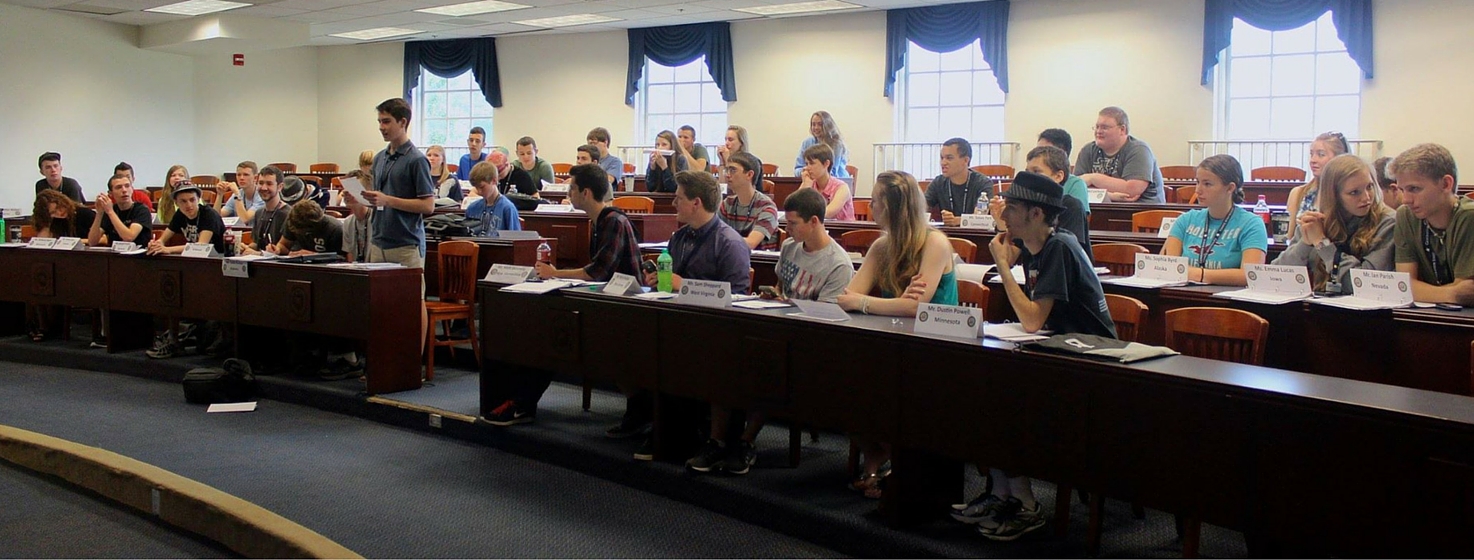
    The Vision of Generation Joshua is to assist parents to raise up the next generation of Christian leaders and citizens, equipped to positively influence the political processes of today and tomorrow.

  • Gazette-Mail Article

    Gazette-Mail Article

    WV lawmakers seek to ease home-school regulations

    (Please note that the HB numbers are switched in this article.)

    For the second consecutive year, state lawmakers are seeking to ease restrictions on home-school students in West Virginia.

    One bill (HB 4175) would remove the requirement that home-school students secure a GED diploma to qualify for the Promise Scholarship, which provides $4,750 a year in college tuition.

    “We’re trying to streamline the process for home-school kids to qualify for the Promise Scholarship,” said Delegate Brian Kurcaba, R-Monongalia, lead sponsor of the bill and father of home-schooled children.

    The House of Delegates and the Senate unanimously passed the legislation last year, but Gov. Earl Ray Tomblin vetoed the bill, saying it could entice students to drop out of high school.

    According to this year’s bill, students could qualify for the Promise Scholarship if they score in the 85th percentile on a college entrance exam, like the ACT or SAT. That would be four points higher than the ACT score that public school students must achieve to qualify for Promise. Public school students also must graduate with a 3.0 grade-point average to qualify.

    Another bill (HB 4215) under consideration this year would ease home-school testing requirements and limit paperwork that parents must submit to county school officials.

    Under the legislation, parents also no longer would have to notify county school systems two weeks before withdrawing their children from public school.

    “A lot of parents are pulling their kid out because there’s bullying or some other serious thing going on,” said Don Kincell, board member with Christian Home Educators of West Virginia. “They’re trying to protect them from something the school is either unwilling or unable to guard against.”

    Another provision would require county superintendents to show probable cause before getting a court order to deny home schooling.

    “We’ve had a lot of counties go beyond the law and actually try to threaten parents,” Kincell said. “The state Board of Education and local boards seem to be trying to tie truancy to home schooling.”

    On Monday, several House Democrats raised concerns that some home-schooled children could be left behind if the state eliminates academic progress and testing requirements.

    “I’ll see kids on a four-wheeler all day long, and they’re home schoolers,” said Delegate Ralph Rodighiero, D-Logan.

    But those who support the bill said home-schooled students typically outperform public school students on standardized tests.

    “We should be lifting up the home-school community,” Kurcaba said. “The statistics out there are very good.”

    The House Education Committee took no action on the bill Monday. The committee plans to resume discussions and vote on the legislation Wednesday.

    Also Wednesday, committee members are expected to take up the bill that no longer would require home-schooled students to pass the GED exam to qualify for the Promise Scholarship.

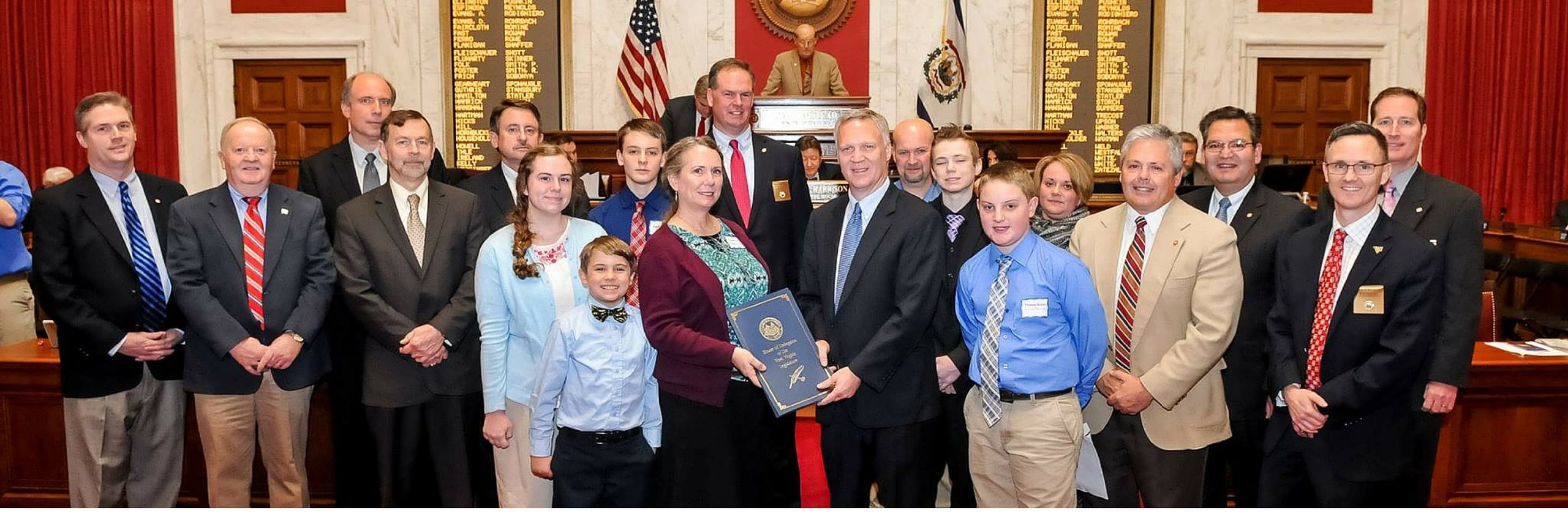
    Monday was “Home-school Day” at the state Legislature.

    Reach Eric Eyre at ericeyre@wvgazettemail.com, 304-348-4869 or follow @ericeyre on Twitter.

    – See more at: http://www.wvgazettemail.com/news/20160125/wv-lawmakers-seek-to-ease-home-school-regulations#sthash.ke7gL3o7.dpuf

  • Looking Forward to Next Week!

    Home School Day At the Capitol (HSDC) – Special Briefing   Info Here!
    From 9:00 to 10:00 a special briefing will be held where Senator Robert Karnes, Delegate Brain Kurcaba, CHEWV Legislative Liaison John Carey, and HSLDA Attorney Mike Donnelly will discuss the bills you should know about and provide a deeper understanding of the legislative process. Please come! This will truly be an educational event.

    Modernization and Promise Bills Up for a Vote in House Education   Committee Schedule here.

    The Promise Scholarship Bill is much different from last year. The GED requirement is not removed but is included simply as one of several available options.

    The Home School Modernization Bill will address several provisions of the home school law that have needlessly created conflicts between authorities and home educators. Home schooling has proven to be a highly successful educational alternative. It is time that the home school law reflected this fact.

    Rally for Religious Freedom on Thursday, January, 28th

    A special site has been created to enable supporters of religious freedom to contact their legislators and express their support. All that is needed is a ZIP code to identify and send a customizable pre-created message.  Click Here!

    The rally will be held at 2PM on the rear steps of the State Capitol. Private Christian School students as far away as the Panhandle are attending this event. Special speakers and music will be provided. This week could very well determine the future of this legislation. Please choose to take a stand for religious freedom – one of the two pillars that support our right to home school.

    Active Legislation:
    Home School Modernization Bill
    HB 4175
    SB 318
    Home School Promise Scholarship Bill
    HB 4215
    SB 316
    Tax Credits for Educational Expenses

    SB 292

    The Religious Freedom Restoration Act
    SB 11


    Like this effort on the Heritage Communications of WV Facebook Page.
  • Bills Introduced!!

    Bills Introduced!!

    ACTION NEEDED—RALLY TO SUPPORT FREEDOM FOR HOME EDUCATION!

    Join me along with CHEWV, WVHEA and hundreds of others  next week for the 26th Annual Day at the Capitol in Charleston and advance freedom for homeschooling in the Mountaineer state!

    Two important bills will be heard that day in the education committee and your presence will help support passage of both. At 9:00 a special briefing will be held where Senator Robert Karnes, CHEWV legislative Liaison John Carey, and I will talk about bills you should know about. At 11:00 watch the house in session and meet legislators. At 12:15 we will gather in the Rotunda to hear from other leaders and legislators.

    At 2:00, the House Education Committee is expected to hear HB 4175, the homeschool modernization bill, as well as HB 4215 which addresses homeschoolers’ qualification for the Promise scholarship. I plan to be on hand to answer questions. Among the reforms are elimination of the GED requirement for the PROMISE scholarship, revising the 50th percentile standard for academic progress, changes to test administration requirements, removing the plan of instruction, and a one-time Notice of Intent.

    The special program for the 26th Annual Day at the Capitol will be full of events you’ll want to be part of. You will hear from members of the House of Delegates and Senate and be able to visit your own delegate or senator.  I will be speaking about the importance of freedom in education and why West Virginia parents deserve more freedom.

    In addition to the program, you’ll want to visit the West Virginia Capitol’s impressive museum of West Virginia history and culture.

    Make plans to join us in Charleston, West Virginia, next Monday, January 25. Events start at 9:00 AM. Register to let us know you are coming and to stay informed.

    See you there!

    Montani Semper Liberi!

    Mike Donnelly

    Michael P. Donnelly, Esq.
    Staff Attorney