Category: Testing

  • Choosing the County Report or the Progress Report

    Choosing the County Report or the Progress Report

    [et_pb_section fb_built=”1″ admin_label=”section” _builder_version=”4.16″ global_colors_info=”{}”][et_pb_row admin_label=”row” _builder_version=”4.16″ background_size=”initial” background_position=”top_left” background_repeat=”repeat” global_colors_info=”{}”][et_pb_column type=”4_4″ _builder_version=”4.16″ custom_padding=”|||” global_colors_info=”{}” custom_padding__hover=”|||”][et_pb_text admin_label=”Text” _builder_version=”4.27.4″ background_size=”initial” background_position=”top_left” background_repeat=”repeat” hover_enabled=”0″ global_colors_info=”{}” sticky_enabled=”0″]

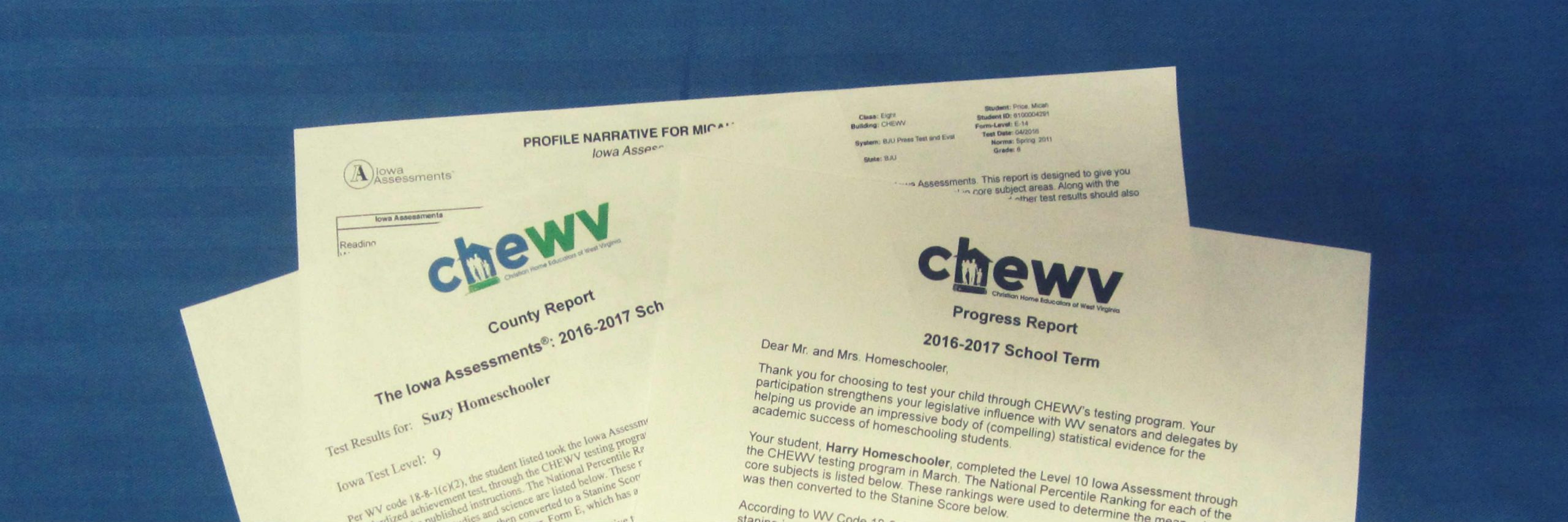
    The homeschooling law requires that assessment results be submitted to the county by June 30 when students are in grades 3, 5, 8 and 11. For those students, our County Report is appropriate.  Since ALL STUDENTS must still be assessed annually and must meet acceptable progress standards, our Progress Report is designed to help parents know if their student has met the requirements for “acceptable progress” in years when the results are not submitted to the county. 

    Both the County Report and the Progress Report are WV-specific.  Both reflect the necessary calculations to determine how the child’s test scores compare with WV law requirements. 

    The law requires that students annually make acceptable progress – as defined in the law.  If not, remediation is required.  The second consecutive year that acceptable progress is not made, additional evidence of appropriate instruction must be submitted to the county.  This is applicable for ALL STUDENTS IN ALL GRADES.

    At the time of testing registration, parents will be given the option of either choosing one of the two reports or choosing not to receive a CHEWV report at all. Reports will not automatically be sent — the parent must request it if they wish when they register for testing.

    In all cases, annual assessment results must be kept on file for three years.  Questions?  Email testing@chewv.org.

    [/et_pb_text][/et_pb_column][/et_pb_row][/et_pb_section]

  • Help With Ordering Your Tests

    [et_pb_section fb_built=”1″ _builder_version=”4.16″ global_colors_info=”{}”][et_pb_row _builder_version=”4.16″ background_size=”initial” background_position=”top_left” background_repeat=”repeat” global_colors_info=”{}”][et_pb_column type=”4_4″ _builder_version=”4.16″ custom_padding=”|||” global_colors_info=”{}” custom_padding__hover=”|||”][et_pb_text admin_label=”Text” _builder_version=”4.19.4″ _module_preset=”default” text_text_color=”#284679″ header_text_color=”#298500″ global_colors_info=”{}”]

    Let’s make this simple.


    Once you click the red link to the Christian Home Educators of WV (CHEWV) Parent Portal on the BJU Press website, follow these steps.


    First, for all tests:

    • Click on grade level.
    • In the yellow boxes, enter the quantity needed in the second box. ***WARNING: DO NOT CHOOSE THE OPTIONAL, MORE EXPENSIVE TEST WITH CogAT, MARKED WITH RED X’S BELOW.***  CHEWV does not use these.  See the red notes in the screenshots below.
    • Repeat for each child.

    [/et_pb_text][et_pb_image src=”https://new.chewv.org/wp-content/uploads/2022/01/tempsnip-2.png” title_text=”tempsnip 2″ _builder_version=”4.16″ _module_preset=”default” border_width_all=”2px” border_color_all=”#000000″ global_colors_info=”{}”][/et_pb_image][et_pb_image src=”https://new.chewv.org/wp-content/uploads/2022/01/tempsnip-3.png” title_text=”tempsnip 3″ _builder_version=”4.16″ _module_preset=”default” border_width_all=”2px” border_color_all=”#000000″ global_colors_info=”{}”][/et_pb_image][et_pb_text _builder_version=”4.16″ _module_preset=”default” text_text_color=”#284679″ global_colors_info=”{}”]

    • Click “Check Out.”
    • Choose Shipping and Billing address. NOTE: If address is not verified, simply click “Accept as Entered.”
    • Enter student info for each test.


    Next, for online tests (paper testers can skip to next section)…

    • Review remote proctor information and edit as necessary.
    • Choose date and time from the list. See red notes in the screenshot below.

    [/et_pb_text][et_pb_image src=”https://new.chewv.org/wp-content/uploads/2022/01/tempsnip4.png” title_text=”tempsnip4″ _builder_version=”4.16″ _module_preset=”default” border_width_all=”2px” border_color_all=”#000000″ global_colors_info=”{}”][/et_pb_image][et_pb_text _builder_version=”4.16″ _module_preset=”default” text_text_color=”#284679″ global_colors_info=”{}”]

    • Read and agree to the User Agreement. NOTE: If you haven’t done the System Check on the device you will use for testing, you can find it in the User Agreement.
    • Enter your payment information and you’re all done!

    [/et_pb_text][et_pb_text admin_label=”Text” _builder_version=”4.19.4″ text_text_color=”#284679″ header_text_color=”#284679″ background_size=”initial” background_position=”top_left” background_repeat=”repeat” hover_enabled=”0″ global_colors_info=”{}” sticky_enabled=”0″]


    Now for paper tests:

    • Enter Test Center Coordinator’s administrator number if testing at a center, or your chosen administrator’s number if testing privately. If you are approved and your name appears, you may choose that option. See red notes in the screenshot below.
    • Choose a date for testing between March 6 and April 7. Tests must be completed during this window. If you are testing at a test center, check with your Test Center Coordinator to determine the date.

    [/et_pb_text][et_pb_image src=”https://new.chewv.org/wp-content/uploads/2022/01/tempsnip.png” title_text=”tempsnip” _builder_version=”4.16″ _module_preset=”default” border_width_all=”2px” border_color_all=”#000000″ global_colors_info=”{}”][/et_pb_image][et_pb_text _builder_version=”4.16″ _module_preset=”default” text_text_color=”#284679″ global_colors_info=”{}”]

    • Read and agree to the User Agreement.
    • Be sure “Free Testing Shipping” is selected.
    • Enter payment information and you’re done!

    [/et_pb_text][/et_pb_column][/et_pb_row][/et_pb_section]

  • Second Year to Struggle With Assessment Results?

    Second Year to Struggle With Assessment Results?

    Remember that the second consecutive year that a homeschooled student does not make “acceptable progress” on their annual homeschool assessment, the parent or instructor must submit “additional evidence” of appropriate instruction TO THE COUNTY.
    • What is “acceptable progress?”

    Acceptable progress is made when the average of the five required test scores (reading, language, math, science, and social studies) falls at or above the 23rd percentile or 4th stanine. Find additional details here.

    OR

    When a portfolio reviewer makes the statement that the child has progressed according to their abilities.
    Find a helpful flow chart here.


    • What is “additional evidence?”

    While the law does not give clear guidelines for what additional evidence means, it could include remedial plans, additional tutoring, or even evidence of progress. It might also include diagnostic information or statements by medical personnel that explains why low scores might be expected.

    This article should provide additional help.


    • Isn’t this requirement only for grades 3, 5, 8 and 11?

    NO. This is true no matter what grade level your student is in. However, it is only the second consecutive year that a child is below acceptable progress that this applies.

    Questions? Contact Becky at testing@chewv.org.


  • A Mom’s View of Standardized Testing

    A Mom’s View of Standardized Testing

    Standardized testing often gets a bad rap in the homeschool world. After all, testing is a public school thing. Public schools have come to rely on test scores for funding, teacher promotions, grade promotions, and school excellency awards; and many base their entire curriculum on test prep. When the progress of hundreds of children requires evaluation, a simple, straightforward method is appealing. Only…it isn’t a simple, straightforward method, and this is why testing gets a bad rap. Public schools mostly concentrate on two scores – reading and math – to make a determination of a child’s intelligence. How fair or accurate is that?

    As a homeschool mom who has been utilizing standardized testing for my students’ annual assessment for 30 years, I have a totally different perspective of testing. In fact, I look forward to the testing process and results because of the benefits!

    Comparison. The test compares my student’s education with other students of the same grade level. This may seem contradictory and surprising, but hear me out! I am not comparing my students’ intelligence! I am comparing their education. Unlike the standard public school education, homeschoolers utilize various curricula and teaching methods. When I see my student score average or above average in math, it assures me that my student’s math curriculum is working and he is understanding basic math principles. If my student’s rank in math is below average, it could mean the math curriculum I chose is not challenging him, he isn’t grasping as well as I thought, it was a bad day for a test, or he froze! There are many reasons for a below average score, but the ability to compare gives me pause and helps me to thoughtfully determine why the score was on the low end. Comparing can be useful!

    Consistency. Throughout the years, we have only utilized two different standardized tests – Stanford 10 and IOWA. Using the Stanford for many years and then switching to the IOWA for the remaining years meant I could get a solid comparison of my students’ scores from year to year. It gave me a solid, steady base where I could monitor my student’s growth. In the early grades, scores are sometimes low due to the test being picture heavy and a young child’s perception of the pictures. I remember giggling when the kindergartners were quite perturbed about a picture question on a test…Milk comes from_____. The three choices were 1. goat 2. chicken 3. cow My farmer kids were not happy with this obvious city question!

    Experience. At some point in time, all of us are usually placed in a situation where we need to take a test for a scholarship, job, for college entrance exams (PSAT, SAT, or ACT), or to complete an important questionnaire. Being exposed to a pressure situation can produce, as my grandma would say, quick thinking on your feet! Experience making snap decisions is a useful tool in all areas of life. I didn’t want my students’ first time taking a test to be an important test like the SAT. I wanted my students to have a few years’ experience to establish a comfort level.

    Simplicity. I am not the type of person who would remember to place the report in a file or snap a picture of the project and add to a portfolio throughout the year. The end of the year would mean a mad search through piles of paper, documents, and pics. Not to mention, there were years we did not have much actual work (in the traditional sense) to even create a portfolio. For me, this spelled S-T-R-E-S-S. Going to our local testing center was a car ride away with the promise of a two day break from school, hanging with friends during breaks, and a pizza party at the end.

    Grade Equivalency (GE). GE is another piece of my assessment puzzle. Before explaining why this is helpful, let me explain what it is NOT. It is NOT to show the grade level of your student in a particular subject. Your first grader with a 6.2 GE is not on 6th grade level reading and ready for 6th grade reading assignments. The GE DOES mean that the 1st grader’s performance on the 1st grade subject is what would be expected of the average 6th grader on the same 1st grade test. Such a GE means the 1st grader has a thorough mastery of the material covered on the 1st grade test. A higher GE, therefore, is a huge confirmation that my curriculum, teaching methods, and student are all on the right track. On the other hand, if the GE is lower, it could be another indication I may need to make some adjustments and tweak what we are doing for that subject. I may also need to look at any factors which could have resulted in a lower GE, such as age/maturity, interest in the subject, an illness, or a distraction.

    Community-mindedness. Lastly, standardized testing meant something bigger than just our own family’s assessment. I knew CHEWV used the results of the standardized test to create meaningful statistics to show legislators the results of home education. Some scores are high. Some are low. But the stats show homeschooling does not adversely affect education quality. The public schools have their stats and we can unashamedly show the homeschooling stats. Compiling these statistics made important impacts when homeschoolers lobbied to remove the notorious 4 year requirement, get the portfolio option, gain diploma fairness, Promise Scholarship equity, and improvements in reporting to the county.

    Standardized tests have their place. The test is not a definitive measure of your student’s knowledge or intelligence. The test is a tool which, if understood properly, can give insights into your educational methods. Tools are used to create products, but tools are not used to define products. Similarly, a parent should not apply a pass/fail mentality, but more of a search-and-find mentality where the standardized test provides clues. The student may have a really low math score this year, but looking at the clues within the test results of how or why there is a low score is of greater importance than the fact the score was low.

    The CHEWV website is a huge help in understanding the benefits reaped from standardized testing. Under the testing section you’ll find great articles of explanation and encouragement for standardized testing. My favorites are “Temptation, Truth & Test Scores” and “Why Are Our Test Scores Low?” These help explain valid reasons for student scores and, more importantly, remind us that the annual assessment is merely a tool to help parents learn, contemplate, and adjust. Of course, by law homeschoolers are required to obtain an annual assessment – so we test to comply with the law. But really, the assessment is for us!

     

  • CHEWV Scores Will Be Released in Plenty of Time

    CHEWV Scores Will Be Released in Plenty of Time

    This is an unexpected season when we sacrifice ourselves for the well-being of others.  CHEWV testing is no different.  With the gracious help of BJU Press Testing & Evaluation, we have extended our testing deadline to late this month in order to get as many students tested as possible.  That means, however, that our group scores will be released much later than usual as we all wait for the others to complete their administration. 

    Nevertheless, both official scores and CHEWV WV-specific Reports should be available in late May or early June. 


    In the meantime, please refrain from contacting us to ask about scores, which actually slows down the process. 

    Online scores will be available before paper test scores, but both will be processed as soon as we possibly can. Watch for score releases via email.

    Kudos to the entire testing team that has cheerfully stepped up to serve in more sacrificial ways than ever before.  We truly do homeschool stronger together!

  • 2020 Assessment Deadline Update

    2020 Assessment Deadline Update

    Please Don’t Call the WVDE

    Some homeschool parents are concerned about getting assessment results in time for the June 30th deadline in light of the COVID-19 guidelines and the cancellation of test centers.

    Both the WVHEA and CHEWV have been in contact with the state BOE. Dr. Derek Lambert has spoken with and emailed both organizations. John Carey is also conferring with legislative leadership and attorneys.

    Here is what we know thus far:

    * The state DOE assures us that they believe county superintendents will show understanding if assessment results are delayed.
    * Because state DOE attorneys have a large number of issues to address at present, this issue will be addressed by them in the coming weeks.

    IT’S ESSENTIAL TO UNDERSTAND THAT OUR ANNUAL ASSESSMENT REQUIREMENT HAS NOTHING TO DO WITH THE SCHOOL SYSTEM. Homeschool requirements are legislated; we homeschool under the requirements of State Code 18-8-1. The only reason we have conferred with the state DOE is because there is a possibility that the State Superintendent could make an emergency rule that would hold the weight of law until the legislators again meet. However, whether he can or not hasn’t been determined by attorneys.

    THEREFORE, IT’S IMPORTANT THAT HOMESCHOOLERS DO NOT BOMBARD THE STATE DOE WITH PHONE CALLS OR EMAILS. Please let the two state groups work on your behalf. Overwhelming the DOE will only slow down the process.

    Please understand that the fact that we homeschool under state code, not under the DOE, is a very positive blessing! While that means the school system might not be able to relieve this immediate burden, it also assures that they cannot change aspects of homeschool  requirements at other times either.  That’s why we have been able to combat attempts to “approve” homeschooling, “approve” homeschool curriculum, or otherwise add to the requirements of 18-8-1. Only legislative bills can affect the requirements of WV homeschoolers – which is why we remain active each legislative session.

    While we all try to figure out what to do right now with assessments, here are some options to consider:

    * Online testing. Both state organizations are prepared to help you with that option.

    * Private testing. Both state organizations offer private testing in homes.

    * If testing options do not work, portfolio review may be a viable alternative. Several reviewers on our list have offered to work with families who need help this year. Before worrying, we highly recommend that you contact some reviewers and ask what they’d need to see and how you could provide the material to them. Keep in mind that options like photographing work, uploading content, speaking over the phone, and Skyping do exist. You might be surprised at how doable this might be for a creative teacher! And on the side, you could be given some valuable pointers! Before panicking because you have not kept a portfolio, start with the facts instead – from the reviewers. Each teacher, like each parent, is different, so be prepared to touch base with a few and ask questions. Most are well aware of the issue at hand! They want to help.

    Unfortunately, there is an expectation from the school system that several homeschool families never turn in assessments at all. That puts all homeschoolers at a disadvantage when asking for an extension.  As a community, we should assertively discourage any “working around” the law. Skipping grades or otherwise avoiding submission of assessment results every 2-3 years as required, is harmful to the entire homeschool community! Be willing to speak up to any homeschooling parents you know who are not homeschooling with integrity.

    Both WVHEA and CHEWV have been serving homeschoolers in this state for over 30 years. We are here to help. To contact CHEWV about assessment options, contact Becky Price at testing@chewv.org.

    And please help us quickly disseminate accurate information by forwarding to your local groups and homeschooling friends.

  • Choosing the County Report or the Progress Report

    Choosing the County Report or the Progress Report

    [et_pb_section fb_built=”1″ admin_label=”section” _builder_version=”3.22″ global_colors_info=”{}”][et_pb_row admin_label=”row” _builder_version=”3.25″ background_size=”initial” background_position=”top_left” background_repeat=”repeat” global_colors_info=”{}”][et_pb_column type=”4_4″ _builder_version=”3.25″ custom_padding=”|||” global_colors_info=”{}” custom_padding__hover=”|||”][et_pb_text admin_label=”Text” _builder_version=”4.9.11″ background_size=”initial” background_position=”top_left” background_repeat=”repeat” hover_enabled=”0″ global_colors_info=”{}” sticky_enabled=”0″]

    The homeschooling law requires that assessment results be submitted to the county when students are in grades 3, 5, 8 and 11.  For those students, our County Report (formerly called Report to the Superintendent) is appropriate.  Since ALL STUDENTS must still be assessed annually and must meet acceptable progress standards, our new Progress Report is designed to help parents know if their student has met the requirements for “acceptable progress” in years when the results are not submitted. 

    Both the County Report and the Progress Report are WV-specific.  Both reflect the necessary calculations to determine how the child’s test scores compare with WV law requirements. 

    The law requires that students annually make acceptable progress – as defined in the law.  If not, remediation is required.  The second consecutive year that acceptable progress is not made, additional evidence of appropriate instruction must be submitted to the county.  This is applicable for ALL STUDENTS IN ALL GRADES.

    At the time of testing registration, parents will choose between the two reports.  If their student is in 3rd, 5th, 8th, or 11th grade, they should choose the County Report – a hard copy sent to parents in the mail which is designed to be turned in to the county by June 30.  If not, they should choose the Progress Report — an electronic copy sent via email attachment so that they can easily determine if they owe “additional evidence” to their county. 

    In all cases, annual assessment results must be kept on file for three years.  Questions?  Email testing@chewv.org.

    [/et_pb_text][/et_pb_column][/et_pb_row][/et_pb_section]