Category: Testing

  • Assessment Considerations

    Assessment Considerations

    [et_pb_section fb_built=”1″ admin_label=”section” _builder_version=”4.16″ global_colors_info=”{}”][et_pb_row admin_label=”row” _builder_version=”4.16″ background_size=”initial” background_position=”top_left” background_repeat=”repeat” global_colors_info=”{}”][et_pb_column type=”4_4″ _builder_version=”4.16″ custom_padding=”|||” global_colors_info=”{}” custom_padding__hover=”|||”][et_pb_text admin_label=”Text” _builder_version=”4.16″ background_size=”initial” background_position=”top_left” background_repeat=”repeat” global_colors_info=”{}”]

    While a homeschool assessment must be done every year for students of compulsory age, there are two main options to choose from: testing and portfolio review.  The portfolio review option was hard-won in 1994 to help special needs students and others for whom testing is less appropriate, such as students with test anxiety or pre-readers. For example, there are disadvantages to using standardized testing prior to 2nd or 3rd grade.  We recommend becoming educated about the level of reading required for early-level testing.  If your student is not yet ready for that reading level, you might consider an alternative assessment.

    As you consider your choices, this article about reading-readiness prior to age seven should be helpful.  If you decide that testing is your best choice this year, another of our articles gives prep ideas, many of which need implemented several weeks before testing.

    Keep in mind that testing environment matters.  While students who are good testers (usually those who easily sit still for book work) do well in almost any testing environment, most students gain an advantage when the environment is familiar.  That serves well when testing with co-op buddies or homeschool friends.  But for those who are heading to an unfamiliar test center, prepare your child by helping them relax and not feel pressured from the stress of the new social situation. 

    Private testing in your own home is an option that allows a young student to test in an un-rushed manner in a familiar environment. Short attention spans might also benefit from private testing, as a parent could make arrangements with a private administrator to span the testing over additional days.  

    Using the same assessment option year to year isn’t necessary, as both testing and portfolio review have their own benefits.  While portfolio review is designed to compare the student with his or her own abilities, testing does give credible and useful information about how your student compares with other students.  Standardized tests are also good practice for testing environments down the line, such as college prep exams and dual enrollment classes.  Many parents who use portfolio review in the early years switch to testing by mid-elementary. 

    Hover over the “Assessments” menu option to peruse all your assessment options.  Still have questions?  Email testing@chewv.org.

    [/et_pb_text][/et_pb_column][/et_pb_row][/et_pb_section]

  • Wait!  Does That Test Meet WV Code?

    Wait! Does That Test Meet WV Code?

    While the myriad of testing choices available to parents may offer more flexibility, they come with an equal dose of responsibility.  Recent ads to WV families have promoted online and traditional versions of the Stanford test – some of which do not meet state code.  The Comprehensive Testing Program (CTP) is also advertised, but appears not to offer the five required subjects.

    The testing assessment option in the state code requires a nationally-normed standardized test published or normed within the previous 10 years.  It must provide scores for five subjects:  reading, language, mathematics, science and social studies.  Further, it must be administered under the standardized instructions given by the publisher.

    Though it is the parent’s responsibility to ensure that any assessment they use meets WV code, CHEWV is here to help!  Not only do we provide a testing service and do all the work to ensure the tests meet WV requirements, but we’re also here to answer questions about other assessment options. 

    Our testing program is  a non-profit service, so we have no reason to discourage you from using other options. However, we do have an interest in educating families to ensure they choose tests that meet state code – both to protect individual families and to protect the homeschool freedom of all.

    Even if a county does not notice the first year a test doesn’t meet code, it’s still a hazard to all homeschoolers if families mistakenly test using outdated materials.  When a test’s obsolescence becomes known, it immediately casts negative attention on homeschooling and is fodder to call for greater regulation.  Please help us pass the word so that everyone is compliant!

    Remember that your state organizations exist to serve homeschoolers and help them meet the legal requirements to homeschool in WV.  Contact testing@chewv.org with any questions.  Click to read about assessment options or to read over the WV code.  To support CHEWV by joining, click here.

    Defending freedom, serving families…together.

  • Having Difficulty Taking the TASC?

    Having Difficulty Taking the TASC?

    Some students are having difficulty scheduling the TASC test to meet the PROMISE Scholarship deadlines.  Betty Jo Jordan, Executive Assistant to State Superintendent Payne, assures CHEWV that this form is all that is necessary to schedule the TASC requirements. 

    The public form should be taken to the county Attendance Officer to complete and stamp.  The completed form is then used to make arrangements to take the TASC. 

    CHEWV is working diligently on legislation that would remove the GED/TASC requirement from the PROMISE requisites.  Stay tuned to our media – website, social media, and e-newsletter – for updates through the 2018 Legislative Session which begins in January.  This is an ideal time to email your senator and delegates about this issue – before the session begins and distracts them.  Find contact information here.

  • Time for a New Test Report Sheet!

    Time for a New Test Report Sheet!

    CHEWV is introducing a new Report Sheet option for CHEWV testing families!  This year we are unveiling our new Progress Report in response to recent changes in the law. 

    The revised homeschooling law requires that assessment results be submitted to the county when students are in grades 3, 5, 8 and 11.  For those students, our County Report (formerly called Report to the Superintendent) is appropriate.  But ALL STUDENTS must still be assessed annually and must meet acceptable progress standards.  Our new Progress Report is designed to help parents know if their student has met the requirements for “acceptable progress” in years when the results are not submitted. 

    Both the County Report and the Progress Report are WV-specific.  Both reflect the necessary calculations to determine how the child’s test scores compare with WV law requirements. 

    Just like the previous law, the revised law requires that students annually make acceptable progress – as defined in the law.  If not, remediation is required.  The second consecutive year that acceptable progress is not made, additional evidence of appropriate instruction must be submitted to the county.  This is applicable for ALL STUDENTS IN ALL GRADES, just like before.

    At the time of registration, parents will choose between the two reports.  If their student is in 3rd, 5th, 8th, or 11th grades, they should choose the County Report – which is designed to be turned in to the county by June 30.  If not, they should choose the Progress Report so that they can easily determine if they owe “additional evidence” to their county. 

    In all cases, annual assessment results must be kept on file for three years.  Questions?  Email testing@chewv.org.

  • Stanines, Percentiles, and Freedom

    Stanines, Percentiles, and Freedom

    Learning. It’s not just for our students!  There is certainly a learning curve for the newly revised law.  This is a good thing, however, for through this law we have gained freedom!  Nevertheless, with freedom comes responsibility – the responsibility to learn.

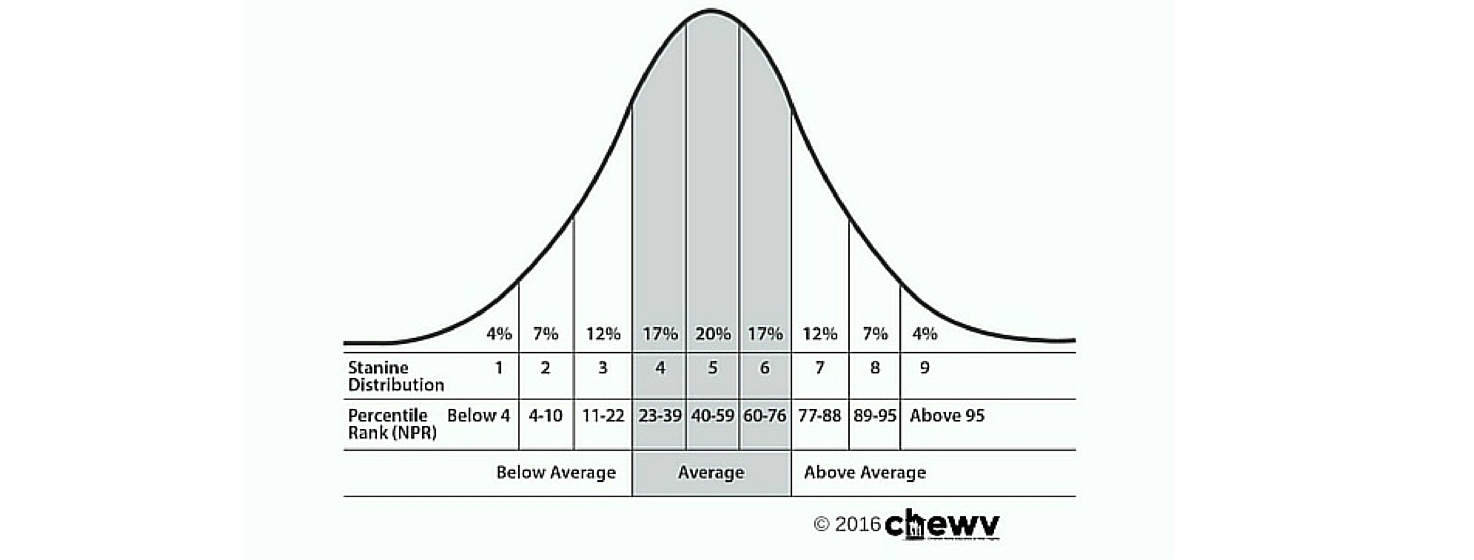
    Those parents who have chosen testing for the annual assessment are beginning to realize that stanines are quite different from percentiles.  Although stanines are less precise than percentiles, in many ways they reflect the bell curve much more.  If you recall, the purpose of a standardized test’s norm group is to plot the scores on a bell curve and then draw comparison scores thereafter.  The normal bell curve with its distribution can be referenced above.

    Looking closely at the bell curve distribution, you will notice that the 4th, 5th and 6th stanines include a large range of percentile scores.  This reflects the fact that the bell curve is tallest in that middle range:  that those ranges represent the most students.  The 5th stanine contains the most scores – from the 40th to the 59th NPR (Normed Percentile Rank).  A stanine score of 5 is not very precise, but reflects that the student falls right where the largest group of other students do.

    In comparison, the 9th stanine includes only 4 NPR scores: 96-99. The 9th stanine is much more discriminating than any other except the 1st. Only 4% of students are expected to score in that stanine distribution.

    Be cautious that you don’t assume that the 1st digit of an NPR is reflected in the corresponding stanine rank because that just isn’t true. For example, an NPR of 93 falls in the 8th, not 9th, stanine rank. A 23 percentile rank falls in the 4th stanine, not the 2nd. For those with high scoring students, you’ll want to realize that both the 8th and 9th stanines cover NPR’s in the 90’s: the 8th stanine for scores from 89 to 95 and the 9th stanine for scores from 96 to 99.

    Conversely, scores in the 1st or 2nd stanines are particularly low. Only 11% of the student population scores as low. This is why the articles in the scoring section of our website have been changed to help parents whose children are scoring in those low ranges. We highly recommend that parents identify why their students are struggling and search for strategies to help them reach their full potential.

    Perhaps you’ve never aspired to understand statistics or bell curves, and you shudder when you see a percent sign! Although we want to help you understand these things, what is truly important is educating our children. The law is definitely a hoop we must jump through to get that privilege, and CHEWV is here, in part, to help you make that jump as painlessly as possible. You must know how to satisfy the law’s requirements and to do so with integrity. While a rudimentary understanding of stanines and percentiles is needful, understanding our own children and educating them to their God-given potential is the higher goal!

  • Getting Ready to Test: K, 1st & 2nd

    Getting Ready to Test: K, 1st & 2nd

    Aha! Testing time! Moms may worry about how their littles are going to do and so may head over to Barnes and Noble for the Test Prep workbook, but there are actually many (and perhaps even better) ways to prepare.

    In the earliest grades, many of the questions are read aloud and the choices are shown in picture form.  Exposure to many different environments and situations can actually help these students figure out what the picture choices represent.  Besides, these are good foundational learning experiences.

    For example, going to the library together and picking out books about animals, their habitats, and their young for read-aloud and discussion is a great way to learn and prepare. Measuring things (the length of a toy, the weight of the dog, the height of the doorway) and discussing how to do it and perhaps making a nice list of comparison sizes (dog versus elephant) can help. Which is longer? Heavier? Observe things in everyday life – how ice cubes are bigger than the water before it is frozen, or how it’s more difficult to walk uphill the steeper it is.

    Just gradually teaching your child to attend to his or her daily work is also a big help. Can they sit and follow directions for a couple hours? Usually that means that you’ve taken a few weeks to gradually increase the amount of time that they can sit and work. Start with ten minutes of read-aloud time with a couple questions afterward. Slowly increase that time, watching for their ability to attend. When their mind wanders, stop for the day. Then see if they can work for one or two additional minutes tomorrow.

    In these years, children are not well designed to sit for extended periods of time and usually do not yet have the ability to stay focused on book work for all that time. Even if they’ve been taught to sit politely and not cause trouble, that still doesn’t mean that they can keep their minds focused after two hours of testing. If you know your child is not developmentally ready to do that, perhaps you should consider private testing so you can lengthen administration over more days. Or, switch to a portfolio review until about 3rd grade. At the very least, you should hold the test scores lightly. And remember, a child who is unable to attend for that long at these ages is not a “bad” child nor necessarily a “slow”child. Perhaps he is just not developmentally ready for this type of testing environment. The experience may help him become more familiar with testing, but the scores may not accurately reflect his knowledge.

    To hold the test scores lightly, you and your spouse must put the scores in perspective. For instance, if the math score is lower than you would expect, you know that this may or may not actually reflect the math that your child knows. Therefore, it doesn’t necessarily reflect what you will see in later testing. Encourage your child to do his best, but don’t put undo pressure or value on testing, especially in these years.

    What should you tell your child about testing? We think it’s important to be firm about behavior expectations, but light about results. In other words, it may not be wise to talk about how they should do their best so that they won’t fail. It can be very counter-productive to say things such as if they don’t do well they might have to repeat a grade, or worse, flunk, or especially that they need to do well so that the county thinks they are doing okay. All of those types of statements put too much pressure on a young child – placing the responsibility for the success of his schooling on his testing performance. No wonder such a child might be nervous before testing, learn to dread it, and not then feel well enough to really do his best. Instead, put the emphasis on sitting quietly, listening carefully, and doing his best. “Sweetheart, you will have to work hard today to listen carefully to what the teacher says and do your best to follow the instructions.” Remind him that there will be questions that he does not know the answer to, and that it’s okay. A second-grader might be able to understand how to eliminate some answers and then guess between the ones left. But don’t stress if your child does not yet understand that concept.

    If testing time is not dreaded by your child, he or she will tend to do better. For our family, we calmly talked about how it would be nice to see our friends and we did not do additional school when we got home. Between those two things, it was a welcome break for everyone! In fact, we purposely did fun things in the afternoons after testing!

    Think of these years as setting a solid foundation for later testing. If your child learns to like testing and to be comfortable in testing situations, that will go a long way in helping him later on.

    Below are a few developmental milestones and the usual ages that children attain them. Notice that several of these could affect test performance. Note, too, that although children usually progress through the same order of milestones, each child grows and gains skills at his own pace. Therefore, milestone ages (such as the ones given below) are just averages. At this age, being behind or ahead of these averages does not usually indicate anything about intelligence because normal rates of development vary so greatly.

    1. Uses future tense: 5 years old
    2. Speaks sentences with more than five words – 5 years old
    3. Better understands the concept of time – 5 years old
    4. Can ignore minor distractions and if alone, will focus on an interesting activity for 10-15 minutes or an assigned task for 4-6 minutes – 5 years old
    5. Personal interest is the most important motivation for a 5-year-old. It will double their attention span.
    6. A normal attention span is sometimes said to be 3-5 minutes per year of age.
    7. Directions should be given in chronological order. They can’t turn them around at age 5-6.
    8. Pictorial directions are better understood than verbal directions at age 5-6.
    9. By age 6 most children understand the concept of “10.” For example, they can count 10 objects (which is harder than rote, verbal counting to 10 or beyond).
    10. By around age 6, children are beginning to understand cause and effect relationships.
    11. By around age 6 they can read simple words and can describe a story.
    12. Can follow 2- to 3-part commands by around age 5. For instance, “Put your book down, brush your teeth and get in bed.”

    For more information about learning during the preschool years through about age 5, see our preschool section under “Helps.”

    For parents who want to use test prep materials, workbooks can be purchased at many bookstores such as Barnes & Noble or Books-A-Million.  Or they can be purchased from our test distributor, BJU Press Testing, here.  Materials are also available from Amazon via our Amazon Smile (see right sidebar).  Once at Amazon, search for “standardized test practice.”

  • Preparing for Testing

    Preparing for Testing

    It can be tempting to think that a test will accurately assess how we are doing as teachers and how our children are doing as students.  But it can do neither.  Standardized testing is only a tool to determine how our children compare academically with other students in the same grade level at the same time of the school year.  The resultant scores are percentile rankings.

    On the other hand, nationally normed tests can help us find relative strengths, weaknesses and learning gaps.  For many families, they can be a wake-up call when busyness has pushed schoolwork into the background, for we want to be faithful with our God-given role of educating our children.  Besides, testing can hone our children’s skills in group situations, as well as in test-taking strategies, both of which are necessary for future endeavors like college.

    So what are practical ways to prepare? Simply learning a little strategy and becoming familiar with the format can make a big difference.

    Understand the Directions

    Children need to understand the directions before they begin the test.  Although they feel free to ask for repetition at home, they may be less likely to do so in an unfamiliar situation.  The administrator can restate the directions and clarify as long as no answers are implied, so encourage your child to ask if he doesn’t understand the directions.

    Choose the Best Answer

    *Good guesses
    *No penalty for wrong answers
    *First hunches are usually best

    Your child will thoroughly understand and readily know the answer to many of the questions. He will be hesitant and confused by others.  Prepare him for this and teach him to make good, but not wild, guesses. Teach him to eliminate obviously wrong answers and make reasonable guesses from the others.  Since there is no penalty for wrong answers, so encourage him to answer all questions as best he can, and avoid leaving any blank if there’s time to finish.  Unless he has confidence that his choice was not a good one, discourage him from switching answers.  First hunches are often best.

    Make Good Use of Time

    *Easy questions first
    *Mark skipped questions
    *Don’t dally over bubbles
    *Practice time constraints
    *Dull lead for bubbles, sharp for math

    If a question or problem is particularly difficult, it should be skipped and worked after easier questions are answered.  There is a hazard, however:  students must insure that they do not get off sequence on the answer sheet.  Help them work out a system for staying on number sequence and flagging the skipped questions.

    Marking the answer bubbles can also waste time.  Perfectionistic marking is not necessary for the scoring machine to read the answer – although marking way outside the circles is not wise.  Dull pencils are actually better for marking bubbles quickly; math problems are worked more quickly with sharp pencils.

    We are not typically bound by time constraints at home, so practicing with time limits might prove helpful.  Math is a good subject for timed practice.  Math subtests generally allow 20-40 minutes, so within this time frame, have your child see how many problems he can work with attention to accuracy.  Children who are meticulous or slow workers will need some training to work within time constraints.  Younger children will also need help transcribing horizontally given math problems into vertical form to work. Giving them regular practice on a skill as straightforward as this can be a big boost. And they must learn to sit quietly and not distract others.

    (IMPORTANT NOTE: grade 3, level 9, is the first level with a separate answer sheet.  In the early grades, most of the test is read aloud by the administrator, and students move along together in their individual, self-contained booklets. The child, then, cannot skip answers and go back on most of the early levels.)

    Become Familiar with the Test Format

    Completing worksheets with a test format will give your child some practice and help him feel more secure at the onset of the testing session.  For example, prepare groups of math problems with possible answers including a “not given” or “not here” choice.  Language mechanics requires finding errors in punctuation or capitalization, so sample sentences can be made for practice.

    Maps, charts and graphs are included on most levels of the Iowa and are now embedded in the subject tests rather than being a separate subtest. Learning how to read and interpret information presented in these formats is not only an academic requirement but an invaluable life skill. Help your children become familiar with directions on a map, types of legends, and different symbols and labels. Teach them how to make sense of pie charts, bar graphs, and other kinds of graphic representations of data.

    Test levels through the third grade contain a listening subtest.  Prepare for this by reading short paragraphs and asking questions afterward. Include simple inferences, drawing conclusions, and retention of meanings and details. For example, read a simple paragraph and follow with questions such as, “Which of these was done first,” “What color was the horse,” or “What do you think the child will probably do next?”  Offer four choices. On the actual test, these readings cannot be repeated; teach your child to listen and attend the first time.

    Finally, practice tests may help many students, especially if they have not tested previously.  Practice booklets are widely available online or at bookstores.

    Don’t Expect to Know it All

    Remind your child (and yourself) that he is not expected to know everything on the test.  Some of the test items will be beyond the grade level to accurately cap the higher scores.  Students can answer several questions incorrectly or not at all and still do well on their scores because they are comparison scores.  Your child’s score will be determined in comparison with other students who also got some answers wrong.

    Even the academic subsections can vary from our specific curriculum’s scope and sequence.  For instance, Christian homeschoolers often study history and geography intensively.  But the IOWA, Stanford and Terra Nova cover only “social studies”.  While this may include history and geography, it often centers more on social concepts like community service, minority group progress, recycling, and government and political issues.  If we emphasize subjects differently from mainstream educators, we should adjust our expectations and view test results accordingly.

    Finally, remember that your work is unto the Lord.

    What happens throughout the entire year is a better indication of your faithfulness than what happens during testing week.  And your child’s heart condition is vastly more important than his academic performance.

    “Do not be anxious about anything, but in everything, by prayer and petition, with thanksgiving, present your requests to God.  And the peace of God, which transcends all understanding, will guard your hearts and your minds in Christ Jesus.”           Philippians 4:6-7

    Rather than worrying, make testing week something to look forward to – with afternoons off or pizza at the end! Wise preparation can help make this a pleasant change of pace!


    Note: For parents who want to use test prep materials, workbooks can be purchased at many bookstores such as Barnes & Noble or Books-A-Million.  They can also be purchased from our test distributor, BJU Press Testing, here.  Materials are available from Amazon via our Amazon Smile (see right sidebar).  Once at Amazon, search for “standardized test practice.”

  • New Iowa – What’s Ahead?

    What to Expect From the New Iowa Assessments™ Test

    CHEWV’s annual testing program is in full swing. Registration is open until February 5, and tests will be administered between March 7 and April 1. This year, we have been given the opportunity to begin using the newest version of the Iowa Assessments: Form E. While this is still considered a traditional achievement test, there are a few changes from Form C, the previous version we have been using.

    The first thing your child will notice is that the new test booklet is more colorful, which should engage our students better. The format has been altered slightly to make it more readable and easier for the child to keep his place. As usual, grades K-2 will mark directly in a consumable booklet, while grades 3-12 will have separate answer sheets. The answer sheets will look a little bit different, but they use the same basic format – the student will still fill in a bubble for each answer.

    The sequence of sub-tests has moved around a bit. Here is an idea of what to expect; for Grades 3-8 (Levels 9-14) the sequence is as follows: 

    • Reading
    • Written Expression
    • Mathematics
    • Science
    • Social Studies
    • Vocabulary
    • Spelling
    • Capitalization
    • Punctuation
    • Math Computation
    • Level 9: Word Analysis
    •  Level 9: Listening

    Note that there are no separate sub-tests for Maps and Diagrams or Reference Materials. These subjects are now absorbed within the other sub-tests instead.

    The total number of questions is very similar to Form C, and it will all be multiple-choice as usual. The total amount of time needed is just about the same, and the same guidelines for accommodations apply. When registering a child for 1st grade, you will see that the levels have been changed to make it more like all the other grades. Levels 5 and 6 are now combined into Level 5/6. Level 5/6 will be normed as Kindergarten by default. Level 7 is the standard 1st grade level. This article will be helpful in determining the best level to choose.

    The score reports will also be a bit different this year. The old Performance Profile is not included with Form E, but has been replaced with the Student Profile. The Profile Narrative will be included as before. Both reports will look a bit different, but they will still have the same scores (NPR, SS, GE, etc.). CHEWV will continue to generate a WV-specific report containing the legally required information. The specific changes in the score reports will be detailed later this spring when scores are released.

    CHEWV’s testing program exists to satisfy the homeschool law’s assessment requirement and its testing conditions. Form C, published in 2007, uses norms from 2005. Under current law, this means that next year (2017) would be the last year Form C can be used for WV assessments. Form E, however, was published in 2012 and uses norms from 2011, affording us several more years of use. As federal mandates and Common Core are changing the look of nationwide testing, we have secured what we believe to be the most traditional, while current, test available that is in full compliance with our WV law – and which is usable for the next half-dozen years. While this version is only available to public and private schools right now, CHEWV has been given special permission from the publisher, and through BJU Press Testing and Evaluation, to use Form E this year. We will be leading the way with the latest and the greatest! It’s a privilege to be the first and to be exclusive with a newer—and much prettier—edition!

    As always, if you have questions or concerns about testing, please contact testing@chewv.org. We are happy to help!

  • New Name, Same Song?

    “No Child Left Behind Act” Becomes “Every Student Succeeds Act”

    The Elementary and Secondary Education Act of 1965 (ESEA) must be reauthorized every 15 years. In 2001 that re-authorization was known as the No Child Left Behind Act. The 2015 version is now called the Every Student Succeeds Act. This version still includes language which protects homeschools and private schools (those that do not accept federal funds) from any federal control.

    The re-authorization of the ESEA in 1996 was the infamous H.R. 6. The H.R. 6 required every teacher to be certified in the subject and grade they taught – including homeschool teachers. When this came to the attention of HSLDA, they notified homeschoolers nationwide, and the Capitol switchboard was shut down from more than one million calls opposing the bill. By God’s grace, H.R. 6 was soundly defeated!

    The No Child Left Behind Act of 2001 included protective language that remains in the most recent Every Student Succeeds Act of 2015. In part, Section 8506 of the 2015 federal law states,

    “APPLICABILITY TO HOME SCHOOLS. – Nothing in this Act shall be construed to affect a home school, whether or not a home school is treated as a home school or a private school under State law, nor shall any student schooled at home be required to participate in any assessment referenced in this Act.”

    In addition, the Every Student Succeeds Act includes some restrictions on the advancement of the Common Core, but there are still requirements for states and local school districts. Although homeschool freedoms are protected in this legislation, the federal government continues to be involved in local public education. That involvement continues to affect homeschoolers indirectly.

    Editor’s Note: Much of this article is from Yvonne Bunn’s Q&A on the website of Home Educators of Virginia and is used with permission.

    https://heav.org/blog/2015/12/15/federal-legislation-and-homeschoolers/