Tag: Legislative

  • Lesley Oxley Joins the CHEWV Legislative Team

    Lesley Oxley Joins the CHEWV Legislative Team

    Mrs. Lesley Oxley, a longstanding member of CHEWV who homeschooled her two children through high school graduation, is the newest member of the CHEWV Legislative Team.  After working closely with John Carey last session, she is joining the CHEWV team in a more official and ongoing capacity as we prepare for the 2018 session.  “I am very passionate about fighting for what’s just and fair, even though it doesn’t affect my children any longer.  I pray that West Virginia homeschoolers can enjoy the freedoms that homeschoolers in other states have,” Oxley writes on her Facebook page.

    Carey, who has been representing homeschoolers in Charleston for nineteen years, hopes to involve more CHEWV families and support groups to strengthen our voice in the legislative process.

    For bills of interest that may be introduced, see our separate news article, “Preparing for the 2018 Legislative Session.”

  • Senator Smith and Delegate Statler Offer Sage Advice to Homeschoolers

    Senator Smith and Delegate Statler Offer Sage Advice to Homeschoolers

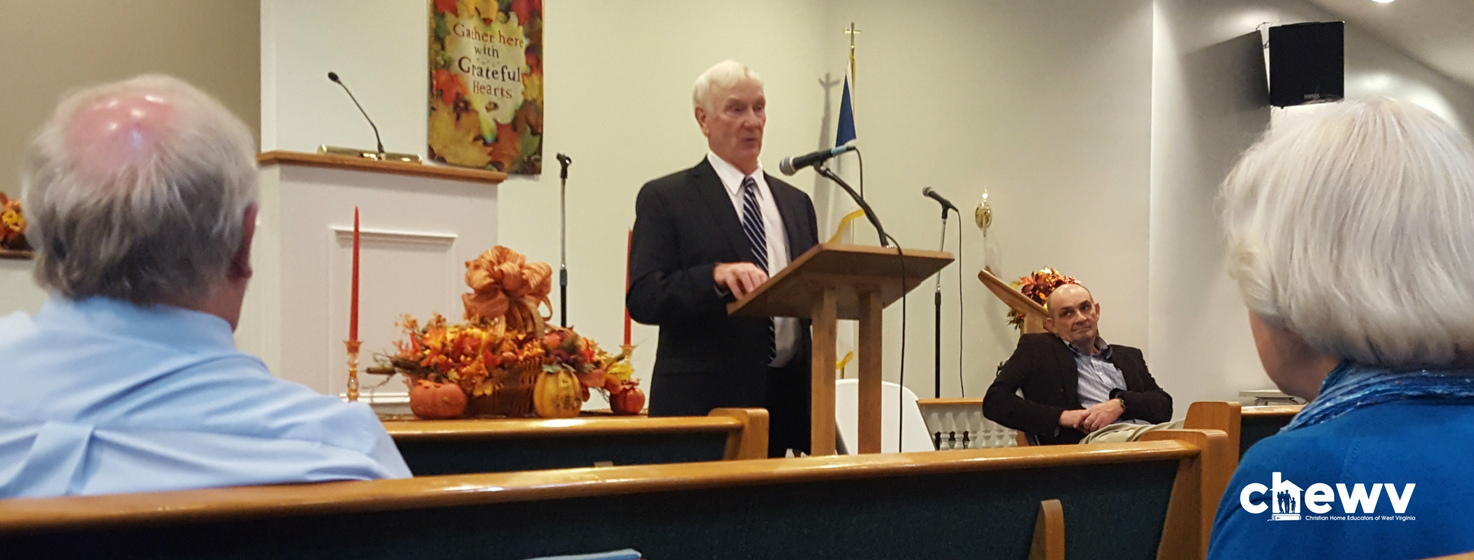
    A disappointingly small crowd of homeschool families came out this past Thursday evening to hear Delegate Joe Statler and Senator Randy Smith, dedicated and energetic WV legislators who have supported the homeschool agenda in Charleston. The Town Hall, hosted by Pastor Jim Cooley and the Morgantown Bible Church, gave both legislators time to share their thoughts about home education and to hear concerns of parents and students. 

    Senator Smith lamented, “The problem with the country is that they don’t get involved.”  Originally from Terra Alta and now living in Davis, Senator Smith has grandchildren who are homeschooled.  He praised CHEWV’s lobbyist, John Carey, when asked how homeschoolers can separate themselves from truants. 

    “Bad laws often get passed because judges are not enforcing current laws,” stated Carey later.  “Judges need to enforce current law and protect children.  When they fail to carry out their judicial responsibility, pressure is put on legislators to take away liberties from law-abiding families.”

    Smith emphasized that legislators are influenced by emails from constituents.  While he discouraged the use of form emails, he stressed the impact of short, personal, heartfelt emails.  Smith noted that communicating before the busyness of the session sets in is strategic.  “Right now, during the fall months, is a good time… We get fewer emails now. But don’t be radical.  Don’t threaten,” he counseled.  “Be cordial, professional, tactful.”

    Delegate Joe Statler, Vice-Chair of the House Education Committee, concurred.  “Never assume we know what the heck we’re doing.  We may not realize the ramification of bills.”  Because hundreds of bills cross legislators’ desks during the session, he encouraged citizens to lobby and help legislators understand what a particular issue or bill could do to them or for them. 

    Statler dislikes the extensive 18-8 education chapter in the WV Law, feeling that it doesn’t allow enough local control.  To a comment about homeschoolers still paying taxes and playing sports, the former Monongalia County School Board member clarified that the tax money is allocated back to the counties according to literal head counts in the public school; this means that homeschool students who are not physically enrolled prevent their parents’ money from coming back to the county of origin. Those funds default instead to general state funds. Consequently, teachers’ unions argue that homeschoolers cost counties needed money.     

    Statler himself is very supportive of homeschooling – along with other school choices – stating that the child’s education must always come first.  He supported the Tim Tebow bill and feels it was vetoed only because it also applied to private schools.  Without that provision, which was added in the Senate, he thinks it can get passed again – and signed.  In fact, he’s looking for that to happen in 2018.

    Roger Sherman, board member with CHEWV and long-time professonal lobbyist in the private sector, commented that most legislators intend to do what’s right, but they often hear from only one side on an issue.  He also pointed out that there is a 40% turnover in Charleston every two years.  “Never forget that four out of ten have never seen us before or heard our past stories.”

    Both legislators referred to the proverbial homeschooler on a four wheeler in the middle of the day – the characterization which has flooded the Capitol for years, intending to malign the diligence of homeschooling families.  Both Smith and Statler say that the antidote is meeting with legislators and letting them get to know real homeschoolers. Carey agrees. “They won’t push the [voting] button and hurt families that they know personally.”   

    “Bring your children with you,” says Smith.  “Their good behavior impresses legislators.”   

  • Homeschool Freedom Town Hall

    Homeschool Freedom Town Hall

    Featuring Senator Randy Smith and Delegate Joe Statler

    The West Virginia Legislature will convene for its 2018 regular session on January 10th.  As in the past, we can expect bills to be proposed and debated that will affect the freedom to homeschool in West Virginia.  A Town Hall for homeschooling families to discuss 2017 and 2018 legislation has been scheduled for Thursday evening, September 28th, at the Morgantown Bible Church, 1407 Brookhaven Road, from 7:00 to 8:15.

    This event is an opportunity for homeschooling families to become aware of the legislative process, attuned to current issues, and involved in both politics and prayer.  These types of events also demonstrate to legislators that homeschoolers are informed, and that we care.

    The evening will feature Senator Randy Smith and Delegate Joe Statler, who will be offering an overview of the 2017 session and discussing issues of interest as we look forward to the 2018 session.  Senator Smith represents Barbour, Hardy, Preston, Taylor and Tucker counties, as well as parts of Grant, Mineral and Monongalia counties.  Delegate Statler represents District 51, which includes a large amount of Monongalia County.  Both legislators are friendly to homeschooling concerns.  In addition, John Carey, CHEWV’s Legislative Liaison, will contribute to the discussion.

    Morgantown Bible Church is sponsoring the Town Hall on behalf of homeschooling families and in cooperation with CHEWV.  The discussion will be moderated by Pastor Jim Cooley.   

    At this meeting, we want to hear firsthand from you whether you find our homeschooling laws, particularly the recent changes, helpful; and whether there are further changes you would like the legislature to consider.

    “Today, homeschooling families in WV enjoy a level of freedom that was hard to imagine only 30 years ago,” says Roger Sherman, founding CHEWV board member and part of the group who fought for the initial right to homeschool in WV.  “Families then were often fearful of having their children taken from them if they let it be known that they were homeschooling.  That freedom was hard-won and is maintained today through the active, prayerful engagement of homeschooling families in the legislative process.  God has blessed those efforts but we must not allow complacency to put our successes at risk.”

  • Compulsory Age Changes

    Compulsory Age Changes

    Compulsory age is the age when children are required to attend public school unless they meet a legal exemption. For children of compulsory age who are to be homeschooled under WV code 18-8-1(c)(2), a notice of intent must be provided to the home county prior to commencing home education. 

    Current compulsory age begins when a child turns 6 prior to September 1st OR as soon as they are enrolled in a publicly funded kindergarten program. However, as of the 2019-2020 school year, the deadline date will be moved back from September 1st to July 1st. Children being homeschooled in the summer of 2019 will be of compulsory age if they turn 6 prior to July 1st.  Until two years from now, the cutoff date will remain the same – September 1st – for compulsory attendance age.

  • After the 2017 Legislative Session

    After the 2017 Legislative Session

    Where Does Homeschooling Stand Now?

    by John Carey, CHEWV’s Legislative Liaison

    Prior to the 2017 WV Legislative Session, CHEWV decided it was time to step back and to give the legislature a break from homeschool legislation.  We gratefully acknowledged the progress made in the last two regular sessions: the legislature had supported our efforts to advance no fewer than five homeschool bills through both the House and the Senate.

    Our stepping back unexpectedly led to several homeschool-friendly legislators choosing to step up, actively encouraging their colleagues to support homeschool sports and vocational school legislation.  As the session progressed, however, we witnessed the introduction of disturbing legislation designed to challenge our basic civil rights to educate our children and live out our faith.  Needless to say, the CHEWV lobbying team was the one group at the legislature this session that never did get a break.  What follows is my synopsis of the good, the bad, and the deplorable legislation, followed by a look at homeschooling’s future challenges.

    HB 2196 – The Tim Tebow Bill
    From the start, this bill was severely handicapped.  While Senate Education Chair Mann allowed the Tim Tebow bill to advance through his committee, he refused to speak in support of the bill on the floor of the Senate.  As it turned out, the Chair and the Governor gave their support to the Public School Virtual School Bill instead. By vetoing the Tim Tebow Bill, the Governor saw an opportunity to give homeschoolers who want to participate in sports an incentive to stop homeschooling and join the Public Virtual School instead in order to play. 

    HB 2589 – The Vocational School Bill
    The other homeschool bill the Governor decided to veto this session was a bill to ensure that homeschooled and privately schooled students could take advantage of vocational education courses. While most counties allow homeschool students to take these classes, at least one, Raleigh County, does not make room for homeschool students. When seeking admission, the county consistently states that there is not enough room. This bill would have required that they, and all counties, make room for qualifying homeschool and private school students.

    SB 630 – The Virtual School Bill
    The Accessibility and Equity in Public Education Enhancement Act, signed into law by the governor and technically unrelated to homeschooling, may still negatively affect us.  According to the Charleston Gazette-Mail, this bill “would allow county school systems to offer full-time K-12 virtual education and ‘an online pathway for earning a high school diploma,’ while also receiving the full per-pupil state school aid formula funding for each student who participates.”  Kanawha County Schools Superintendent Ron Duerring, who testified in support of the bill, said it would allow participating students, “including homeschooled students,” to participate in sports and other public school activities.  This statement is not accurate, however, because homeschoolers in WV are those who are being educated according to the homeschooling exemptions to compulsory attendance, such as 18-8-1(c)(2), and as such have the freedom to choose their own curriculum, something that will not be allowed if they enroll in the public school virtual school program. This issue will be discussed in greater detail in future articles.

    SB 186 – Change in Compulsory Age

    In a cultural climate that usually pushes compulsory school age younger and younger, this year’s legislature made a surprising move.  SB 186, which makes compulsory age older by two months, was passed by the legislature and signed by Governor Justice. 

    Starting in the 2019-20 school year, children who turn six prior to July 1st will be of compulsory school age.  Students who turn 6 between July 1st and September 1st will not be of compulsory age as they are now.  

    However, children who are enrolled in a publicly supported kindergarten program automatically become of compulsory age regardless of age.

    How does this affect homeschooling? Currently, a notice of intent is required the year that the student reaches compulsory school age, which is six years old prior to September 1st at the latest.  But in 2019, this will only be required for students who turn six prior to July 1st (unless they’ve ever been enrolled in a publicly supported kindergarten program).  

    SB 186 recognizes that many students are not ready to begin formal schooling at young ages.  Because the bill primarily affects preschool and kindergarten public school students, it allows for a bit more maturity before children enter those programs.  It also makes the cut-off age prior to the commencement of the school year.  

    Now for Deplorable Legislation

    SB 528 and HB 2702 – “establishing process to provide student is ineligible for home instruction exemption”*

    HSLDA described SB 528 as “an excessive and unnecessary intrusion into families.
    ….It treats parents who want to homeschool as suspected child abusers who must be investigated.”

    HSLDA continued, “West Virginia Senate Education Chair Kenneth Mann (R-Monroe, 10), has teamed up with Democratic senators Michael Romano and Ron Stollings to propose an alarming law that would effectively prohibit homeschooling and order CPS investigations if parents wanted to homeschool children who had accrued 10 absences without acceptable excuse.”

    Senator Mann and Delegate Westfall, who sponsored HB 2702, an identical bill introduced in the House, publicly expressed their conviction that some parents use homeschooling as a means to avoid prosecution for truancy.  Senator Mann later withdrew his support for SB 528.  While Delegate Westfall also removed his support for this offensive provision in HB 2702, he said in committee that he isn’t finished trying to “address this issue.”  This is no surprise, since Delegate Westfall has in recent years been a leading advocate for increased regulation of homeschooling.

    SB 435 and HB 2650 – The Youth Mental Health Protection Act
    The purpose of SB 435 and HB 2650 is to prevent a parent from providing professional counseling for a child struggling with homosexuality unless that counseling encourages the child to identify as a homosexual. 

    The gay lobby convinced many legislators to sign on to this legislation by telling them that they are simply trying to prevent children who identify as having same sex attraction from being abused in a counseling situation. After meeting with legislators and explaining how these bills would actually prevent a parent from getting the help they know their child needs in such a situation, many began removing their support from these bills, including Senator Boso, Senator Swope, and Senator Trump.

    Thankfully, these bills were opposed by legislators who understand the all-important issues of religious liberty and parental rights, and who worked behind the scenes to prevent them from being placed on a committee agenda and advanced. This was quite an accomplishment since SB 435 was strongly supported by Senate President Mitch Carmichael.

    One of our legislative flyers expressed, “Our primary concern with HB 435 is the attack it represents on parental rights.”

    “The rights of parents to the care, custody and nurture of their children is of such character that it cannot be denied without violating those fundamental principles of liberty and justice which lie at the base of all our civil and political institutions.”

    It’s Time to Look Behind the Curtain

    CHEWV was intimately involved in the shaping of both the Tim Tebow and the Vocational Education bills because once a bill that affects homeschooling begins to advance, we must ensure that it does not turn into legislation that harms homeschooling families. We met with stakeholders, crafted amendments with the help of staff, and testified before committees. We also aggressively opposed the Gay Conversion Therapy bills. We were careful to express our opposition based on our primary concern: the impact these bills would have on parental rights and religious liberty.

    All in all, this was a hideous session as it relates to our basic civil right to homeschool. At one time during the session, nearly 40% of the House and over 40% of the Senate sponsored legislation that attacked either homeschooling, parental rights or religious liberty directly. We worked hard to prevent these bills from advancing. In the end, not one advanced without being amended to remove the offending provision.

    Where Do We Go From Here?

    As we look to the future, it has become clear that we cannot wait until next session to meet legislators and make them aware of our concerns.  Generally speaking, legislators did not support anti-parental rights and anti-religious liberty bills in such large numbers because they opposed those freedoms; they simply didn’t understand the attack these bills represented. As CHEWV continued meeting with legislators, we saw them step away from these bills.  Our efforts need to be sustained throughout the year, but we cannot do it alone.  We need an army of respectful and well-informed homeschool families to meet with legislators in their own districts and clear up the confusion that has persisted at the state legislature for the last two years.  We need to set the record straight, and we need to start now.

    Further, we need to become advocates for parent-directed homeschooling, and we need to educate legislators about why parents choose to homeschool and explain the benefits that result from such involvement in their children’s lives. Legislators must not become confused about the difference between a public virtual school and a parent-directed home school. Those families new to homeschooling need to understand the difference as well.

    The homeschool sports issue and the vocational school issue aren’t going to disappear. State legislators will keep pushing them forward.  We must be there to ensure that homeschooling freedom is protected as legislators continue to consider and advance those issues.

    Unfortunately, we will forever have our detractors like the SSAC, the Public School Administrators, and even legislators like Delegate Steve Westfall who subscribe to the notion that parents homeschool not because they care about their kids but because they want to avoid being prosecuted for truancy.

    Finally, it’s crucial to recognize that several factors are at play in the state, simulataneously, in ways that have never existed before. Well-financed groups have entered our state to override parental rights and religious liberty in the name of preventing discrimination. Homeschoolers in West Virginia now outnumber, for the first time, private school students, and some worry about the impact this will have on public schools. Public school officials are reacting by attempting to create their own version of homeschool, even introducing legislation that allows students to work at different grade levels in different subject areas.  We must seize the challenges these changes represent and do what is needed to protect our freedoms.

    Nevertheless, it is encouraging to see the homeschooling progress that has been made over the years and to remember what God says as we look to the future. In Jeremiah we read, “For I know the plans I have for you,” declares the Lord, “plans to prosper you and not to harm you, plans to give you hope and a future.”

    If you’re interested in protecting our freedoms and would like to receive resources to help prepare yourself and others for the 2018 Regular Session, I’d like to hear from you via jcarey@heritagecwv.org.   

    Additional legislation that was related to homeschooling can be reviewed at the Heritage Legislative page.

    *Wording taken from the official WV legislative site.
  • Tips For Lobbying State Legislators

    Tips For Lobbying State Legislators

    It’s Simpler Than You Probably Think

    by John Carey, CHEWV’s Legislative Liaison

    Visiting the State Capitol

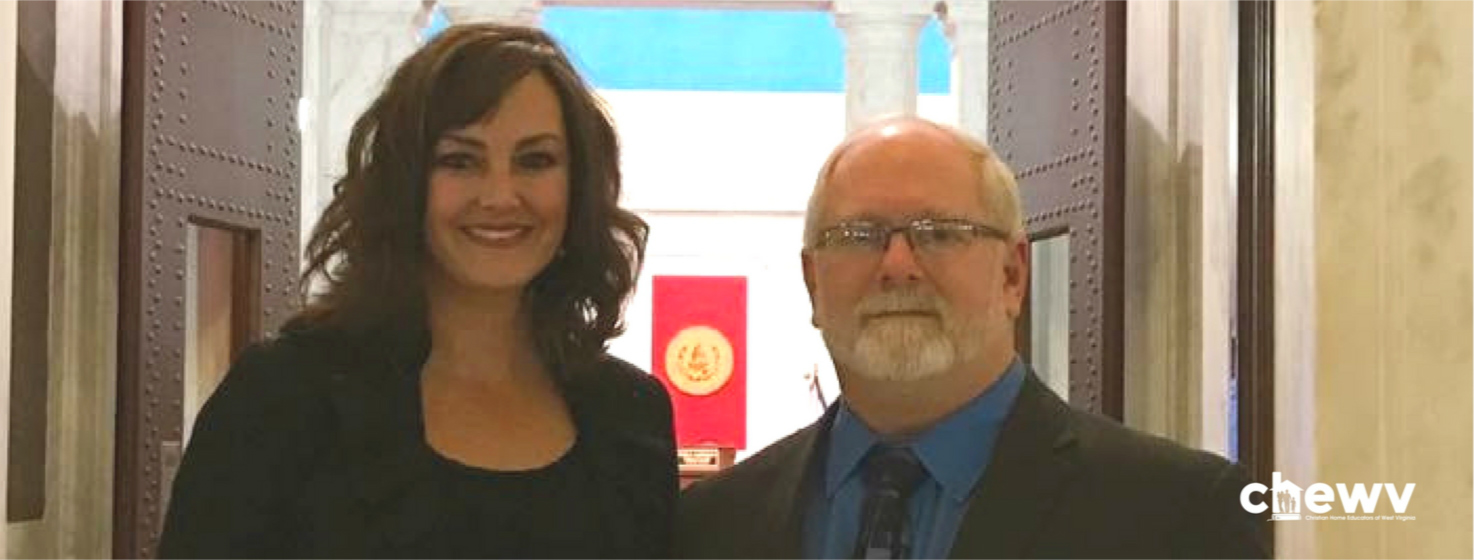
    When visiting the State Capitol, make sure to drop by your representatives’ offices and introduce yourself and your family. A simple meeting, in and of itself, has value to support homeschooling even if you are not lobbying for a particular issue.

    If your representatives have time, ask them where they live, how long they have been in office and if they enjoy serving. You may find that you have the same friends as well as other things in common. Come prepared to tell them why you chose to homeschool and why you like it.  Be brief, recognizing they may be busy with little time to talk. 

    I like to mention that when we began homeschooling, we decided year to year if we would continue, until one day my ten-year-old daughter Vicki was excitedly telling her friends about the characters in a book that I had read for the first time in college. I was stunned that she and her friends had already read the book – and could see that she was way ahead of me at the same age.

    Making a Difference Back at Home

    We are fortunate to have a citizen legislature. citizen legislature is a legislative chamber made up primarily of citizens who have a full-time occupation outside of being legislator. Those who represent us in Charleston live and work among us most of the year.  Therefore, we not only have the opportunity to meet with legislators in Charleston during the two-month regular session, but also during the remainder of the year when they are living in or near our home towns.  This is our bigger opportunity to make concerns heard and understood, and to put a face on our issues. 

    There is an increased urgency to get to know legislators this year than in the past because there has been such a high percentage of turnover in recent years. At least 20 percent are new to the job of representing constituents, and just about as many are new to homeschooling.  On an encouraging note, more legislators than ever either homeschool themselves or have grandchildren who are homeschooled.

    Lobbying is simply influencing our legislators.  A citizen legislature provides many opportunities to influence both in Charleston and at home.  Let’s make the most of the opportunities that our West Virginia state government provides by coming to the Home School Day at the Capitol this year.  Here is a link to learn more.

  • Following in Jefferson’s Footsteps

    To Protect our Religious Freedom

    By John Carey, CHEWV’s Legislative Liaison

    In my last article, I discussed the words of Thomas Jefferson that are embedded in the WV Constitution:

    “No man shall be compelled to frequent or support any religious worship, place or ministry whatsoever; nor shall any man be enforced, restrained, molested or burthened, in his body or goods, or otherwise suffer, on account of his religious opinions or belief, but all men shall be free to profess and by argument, to maintain their opinions in matters of religion; and the same shall, in nowise, affect, diminish or enlarge their civil capacities.”

    Jefferson had an undying passion for religious liberty, a passion that I share.  Why?  Because our freedom to do what our conscience dictates forms the underlying liberty Americans have to serve God without state reprisal.  “Freedom of Religion” was so valued by our Forefathers that they embedded it into the Bill of Rights. 

    Religious freedom is also foundational to many of our other freedoms – like Christian homeschooling!  We can teach our children from a Christian worldview because of our religious liberty.  Yet, even Jefferson knew that creating laws and constitutions was insufficient to protect liberty.

    The price of liberty is eternal vigilance.”

    Vigilance is exactly what is needed right now to protect our religious liberties.  The Religious Freedom Restoration Act (RFRA) is sorely needed to shore up our religious freedom.  But many of our state legislators have said that no action is needed in West Virginia because of Jefferson’s words in our Constitution. 

    Consider Virginia, the state that West Virginians’ freedoms were drawn from.  Virginia boasts a history of religious liberty tracing back more than 200 years.  Yet in 2007 they still took the step to protect those freedoms by passing the Religious Freedom Restoration Act.  Virginia did not claim that Jefferson’s words were enough when faced with the threats to religious freedom evident across our great nation.  Instead they acted, and Governor Tim Kaine signed the Virginia RFRA into law.

    A proliferation of Sexual Orientation Gender Identity (SOGI) laws have recently emerged in local municipalities across West Virginia.  These laws are being passed by town councils for the noble purpose of preventing discrimination against one select group.  Unfortunately, they have the tragic effect of causing discrimination against another.  What they seek to prevent for one group, they end up causing for another.

    What is needed is for a discussion to occur so that these conflicting needs can be resolved, something the RFRA enables through the “Compelling State Interest Test.”  The SOGI’s seek to validate the notion that gender is a choice to be made by individuals, and that government and businesses are obliged to endorse those choices. It is hoped that local governments will revisit SOGI decisions and realign their thinking with what is expressed in the West Virginia State Constitution – that “all men shall be free to profess…and maintain their opinions in matters of religion.”

    In the face of contentious debate, the West Virginia House of Delegates has passed the RFRA twice in the last four years by overwhelming margins, both when Democrats and Republicans were in control.  Each time, however, the Senate has refused to take up the bill or has gutted it so that it was not worth passing.  How can this happen when it was reported in the last session that 93 percent of West Virginians want the RFRA passed to protect their freedoms?

    While it can be said that vocal proponents on both sides of the issue have encouraged unfair assumptions about the intent of their adversaries in order to inflame the dialogue, excellent testimony in the House and the Senate in support of the RFRA also brought clarity to this issue.  Such testimony, particularly that of Judiciary Chairman John Shott and Senator Ed Gaunch, can serve as a basis of understanding as we seek to move forward.  Let’s earnestly pray that God will enable an HONEST dialogue to make clear to the West Virginia Senate and local governments that the issue is not about hatred, but about embracing the fundamental freedoms for which Jefferson fought.  Simply said, the issue is to ensure that individual rights of conscience are protected – for “all men.”

    It is not yet clear what the Legislature will do regarding RFRA in the 2017 session.  But it is clear that this issue cannot easily be dismissed, for the threats to our religious freedom persist.  WV Christian families should stay informed and prepared for action against any potential threat to our liberty to educate our children as we see fit.  After all, Mountaineers must remain as tenacious and committed to religious liberty as Thomas Jefferson himself!

    If you want to learn more about the RFRA, click here!

  • The Changing Face of Testing

    The Changing Face of Testing

    Stanford Publisher Among Those Providing
    Common Core Materials

    No Child Left Behind (NCLB) legislation precipitated a major shift in testing when it was signed by President Bush in 2002.  Prior, annual testing was primarily via standardized achievement tests, which were designed to measure a student’s academic knowledge compared with other students nationwide. Achievement tests were also nationally-normed so that a particular curriculum or student background would not statistically affect the comparison scores.

    In stark contrast, the stated purpose of NCLB testing was to assess mastery of specific curriculum content.  NCLB required states to develop standards – i.e., specific subject content – for teaching, then assess by means of content-based exams such as the WESTEST whether those standards had been met.  Although in and of itself this was not bad, tests like the WESTEST were far different from previous achievement tests because they intentionally tested the specific material covered in a given state’s public school classrooms.

    Since these new tests were directly tied to receiving federal funds, they inadvertently drew attention and funds away from the traditional and reliable nationally-normed standardized tests.  Educators knew the value of achievement tests, but federal funding largely dwarfed their use.

    As a result, the publishers of these expensive-to-produce nationally-normed tests suffered a shrinking market and published fewer updated versions. The combination of our state law’s assessment requirement and its ten-year publishing/norm date stipulation made this turn of events a WV homeschool issue. 

    For example, Pearson, publisher of the Stanford test, announced last year that they would no longer provide and support the Stanford 10 test. While Pearson subsequently changed its mind, the most recent Stanford version was normed in 2007, which means this is the last school year it can be used by WV homeschoolers. Pearson could choose to re-norm it or publish a newer version, but that doesn’t seem likely.

    For the economic reasons described, test publishers must decide whether to continue offering the expensive-to-produce achievement tests or to compete in the Common Core market instead. Pearson was awarded a contract in 2014 to administer tests aligned with the Common Core Standards, a project described as being of “unprecedented scale” in the U.S. testing arena. The contract is associated with the Partnership for Assessment of Readiness for Colleges and Careers, one of two main consortia of states creating exams to match Common Core State Standards (the other being Smarter Balanced, in which WV participates). Under the contract, Pearson will develop test items, paper-and-pencil tests, and computerized tests that align with CCSS. Pearson appears focused on Common Core rather than the traditional achievement testing that gave rise to their Stanford test. Pearson has recently lost some state contracts; whether this development keeps the traditional Stanford on their radar screen is still to be determined.

    What does all this mean?  It appears that most publishers of standardized tests are caving in to the Common Core market.  Besides the difficulty of finding a recently normed standardized test, homeschoolers now have to work hard to find one that isn’t aligned with the Common Core Standards. Yet the landscape could change as a result of a growing, credible back-lash from dissatisfied educators, informed parents, and Constitutional conservatives against Common Core.  Nevertheless, because federal money continues to drive and fund Common core, the state-by-state pushback is slow to regain ground.  

    We expect that once the Stanford 10 is too old to use (after this year), the highly respected Stanford option will be gone for WV homeschoolers.  We do expect Pearson to soon offer an alternative standardized test, but it will likely be similar to WV’s new General Summative Assessment – which is basically a Common Core test rather than a traditional achievement test.  

    Right now, CHEWV is pleased that Riverside Publishing has decided to take a risk and keep their newest IOWA only partially aligned to CCSS and looking much like the traditional tests that have been trusted through the years.  CHEWV will continue to stay abreast, as much as possible, with what is happening in testing.  Among the tests available which satisfy our state law, we are committed to providing the best testing option possible to West Virginia homeschooling families.

  • On Socialization, Elections, and Religious Freedom

    On Socialization, Elections, and Religious Freedom

    By John Carey, CHEWV’s Legislative Liaison/Lobbyist

    As you consider the upcoming election, it is important to support those who not only stood up for your freedoms by advancing positive home school legislation but also promoted bills that strengthen parental rights and religious liberty.

    Legal protection of homeschooling is built upon two pillars:  parental rights and religious liberty.  If we ever lose the fight for religious freedom, we will find ourselves unable to stop laws which wrest control of home education away from parents and place it in the hands of government agents.  We must consider the actions of officials at the local, as well as national level, as they relate to religious liberty.

    During the 2016 regular legislative session, as many of you will recall, Delegate Hornbuckle proposed an amendment that would have required homeschool students to undergo diversity instruction by periodically requiring “public school visits and activities” to “enhance social skills and tolerance for others with different beliefs or backgrounds.” 

    But it does not stop at one WV legislator.  Recently HSLDA reported that U.S. Department of Education Secretary King has also expressed his concerns about the social development of homeschool students.  King worries that “students who are homeschooled are not getting the kind of rapid instructional experience they would get in school” unless parents are “very intentional about it.”  King said the school experience includes building relationships with peers, teachers, and mentors—elements which he believes are difficult to achieve in homeschooling.

    If that is true, if students get an excellent social development experience in public school, where is the proof of it?  Are America’s public school students known around the world for excellent social development?  How happy, content and self-assured are they?  Consider this:

    • Suicide is the SECOND leading cause of death for college-age youth and ages 12-181.
    • More teenagers and young adults die from suicide than from cancer, heart disease, AIDS, birth defects, stroke, pneumonia, influenza, and chronic lung disease COMBINED2.
    • Each day in our nation on average, over 5000 young people grades 7-12 attempt suicide3.

    Tragically, a child in a West Virginia elementary school recently committed suicide, and perhaps because of bullying4.

    It has been my observation that many parents homeschool primarily because they are concerned about proper social development.  They want their kids to grow up with a solid self-image and gain essential social skills.

    It would seem that there is another reason that King and Hornbuckle want our kids exposed to public school.  This can be seen in the second justification that Delegate Hornbuckle gave for his committee amendment: “tolerance for others with different beliefs or backgrounds.”  Secularists who share the worldview of Secretary King and Delegate Hornbuckle do not want parents, especially Christian parents, directing the education of their own children because these parents teach that homosexual marriage is wrong and traditional marriage is right.  In their minds, to teach that this is the only way to look at life is to be intolerant. 

    Stepping back to view our culture, we can see that it is not Christians but the godless society around us that is becoming intolerant of those who believe that objective truth can be known and lived out in the world.  The traditional view of absolute truth is being replaced with “Cultural Relativism,” which says all cultural beliefs are good and must be appreciated.  Those who believe that there is a best way or a right way to live are quickly being defined as bigots.  This is why our children must be exposed to “different beliefs and backgrounds” as the Hornbuckle amendment mandated.  Yet Christian parents know this is not true.  Some ways of looking at life are very harmful, even destructive.

    Some ways of looking at life are very harmful, even destructive.

    On the floor of the Senate during the 2016 regular session, Senator Mitch Carmichael, in a tearful speech, gutted the West Virginia religious freedom bill in the final moments of the debate by, in effect, mandating that Christians who bake cakes or take wedding pictures be legally required to use those talents to affirm homosexual marriage – “or else.”  Consider if this proposal had been made law.  It clearly would have set a precedent for limiting religious freedoms in other areas as well.  Why not eventually homeschooling?

    A battle is raging all around the country, even in West Virginia, over religious liberty. For those of us who have chosen God’s Word as the sure foundation of our lives and families, the religious liberty purchased for us by America’s forefathers should be precious to us.  We must rise up to protect that liberty if we want to keep the right to direct the education of our children.

    If ideas which are counter to the Bible gain momentum in society, parents will eventually have no legal means to prevent their children from being indoctrinated in the name of the “greater good” of society.  And what is the greater good?  That all ways are equally acceptable.  To think otherwise is to be one who hates and is intolerant.  Instead, students in school should be encouraged to discover what is true and right, and what will enable them to be successful in life, just as homeschool students are already doing.  True success is never found in placing equal value on all ideas as Cultural Relativism mandates, but by embracing the best ideas – God’s ideas!  The LORD our Maker says, “For as the heavens are higher than the earth, so are My ways higher than your ways and My thoughts than your thoughts.”  (Isaiah 55:9)

    Anything contrary to the ways and thoughts of God puts men and women, girls and boys, in bondage.  Only the knowledge of the Truth of God’s Word will set us – and these children – free.

    Jesus said, “If ye continue in my word, then are ye my disciples indeed; and ye shall know the truth, and the truth shall make your free.”  – John 8:31-32

    It is for freedom that Christ has set us free.  Stand firm, then, and do not let yourselves be burdened again by a yoke of slavery.  – Galatians 5:1

    _______________

    1 https://www.jasonfoundation.com/prp/facts/youth-suicide-statistics
    2 Ibid
    3 Ibid
    4 https://www.washingtonpost.com/news/education/wp/2016/09/16/bullies-tormented-a-9-year-old-boy-relatives-say-it-may-have-driven-the-child-to-suicide/


    1. https://www.jasonfoundation.com/prp/facts/youth-suicide-statistics []
    2. Ibid []
    3. Ibid []
    4. https://www.washingtonpost.com/news/education/wp/2016/09/16/bullies-tormented-a-9-year-old-boy-relatives-say-it-may-have-driven-the-child-to-suicide/ []