Author: CHEWV

  • CHEWV Meets With Dr. Paine

    CHEWV Meets With Dr. Paine

    In response to WV Superintendent of Schools Steve Paine’s comments late last week, John Carey (CHEWV’s legislative liaison) quickly arranged a meeting with State Superintendent Paine.  Also in attendance were two leading members of the State Board of Education, President David Perry and Vice President Miller Hall.  CHEWV Board members James and Wendy Summers, along with Mike Donnelly from HSLDA, questioned Dr. Paine about the accuracy of the data on which his comments to the State Board were based.

    Department of Education staff, using data from their attendance tracking system, indicated that there have been over 18,000 new homeschoolers in West Virginia in just the last five years.  CHEWV questioned the accuracy of that number and requested that WVDE compare that number to the number of NOI’s that have been submitted by legal homeschoolers, which they agreed to do.  CHEWV emphasized the difference between legal homeschoolers and truants.  Both Superintendent Paine and Board President Perry voiced their support for legal homeschoolers.  Stating that their concern is for children of whom the counties have lost track, they acknowledged that a portion of that problem could be on their end.  Not only did Paine and Perry clarify that there was no plan to initiate new board policy or legislative action, but they agreed to communicate with CHEWV should any new board action related to homeschooling be proposed in the future.

    While the meeting was very positive and alleviated many immediate concerns raised by the Superintendent’s comments quoted in the media, this remains a critical season where CHEWV expects challenges to our homeschooling  freedoms to arise over the next several months.

    The State Board of Education may not initiate action to increase regulations of homeschoolers, but other educational groups can – and likely will – work to encourage legislators to increase homeschool regulation.  CHEWV will be there throughout the process to monitor legislation, and we will continue to keep you informed of issues relative to homeschooling freedom.  Your prayers are vital to the success of CHEWV’s vigilance.

    THANK YOU to all those who partner with us to make this work possible – so that we are all free to train up our children in the Christian faith.

  • Choosing the County Report or the Progress Report

    Choosing the County Report or the Progress Report

    [et_pb_section fb_built=”1″ admin_label=”section” _builder_version=”3.22″ global_colors_info=”{}”][et_pb_row admin_label=”row” _builder_version=”3.25″ background_size=”initial” background_position=”top_left” background_repeat=”repeat” global_colors_info=”{}”][et_pb_column type=”4_4″ _builder_version=”3.25″ custom_padding=”|||” global_colors_info=”{}” custom_padding__hover=”|||”][et_pb_text admin_label=”Text” _builder_version=”4.9.11″ background_size=”initial” background_position=”top_left” background_repeat=”repeat” hover_enabled=”0″ global_colors_info=”{}” sticky_enabled=”0″]

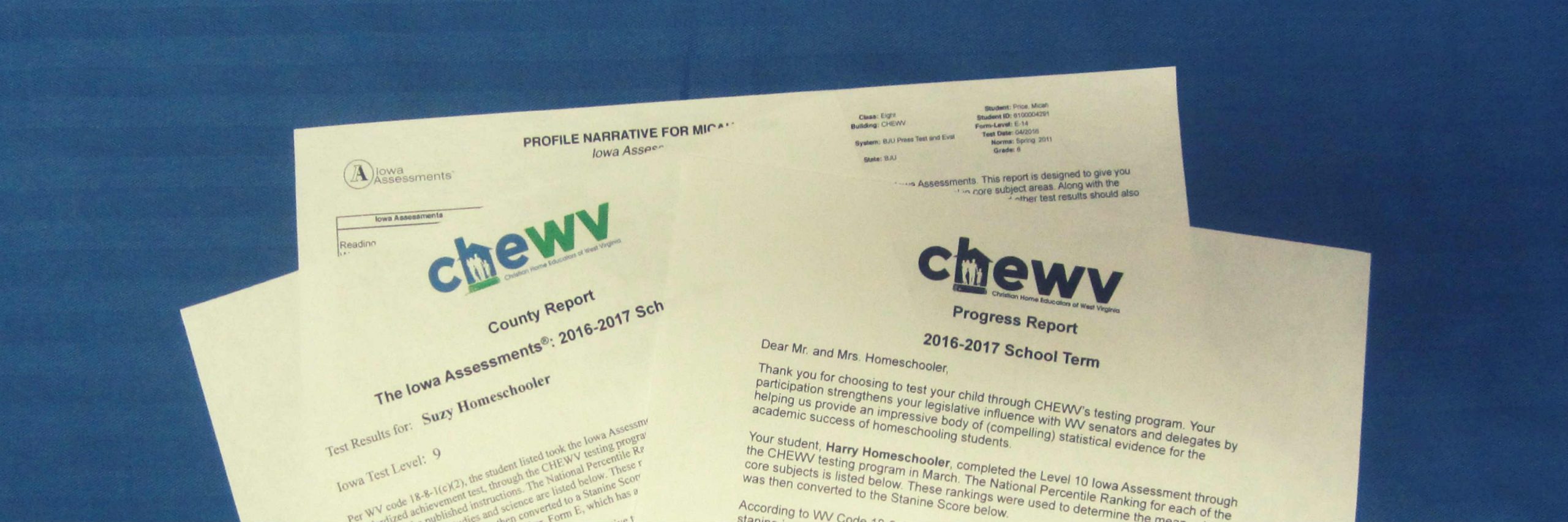
    The homeschooling law requires that assessment results be submitted to the county when students are in grades 3, 5, 8 and 11.  For those students, our County Report (formerly called Report to the Superintendent) is appropriate.  Since ALL STUDENTS must still be assessed annually and must meet acceptable progress standards, our new Progress Report is designed to help parents know if their student has met the requirements for “acceptable progress” in years when the results are not submitted. 

    Both the County Report and the Progress Report are WV-specific.  Both reflect the necessary calculations to determine how the child’s test scores compare with WV law requirements. 

    The law requires that students annually make acceptable progress – as defined in the law.  If not, remediation is required.  The second consecutive year that acceptable progress is not made, additional evidence of appropriate instruction must be submitted to the county.  This is applicable for ALL STUDENTS IN ALL GRADES.

    At the time of testing registration, parents will choose between the two reports.  If their student is in 3rd, 5th, 8th, or 11th grade, they should choose the County Report – a hard copy sent to parents in the mail which is designed to be turned in to the county by June 30.  If not, they should choose the Progress Report — an electronic copy sent via email attachment so that they can easily determine if they owe “additional evidence” to their county. 

    In all cases, annual assessment results must be kept on file for three years.  Questions?  Email testing@chewv.org.

    [/et_pb_text][/et_pb_column][/et_pb_row][/et_pb_section]

  • Misleading News Targets WV Homeschooling

    by John Carey, CHEWV’s Legislative Liaison

    A recent WVNews article by Kailee Gallahan claims that “homeschooling cuts over $2 million from Harrison School systems funding.”  In the article, Harrison County public school officials accuse homeschoolers of costing the county millions. The article also asserts that most of those homeschooling in Harrison County –  if not throughout the state – are using homeschooling as an excuse to avoid truancy prosecution.  County officials lament the fact that parents are not required to submit an application to homeschool but are allowed to simply notify the county of their intentions.  In their own words, “We cannot intervene, we cannot prevent, and we cannot deny.”

    Public officials do not make such bold statements simply for the purpose of informing the public.  Their purpose is to misinform the public and influence legislators to support their positions, granting them the power to do what they want, the way they want. In this case, the officials want the law changed so they can stop the growth of homeschooling in Harrison County.  They want the power to decide who can and cannot homeschool. They complain that “The law allows [parents] to homeschool at any point in time if they wish.  It’s not an application process, it’s a notification process.” 

    So should you care about any of this if you don’t live in Harrison County?  Absolutely! The changes in homeschooling which Harrison County officials seek would inevitably affect families throughout the entire state.

    What county officials do NOT consider is that their plan to increase public school funding by forcing homeschoolers to attend public school violates the parents’ inherent religious and parental rights. Below is a string of US Court decisions based on the Bill of Rights, all demonstrating that parents have the right to direct the education of their children.

    Meyer v. Nebraska, (1923)

    “The Fourteenth Amendment guarantees the right of the individual … to establish a home and bring up children, to worship God according to his own conscience.”

    Pierce v. Society of Sisters (1925)

    “The child is not the mere creature of the state; those who nurture him and direct his destiny have the right and the high duty, to recognize and prepare him for additional obligations.”

    Wisconsin v. Yoder  (1972): 

    “The history and culture of Western civilization reflect a strong tradition of parental concern for the nurture and upbringing of their children.  This primary role of the parents in the upbringing of their children is now established beyond debate as an enduring tradition.”

    Santosky v. Kramer (1982):
    The Court noted that “freedom of personal choice in matters of family life is a fundamental liberty interest protected by the Fourteenth Amendment.

    It is odd to think that a public-school official would view my child as a source of income – as if my child’s higher purpose in life is to enable the state to achieve its financial goals.  As one county official put it, “The more students, the more funding, the more teachers,” and also “With the 582 students [homeschooled students] enrolled in the public school system, not only would the school system be able to fund more teachers in the county, but also add a myriad of additional school programs and offerings.”

    West Virginia Delegate Terry Waxman wrote an editorial responding to the Harrison County statements.  Her welcome response is a must-read.

    “Children have one shot at childhood and their K-12 education.  If a parent feels that their child is not receiving the best education possible, it is the duty of the parent to do what is in the best interest of their child.  For increasing numbers of people in West Virginia, that choice is homeschooling.”

    Delegate Terry Waxman

    Bridgeport

    Yes, it is our duty, before God, to do what is in the best interest of our children.  It is the duty of the state to protect our right to do so.  We can thank God for the protections that are contained in our founding documents – documents which respect the God-given rights of the people and therefore limit the government.

    We must never forget nor forfeit our precious heritage as citizens of the United States of America, but guard it with all vigor and vigilance:

        …We hold these truths to be self-evident, that all men are created equal, that they are endowed by their Creator with certain unalienable Rights, that among these are Life, Liberty and the pursuit of Happiness. — That to secure these rights, Governments are instituted among Men, deriving their just powers from the consent of the governed, — That whenever any Form of Government becomes destructive of these ends, it is the Right of the People to alter or to abolish it, and to institute new Government, laying its foundation on such principles and organizing its powers in such form, as to them shall seem most likely to effect their Safety and Happiness…

    The Declaration of Independence

    Let’s stand with those who stand with us at the state capitol.  Let’s also gain a deeper understanding of the tools “the Creator” has given us to protect our freedoms as they are expressed in the Declaration of Independence, clearly defined in the Bill of Rights, and established by our U.S. Constitution.

    The God who gave us life gave us liberty at the same time.

    Thomas Jefferson

    Note:  Mike Donnally Esq., with HSLDA, has thoroughly responded to the statements of Harrison County public officials. I encourage you to read Mike’s article and arm yourself with the facts.  Knowing the facts is vital if we are to defend our freedoms before the legislators go back into session in January.

  • December 1: Golden Horseshoe Registration Deadline

    December 1: Golden Horseshoe Registration Deadline

    [et_pb_section fb_built=”1″ admin_label=”section” _builder_version=”4.16″ global_colors_info=”{}”][et_pb_row admin_label=”row” _builder_version=”4.16″ background_size=”initial” background_position=”top_left” background_repeat=”repeat” global_colors_info=”{}”][et_pb_column type=”4_4″ _builder_version=”4.16″ custom_padding=”|||” global_colors_info=”{}” custom_padding__hover=”|||”][et_pb_text admin_label=”Text” _builder_version=”4.21.2″ background_size=”initial” background_position=”top_left” background_repeat=”repeat” hover_enabled=”0″ global_colors_info=”{}” sticky_enabled=”0″]

    ~the 5th in a series of articles~
    Click here to start at the beginning of the series.

    West Virginia native Homer Hickam, author of “October Sky,” has one regret. He did not win a Golden Horseshoe as a student!

    Every year 221 students are awarded the coveted Golden Horseshoe and knighted as Ladies and Knights of the Golden Horseshoe in a ceremony at the Capitol in Charleston, WV, in June. The Golden Horseshoe is a scholastic opportunity open to all 8th grade students in West Virginia. Each county has a minimum of two winners, but counties with larger populations have more winners. The test is a competition within a county, not within the state.

    The test measures a student’s understanding of West Virginia history, geography, civics, geology, culture, economy, and tourism. There are two parts to the test; the first is a written essay and the second is an online multiple-choice test containing 50 questions. The essay portion is not required, but is used only if there is a tie within the county on the multiple-choice testing portion. Both parts are administered at the public school the student would normally attend.

    A registration form must be completed by a teacher, counselor, or school/county administrator where the student would have normally attended public school. About a week after the student is registered, they will be e-mailed additional instructions and links for weekly practice tests to help familiarize the student with the testing format.

    Homeschooled students who want to take the Golden Horseshoe exam must register by December 1st.

    The online multiple-choice test consists of 50 questions. Students have 40-45 minutes to complete the test. Please note: IEP accommodations are allowed.

    To register, send your student’s full name and address to the WV Studies teacher at the school where your student would normally attend public school. The test must be taken at that school. Once the student has been added to the school’s Golden Horseshoe list, your student’s username and password will be emailed to you, a process that should take no more than one week. If it takes longer, please contact the school.

    By January 31, test your student’s username and password. This step can be done on a home computer.

    Online Practice Tests, made available for students in January, will be posted once a week on Friday. In order to access these practice tests, which mimic the testing process, you will be provided with a special link.

    Essay test day for all counties is held in February. This test is used to select a winner in the event of a tie score on the multiple-choice test, as counties are only allowed a certain number of winners. The essay test, which is optional, requires the student to compose an essay of limited length on a specific topic.  Sample essay questions can be found online. Again, the sole purpose of the essay test is to break a tie.

    The Golden Horseshoe exam itself is administered during the last two weeks of February. Additional information and key dates can be found here.

    Read the next article in the series here.

    [/et_pb_text][/et_pb_column][/et_pb_row][/et_pb_section]

  • Homeschooling for a Harvest

    Homeschooling for a Harvest

    [et_pb_section fb_built=”1″ admin_label=”section” _builder_version=”3.22″ global_colors_info=”{}”][et_pb_row admin_label=”row” _builder_version=”3.25″ background_size=”initial” background_position=”top_left” background_repeat=”repeat” global_colors_info=”{}”][et_pb_column type=”4_4″ _builder_version=”3.25″ custom_padding=”|||” global_colors_info=”{}” custom_padding__hover=”|||”][et_pb_text admin_label=”Text” _builder_version=”3.27.4″ background_size=”initial” background_position=”top_left” background_repeat=”repeat” global_colors_info=”{}”]

    by James Summers, CHEWV dad and Board member

    As I write this, we are heading into prime harvest season.  It’s the time of year when you have to keep your windows rolled up and doors locked while you’re at church – or else you’ll come out and find your car full of zucchinis.  Every day we are reaping the rewards of both God’s graciousness and our hard work.  This year my schedule and the weather mostly cooperated, and I was able to keep the weeds from “taking over” the garden – at least for a while.  Somewhere along the line, though, I got too busy to work the garden during the peak of summer activities.  The early harvest was good, but now I find myself searching through the tall weeds for any tomatoes and beans that made it through, despite my lack of attention and work.  I drive by a well-kept garden with envy and regret.

    It can be this way with our marriages, families, and yes, homeschooling, as well. 

    We reap what we sow.  A crop of Silver Queen corn doesn’t just mysteriously appear in my garden.  I have to plant the seeds.  If I want a marriage that radiates God’s glory, or kids that are dedicated Christ followers, or a homeschool that redeems education to God’s purpose, I have to sow the seeds to reap this harvest.  I have to think about what results I desire (and God desires) and then act to bring them about. 

    A man reaps what he sows.
    Galatians 6:7

    Not only do we have to sow the right seeds, we also have to tend the garden.  Gardeners with the greatest harvest spend much time tending their garden – hoeing, weeding, fertilizing, watering, pruning, building trellises, staking tomatoes, dusting for bugs, shooting groundhogs or trapping raccoons, and maintaining the fence to keep out the deer.  Often the work is hard.  Sometimes it is just a simple task, but the work is always intentional.  Master gardeners do what they know needs to be done each day.   Though they almost never see an immediate result, they trust that the desired results will come about.  They follow the wisdom accumulated from hundreds of generations of farmers before them and talk with other gardeners, especially more experienced ones, when they have a question.  Every day they spend time in their garden.

    Let us not grow weary in well-doing, for in due time we will reap a harvest,
    if we do not give up.
    Galatians 6:9

    So what kind of harvest do you want to reap from your years of homeschooling?  What kind of seeds are you sowing, and what kind of work are you doing each day to move toward these goals? 

    Really, seriously, stop and think about these questions for an extended time. Talk about them with your spouse.  Pray about them.  Consider how you can make your homeschool years about more than just academics.  What does the Creator – the Originator and God of all wisdom and knowledge – desire of your homeschool years?

    If you want a more bountiful harvest, cast a bigger vision.  Set higher goals.  Don’t always look for immediate results; think multi-generationally.  Determine to leave a positive spiritual impact on your grandchildren and great-grandchildren.  Make loving and serving Jesus a bigger priority in your family than anything else.  Do the work that you know needs to be done each day.  Spend time every day in the garden where God has placed you to work.  Determine to finish the journey you have started, but know that the most enduring fruit of your labor may not even come in your lifetime.

    Therefore we do not lose heart. Though our outer self is wasting away, yet our inner self is being renewed day by day. For our light and temporary affliction is producing for us an eternal glory that far outweighs our troubles. So we fix our eyes not on what is seen, but on what is unseen. For what is seen is temporary, but what is unseen is eternal.…

    2 Corinthians 4:16-18

    [/et_pb_text][/et_pb_column][/et_pb_row][/et_pb_section]

  • FREE Unit Study: Harvest of Friends

    The Little House series of books based on Laura Ingalls’s childhood in the 1800’s remains popular among readers of all ages, particularly children.  The history, woven into wholesome family stories, makes them especially appreciated by homeschoolers. 

    In 1974, the book series was turned into the beloved television series Little House on the Prairie, also the title of Laura’s third novel.  CHEWV is pleased to provide a short unit study based on the first TV episode, “A Harvest of Friends.”  To access your free study, click here.

  • Video Resources, Member Resources…

    Video Resources, Member Resources…

    [et_pb_section fb_built=”1″ admin_label=”section” _builder_version=”4.16″ global_colors_info=”{}”][et_pb_row admin_label=”row” _builder_version=”4.16″ background_size=”initial” background_position=”top_left” background_repeat=”repeat” global_colors_info=”{}”][et_pb_column type=”4_4″ _builder_version=”4.16″ custom_padding=”|||” global_colors_info=”{}” custom_padding__hover=”|||”][et_pb_text admin_label=”Text” _builder_version=”4.21.2″ background_size=”initial” background_position=”top_left” background_repeat=”repeat” hover_enabled=”0″ global_colors_info=”{}” sticky_enabled=”0″]

    …YouTube resources for studing WV History

    ~the 4th in a series of articles~
    Click here to start at the beginning of the series.

    West Virginia History in 2 Minutes Or Less-A YouTube channel with over 50 short videos on West Virginia History.

    WV History Documentary- This documentary follows a timeline of historical events, from the state’s first inhabitants to the present day, and follows the contributions of the men and women who shaped the state’s cultural, economic, and political landscapes.

    Using paintings, still photographs, and motion picture clips, the series helps students explore what it means to be a West Virginian. Narrated by Richard Thomas.

    West Virginia: The Road to Statehood– This documentary brings to life the issues, differences and disagreements that divided the Commonwealth of Virginia, turning families and neighbors against one another throughout what is now West Virginia.

    Helvetia: The Swiss of West Virginia From the making of Helvetia cheese to Fasnacht and the burning of Old Man Winter….experience Old-World Swiss traditions as they thrive today in the remote mountain community of Helvetia, West Virginia. Descendants of nineteenth-century Swiss immigrants share and discuss their music, dance, yodeling, foodways, crafts, customs, and celebrations.

    The Feud The most famous family conflict in American history, the Hatfield-McCoy feud evolved into a mythic American tale of jealousy, rage and revenge – and one which helped create the negative “hillbilly” stereotype that has shaped attitudes towards Appalachia for more than a century. Much more than a tale of two warring families, The Feud is the story of a region and its people forced into sudden change by Eastern capitalists, who transformed Appalachia from an agrarian mountain community into a coal and timber producing workplace owned and run primarily by outside interests.

    The Mine Wars At the beginning of the 20th century, coal was the engine of American industrial progress. Nearly three quarters of a million men across the country spent ten or twelve hours a day underground in coal mines. The Mine Wars brings to life the struggle that turned the coalfields of southern West Virginia into a blood-soaked war zone where basic constitutional rights and freedoms were violently contested.


    Read the 5th article in this series here.

    [/et_pb_text][/et_pb_column][/et_pb_row][/et_pb_section]

  • Why Bother Studying WV History?

    Why Bother Studying WV History?

    [et_pb_section fb_built=”1″ admin_label=”section” _builder_version=”4.16″ global_colors_info=”{}”][et_pb_row admin_label=”row” _builder_version=”4.16″ background_size=”initial” background_position=”top_left” background_repeat=”repeat” global_colors_info=”{}”][et_pb_column type=”4_4″ _builder_version=”4.16″ custom_padding=”|||” global_colors_info=”{}” custom_padding__hover=”|||”][et_pb_text admin_label=”Text” _builder_version=”4.21.2″ background_size=”initial” background_position=”top_left” background_repeat=”repeat” hover_enabled=”0″ global_colors_info=”{}” sticky_enabled=”0″]

    (plus cool geography games!)

    ~the 3rd in a series of articles~
    Click here to start at the beginning of the series.

    As parents and teachers, we are preparing our children for the future – a future which they will have a vital role in shaping. Understanding the forces (geographical, historic, political, economic, etc.) which have molded and influenced West Virginia in the past is a key important component in determining and defining its future. And West Virginia’s future is exactly what our children will face as they grow up and confront the adult world challenges and opportunities.

    Our job, then, is to not only teach but train our children how to stand as Christians and engage the culture – impacting it, changing it, shaping it – all for the glory of Christ. First Chronicles 12:32 refers to men who understood the times, men with knowledge of what to do.  Likewise, our sons and daughters will one day stand as men and women and help establish their families, their communities, and their state.

    As Edmund Burke famously quipped, “Those who don’t know history are doomed to repeat it.” Today, more than ever, it is imperative to recall the wisdom of Ecclesiastes 1:9:  “The thing that has been — it is what will be again, and that which has been done is that which will be done again; and there is nothing new under the sun.”  We must learn from the past!

    Online WV Geography Games

    Online games are a great way to help students learn geographical information. Here are a few links to get your student started:

    County Game: https://www.purposegames.com/game/48cadb92e8

    Rivers Game: https://www.purposegames.com/game/west-virginia-rivers-game

    River Cities Game: https://www.purposegames.com/game/west-virginia-river-cities-game

    County Seat Game: https://www.purposegames.com/game/west-virginia-county-seats-quiz


    Tip #4 – Groups of 10 or more can often get discounts at educational 

    sites. Call and ask! (They often include parents in the count.)


    Tip #5The Beckley Coal Mine Exhibit 

    Take a tour in a real coal mine, explore a recreated coal town, and visit a comprehensive coal museum. This is a great way to complement a unit study and help ‘book learning’ come to life!


    Click here to read the next article in the series.

    [/et_pb_text][/et_pb_column][/et_pb_row][/et_pb_section]

  • Sports: Maybe It’s Time to Think…

    Sports: Maybe It’s Time to Think…

    …Out of the Box

    by Melody Sheppard

    So far, West Virginia homeschoolers have been barred from participating in any activity governed by the WV Secondary School Authority Commission (WVSSAC).    This not only includes high school sports, but also some band functions and clubs.  Although elementary-aged homeschoolers can usually participate in a vast selection of community sports leagues, once a student enters high school the playing field narrows.

    As a result, many homeschoolers are turning to individualized sports and finding solid opportunities to achieve their sports goals.  Individualized sports allow for flexibility, family participation, and even scholarships.   

    For many, the goals for participating in sports are pretty simple and a team situation is not required to meet them.

    • Develop a lifelong skill
    • Boost confidence
    • Learn mastery through practice
    • Learn sportsmanship
    • Challenge one’s self
    • Build self-discipline
    • Develop friendships/camaraderie
    • Have fun!

    Just as homeschooling allows a child complete freedom to develop skills and maturity at his/her own pace, so does an individualized sport!  Confidence is built and a sense of responsibility is gained, because it is up to the student how many practice hours are devoted.  Outcomes cannot be blamed on a coach or teammate.  The student determines the level of expertise he/she would like to attain – without pressure from a team. 

    Individualized sports can also turn into lifelong interests. Developing a love for a sport that may be enjoyed and pursued through successive seasons of life is healthy both mentally and physically.  Lifelong friendships, not unusual among those who share similar interests and talents, enrich not only learning but social skills.  Often participants span a wide age range, adding to the benefits of socialization.  The many advantages of individual sports can far outweigh the appeal of team sports.

    Listed below are individual sports to explore for your student and even the entire family.  Many have clubs, competitions, and milestones to encourage skill and training. 

    • Archery clubs, NASP
    • Biking – distance, mountain
    • Boating/Kayaking
    • Bowling
    • Cooking – (cooks move!) competition
    • Dancing
    • Equestrian – trail, show, competition
    • Fishing – tournaments
    • Gardening – master garden program
    • Golf
    • Gymnastics
    • Hiking – clubs, achievement ladders
    • Horseshoes/Cornhole
    • Hunting – clubs, milestones
    • Martial Arts
    • Motocross
    • Ornithology – clubs, lectures, bird counts, walks & tours – from local to international, competition
    • Racing – soap box, small cars
    • Racquetball
    • Running – 5Ks, marathons
    • Shooting Sports – Air, pistol, small bore, high power
    • Skating – Ice, Roller
    • Skiing/Snowboarding
    • Swimming
    • Tennis
    • Tractor Pull
    • Weightlifting
    • Woodworking

    Some participatory groups also provide a variety of sports/physical activities.  Examples include Civil Air Patrol, 4H, American Heritage Girls, Boy Scouts, and Girl Scouts.

  • Top-Notch Athletic Activity…

    Top-Notch Athletic Activity…

    …On a Shoestring

    Moms, Dads, Get Moving!

    By Brian D. Ray, Ph.D.

    President
    National Home Education Research Institute
    Salem, Oregon

    www.nheri.org

    For Free homeschool Research News with Dr. Ray, take 17 seconds to sign-up here: https://www.nheri.org/connect/


    So you want to have some intense sports activity for your children, but you don’t know where to go or what to do? In some states, interscholastic sports activities are open to homeschool students, but in other states, like West Virginia, they are not. What might a parent do to provide physically challenging, mentally awakening, and spiritually healthy sports activities for their children, including teens (and even younger children)?

    About 40 years ago, I bumped into a group of young folks playing a game that I’d never seen before. They were running fast, jumping high, having a blast, smiling, frowning, and going all out. Their enthusiasm really caught my attention. They played on a big field, a little bigger than a football or soccer field, and they threw – accurately, with force, with precision, only 5 yards but sometimes 70 yards—a Frisbee. It was Ultimate. Not Ultimate Frisbee – Ultimate!

    It is not “Frisbee Football.” It is not Disc Golf. It is its own sport with its own rules. It is also fast-paced, athletic, and non-contact.

    My wife and I took it up and had a blast. We played co-ed. We played men only. We played women only. We ran hard, made a lot of interesting friends, got in better shape, and worked as hard or harder than we had in just about any other sport we had ever played. I had played sports all my life (football, baseball, basketball, soccer, and 4 years of university rowing/crew) but didn’t learn until adulthood that Ultimate is an amazing, challenging, and fun sport. My wife and I watched and played with some of the best athletes we had ever encountered. We learned of rules based on the “honor system.” We met all kinds of people. It was a blast.

    Many years later, we were homeschooling our own children in Oregon. Had there been a law allowing our children to participate in “interscholastic activities” (i.e., playing with public and private schools), we would not have been interested. However, the question arose: What might we find for our children that pressed their bodies to something near an extreme physically, was fun, was inexpensive, and might engage a bunch of other homeschoolers and/or their friends? The answer: Ultimate!

    It was perfect for moneyless homeschoolers. How many sports can run on four orange cones (or pylons), a soccer/football field, a ten-dollar 175-gram disc, and 7 flags (3-foot strips of bright orange cloth)?  That is about $22 in addition to the “free” tax-funded city park’s field or your church’s/friend’s actually-free-to-you field.

    You also need two or three parents or teens who are enthusiastic and can offer organizational skills and dependability. Someone needs to read the Ultimate rules and learn and teach the basics to the group.  Parents, teens, and even elementary kids (7-year-olds who are taught and practice can often play Ultimate with teens and adults) will need to know the rules, where to meet, how to get in shape, and other basics.

    Our group in Salem, Oregon has been at it for roughly 17 years. We are now seeing those who started with us coming back with their children. It’s amazing. 

    Following is what I tell our players as we start up each year in the spring, the first Tuesday after Daylight Savings Time takes effect. (Yes, we often begin in western Oregon in the rain, mud, and 45-degree weather.)

    The Basics

    We begin play at 5:30pm on Tuesdays. I have found that Tuesday or Thursday evenings work best for Christian families – not conflicting with Wednesday-night church meetings nor with Saturday family/farm activities. It is very helpful when several players arrive at 5:15pm to help us hold/reserve the field – by spreading out and tossing the disc that they bring.  It is usually first come, first serve, on city or public play fields.

    We focus on homeschool families, but depending on the circumstances, we might invite others to participate.  However, players should ideally be physically prepared. I always push and run them hard. They must run back to the goal line in between scores. If a player can’t because he is too tired, he must get off the field and call for a substitute (sub). Rest/water breaks between games are only 2 to 3 minutes. It is run, run, run during the game. No lollygagging. No socializing.

    It is a lot simpler than the rest of this article might make it look. You could simply read Ultimate in 10 Simple Rules to get going and have a great time. If, however, you want to learn from our 20 years of experience, read on!

    Physical Prep

    I share ideas on how to physically prepare and stay in condition: 

    • Do calisthenics every day, if you have not been doing so all winter. 
    • Do some aerobic exercise, if you have not been doing so all winter. 
    • Stretch your muscles every day. 
    • Do some mild sprints every other day for a few days, then do some harder ones every other day until your first day on the Ultimate field. 
    • Continue to do calisthenics and aerobic exercise and some sprints at least two days every week while playing Ultimate on Tuesdays.

    Our Ultimate Principles

    My main objectives for establishing a regular get-together for playing Ultimate circa 2001 were the following, in no particular order:

    1. Fun and good times of fellowship with Christians (generally; some non-Christians play)

    2. Intense and competitive athletic exercise, especially for the oldest “children” living in our homes (e.g., teens and “young” adults)

    3. Teaching and learning to play a team sport

    4. Teaching and learning biblical sportsmanship

    5. Teaching and learning leadership on a sport’s field

    6. A sporting event open to interaction with non-Christians

    7. Sporting activity with solid involvement of some parents and responsible young adults

    The principles of our gathering and the Ultimate game we play:

    1. Our focus is on good biblical sportsmanship.

    2. Another focus is being gracious and kind.

    3. We keep the rules relatively simple. (See Ultimate in 10 Simple Rules [url].)

    4. The oldest have preference to be on the field. We go by “Ultimate age.” (See below.)

    5. We do not have referees (generally speaking). The “older” men are generally the key leaders and peacemakers. And we look to the young adults to pay attention, serve, and lead by example in this capacity.

    6. Players politely bring to the attention of the gathering’s leader if something is not in line with the rules and they have never heard an explanation of why. 

    7. We keep the game moving quickly. No pausing, waiting around with the disc lying on the ground, and so forth.

    House Rules

    Besides sharing the principles above, I also share these house rules:

    1. After a foul, very quickly allow the defense to get in order and have the marker (defense) to check or hand the disc to the thrower (offense).
    2. After a throw out of bounds or a turnover, run up to the line, plant your foot and play; we do not touch the ground with the disc before we throw. 
    3. After a score, jog to your team’s goal line, all the way. If you do not, the person in charge may replace you with another sidelined player.
    4. If you are too tired to play hard, keep moving, jog back to your goal line after a score, or be cheerful, you must call for a substitute. If you do not think you can make it through a 5-point game after having just played in a game, it is better to rest one game out so that we do not have confusion organizing substitutes.
    5. Brief breaks (e.g., 2 to 4 minutes between games), but no water breaks during games (unless it’s blistering hot, such as over 90 degrees).
    6. If there are too many players for one field, we encourage the oldest of the non-players or a parent to start a second game “on the side.” (Regulation is 7 players on a team; we go up to 8, maximum; more than this is far too crowed on a regulation-size field and is very counter-productive.)
    7. If you have any questions or concerns about our “rules” and the goals of the Ultimate gathering that I have described, please talk to me.
    8. I would like those who have never played with us before to carefully read Rule #10. It is in the spirit of the golden rule, “So whatever you wish that others would do to you, do also to them, for this is the Law and the Prophets” (Matthew 7:12).  In this Ultimate group, we play real hard while we play very respectfully. 
    9. Show respect for all players, regardless of skill or sex.  Men/young men are expected to lead in this regard.
    10. All players are to be humble and look to the older, well-respected, experienced players for direction and instruction on this Ultimate field.  Younger players do not wander around telling others how to play and acting as if their knowledge of the sport and winning are more important than playing hard and enjoying and building up one another.
    11. Coaching in any depth and discussing strategies are kept to the sidelines or during the breaks between games. Team captain, you have 20 seconds or less on the line to say something to your team before the pull (the beginning throw of the disc to start the next play after a score). The team captain may call a time out every now and then during a game to talk with his team for 30 to 45 seconds.
    12. We play sudden death. The first team to score 5 points wins. No ties, no playoffs, no winning by 2 points.

    We like to run hard, play hard, jump hard and high, play well, laugh hard, and encourage hard.

    The Honor System

    Besides the Ultimate in 10 Simple Rules, where you can read and learn the in-depth rules, we always play on the “honor system.” That is, the person who might have committed or did commit a foul must call it on himself. The person who was or thinks he was fouled may not call a foul on the other person. If a person thinks he is being fouled or thinks a player is rude or fouling. he may go talk with his captain, but he may not call a foul. It is wonderful how this “honor system” works on the spirit, conscience and humility/pride of all players.

    Ultimate Age

    The oldest players to show up each week have priority over the youngest in terms of playing and being on the field. Plus, we reward those who faithfully attend all games, week after week, and penalize those who just show up whenever they feel like it (e.g., vicissitudes of personality, literally fair-weather players, and so forth). Therefore, we created “Ultimate Age”:  if you attended 3 of the last 3 weeks, add one year to your actual age; if you played most weeks last year, add another year to your actual age. For example, if you are 12 and attended 3 of the last 3 weeks and played the majority of weeks last year, then you are 14 years old.  We line up, from the leader’s perspective, oldest on his left and youngest on his right along a line on the field. Then the two captains pick teams. If there are not enough fields or the teams are too crowded, the youngest, by “Ultimate age,” do not get to play.

    And ultimately…

    We have seen significant changes in biblical and godly sportsmanship. We have seen people who really never did any sporting activities come alive. We have had a lot of fun and gotten in great physical condition. Give it a try!


    Editor’s note:  We were exposed to Ultimate while attending national homeschool leadership conferences – where Brian was asked to coach Ultimate with the young people.  Our own teens came away excited about this new game – despite their well-earned exhaustion after.  It comes highly recommended by WV homeschoolers who have had a taste of it!