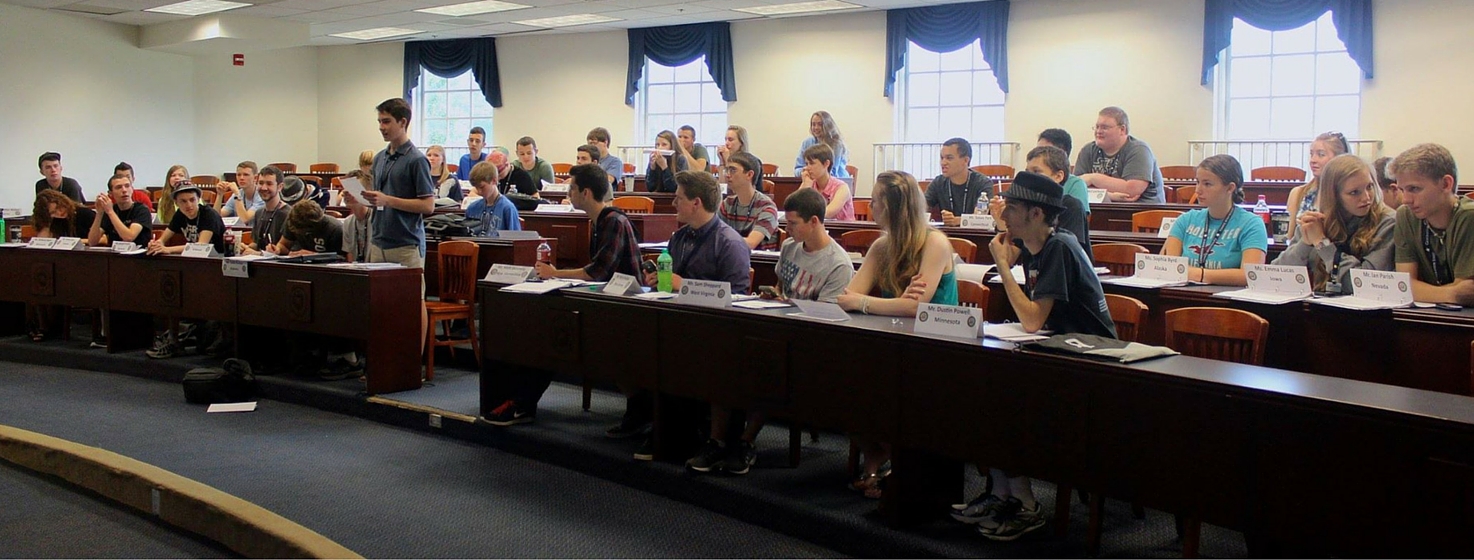
The Vision of Generation Joshua is to assist parents to raise up the next generation of Christian leaders and citizens, equipped to positively influence the political processes of today and tomorrow.
Author: Melody Sheppard
-
Discount on Noah Conference
Are a crazy schedule and a hostile but enticing culture making it hard to stay connected to your kids?
Join families from across the country for the Noah Conference in Cincinnati on August 19 & 20 — just a short drive from the new life-size Ark Encounter and the Creation Museum. Based on lessons from the life of Noah, the Noah Conference will prepare you to Engage your kids, Disciple them in an ungodly generation, Launch them into life as ambassadors of Jesus Christ!
Watch the Noah Conference Trailer
Friends of CHEWV registering by June 15th will receive a special discount of over 30% off full-price admission. (Use discount code CHEWV)
Ken Ham, Kevin Swanson, David & Jason Benham and their father, Flip Benham, Scott Brown, Erik Weir, Steve Riddell, Dave Tucker, and more!
Event Features
- LifeLaunch Track: How to launch into life NOW with clear vision, through one-on-one mentoring relationships and real-life application.
- Dinner with the Benhams: Share a mouth-watering barbecue dinner with the Benhams as they share how they were prepared to thrive like Daniel in today’s Babylon.
- Creation Museum: Attend the Creation Museum for only $10 per person for a 2-day pass!
- Live Entertainment: Ready for some good old-fashioned toe-tappin’ family fun? Enjoy live music from the award-winning Stockdale Family Band and other musicians.
- Free Pizza Party! Don’t miss out on the Saturday Evening Pizza Party – everyone’s invited!
View the full conference schedule: Noah Conference Schedule
Pricing
Remember to use coupon code CHEWV and register by June 15th to receive over 30% off!
Individual Tickets: $139 $85 (Includes Ark Encounter Admission*)
Family Tickets: $349 $239 (Includes Ark Encounter Admission*)
* Normal Ark Encounter Pricing: $40/adult & $28/child (ages 5+)
-

Legislative Session Wrap-Up
A Brief Overview of the 2016 Legislative Session
HB 4175 created a positive change in the West Virginia homeschool exemption.
Considerable effort was needed to secure passage. HB 4175 was deliberated extensively in both the House and the Senate before the “Modernization Bill” was passed by both Houses and sent to the Governor for his signature.The Tim Tebow Bill was passed by the Senate early in the session. SB 105 was not taken up in the House because it lacked support in the House Education Committee. Instead, a Resolution was passed by the House Education Committee which called for a study during the Interim session. This study could result in a recommendation that the legislature support the Tim Tebow during the 2017 Regular Session.
HB 4014, the Stop Common Core Bill, was passed on the last day of the session. HB 4014 was a positive step forward by removing West Virginia from the testing consortium which currently governs testing in West Virginia. The Governor has 15 days in which to decide if he will veto HB 4014.
HB 4012 – The Religious Freedom Restoration Act passed overwhelmingly in the House. Then on the Senate floor, Senator Palumbo introduced an amendment, supported by the Majority leader Mitch Carmichael, that gutted the legislation. Supporters of Religious Freedoms could no longer support the bill and it was killed. What was learned from this effort will be discussed in a soon-to-be-released report.
The following bills did not gain consideration by a committee in either legislative body.
HB 4215 and SB 316 – Which would remove the GED requirement in order to receive the Promise Scholarship.
SB 292 and HB 4242 – Which would provide for a tax credit for homeschooling educational expenses.
HB 2258- The Parent’s Bill of Rights which would define parental rights as a fundamental right.
Thank you to everyone who communicated with their legislator to encourage passage of these bills supporting our freedoms. Thank you to Mike Donnelly of HSLDA for his tireless efforts and expertise on behalf of homeschooling families.
Thank you to Delegate Brian Kurcaba and Senator Robert Karnes for all their hard work, as well as House Education Chairman Paul Espinosa and Senate Education Chairman Dave Sypolt.
-
Revised Law Explained
WV homeschooling families have been blessed by the 2016 legislature’s passage of a revised homeschool law. But many are asking, “What does it all mean?” We’re in the midst of assessment season, so allow us to share a few details of the revised law:
- The law does not take effect until 90 days after it was passed. It was passed February 23rd, so effective date is May 23, 2016.
- Annual assessments are required of every student annually, exactly as before. And the assessment choices are exactly the same. What is different now? Assessments will not have to be submitted to the county boards of education every single year, but only for students in designated grades (see below). Therefore, CHEWV recommends that you continue with the assessment choices you’ve already made for this year.
- The prohibition on parents testing their own children remains in effect until May 23rd, 2016. After that, administrators must be qualified in accordance with the test’s published guidelines.
- You, the parent, are responsible for keeping complete copies of your child(ren)’s academic assessment(s) on file at home for at least three years.
- Assessments must be turned in by June 30th for students in 3rd, 5th, 8th and 11th grades. Note that the deadline is exactly as before.
- CHEWV will provide more information about assessments in the coming weeks. For those who test with us, our Report to the Superintendent will reflect the changes. Our website will help you switch your attention to the stanine score when considering your legal responsibilities.
- And finally, the remediation requirement and the “additional evidence” requirements are still in place – exactly as before! Those requirements are unrelated to whether you must turn in assessments this year. If your child does not make acceptable progress this year for the second consecutive year, your must give the county additional evidence of appropriate instruction – regardless of what grade he or she is in.
- For those who may be pulling students out of public or private school, the two-week waiting period will no longer be in place after May 23rd, 2016. Once these changes go into effect, the notice of intent must still be given to your County Board of Education on or before the date home instruction is to begin.
- HSLDA has confirmed that everyone should submit one more Notice of Intent with the information required in the revised law. Going forward, the NOI would only be needed for each additional child who is starting to homeschool, or when changes as specified in the law apply.
- The revised law no longer mentions a plan of instruction.
There are other details in the law’s 2016 revisions. We urge you, first of all, to read the law for yourself, which is your duty and privilege as a citizen. The actual wording of the law’s changes can be found HERE.
As always, if you have additional questions, please feel free to contact us. If you are a member of HSLDA, you can get legal interpretation and help there. Please be patient with us! Christian Home Educators is working hard to provide accurate information to parents and will continue to update our website over the upcoming weeks to reflect the 2016 changes in the law.
We hope you will rejoice with us in God’s goodness and remember that greater liberty is always accompanied by greater responsibility. On the one hand, we’re blessed to take advantage of new freedoms where our reporting requirements are concerned. On the other hand, we must also prepare ourselves to take the responsibility entrusted to us and honorably comply with the changes to the law that God has helped us to achieve.
Note: This should not be construed to be legal advice. For legal advice, we recommend membership in the Home School Legal Defense Association.
-
Next Stop-Governor’s Desk
HB 4175 will be on the Governor’s desk Thursday. We should know by next Wednesday if he is going to approve HB 4175 the Home School Modernization Bill.
Three signatures have to be collected from both the House and the Senate prior to being sent to the Governor and then he will have 5 days to make his decision.
If the bill is approved it will become effective 90 days from when it passed the legislature, not from when it is signed by the Governor. Bill passage was on February 23, which would make the bill effective on May 23, 2016.
If you would like to express your support for HB 4175 contact the Governor:
Contact Page here!
A simple is all that is needed: “Please support HB 4175, the Home School Bill.”In the event of a governor veto, there is plenty of time to override before the session ends on March 12. A simple majority is needed in both Houses for an override of a governors’s veto in West Virginia.Overview
The new law would improve what is among the most burdensome homeschooling regimes in the country by easing unnecessary bureaucratic requirements on families and school districts.
For example, in West Virginia academic assessments must be submitted annually to the local public school superintendent, but only nine other states require that all homeschool families submit assessments to the authorities. The proposed law would require a family to submit assessments less frequently—only in grades 3, 5, 8 and 11. (All four assessments are still acceptable under the new law.)
Under the proposed law, the annual notice of intent instead would only be submitted upon starting or stopping homeschooling, or if a family moved. The new law would also eliminate what HSLDA has called an unconstitutional 14-day waiting period that parents removing a child from the public schools had to abide by before starting home education. This waiting period has been a burdensome requirement, especially for parents with children having difficulty in the institutional school environment.
The new law would lower the minimum score required to demonstrate adequate progress on standardized tests from the 50th percentile—an unreasonably restrictive score—to around the 23rd percentile. Other states that have minimum test scores set the threshold for acceptable progress in the 13th–30th percentile range.
Due process protections in the new bill would make it harder for school districts to put up roadblocks for parents interested in homeschooling or in harassing those who already are. The proposed law would clarify that homeschoolers are not subject to truancy prosecutions and would also require a superintendent to have probable cause before seeking an order to deny home education.
Making the law simpler will allow families to homeschool with fewer bureaucratic requirements. HSLDA and CHEWV believe that parents are best equipped and empowered to make decisions about how their children will be educated, and this new law takes some big steps in that direction.
Reading the bill will answer most of your questions. Read the final version of HB 4175 HERE.
HSLDA will be supplying a legal analysis in the coming weeks after the bill becomes law.
-
HB 4175 Freedom Bill
On Tuesday, February 23, the West Virginia Legislature sent a homeschool freedom bill for signature to Governor Earl Ray Tomblin.
With Tomblin’s signature, West Virginia will join the ranks of over a dozen states which, in the past decade, have rolled back burdensome regulations on homeschooling families. To see how homeschooling regulation has changed, read this HSLDA article.
Last year Governor Tomblin vetoed a similar bill. In West Virginia, the legislature can override a governor’s veto by a simple majority. However, because the legislature had adjourned, it had no chance to override the governor’s veto—a fact which made the outcome seem like a missed opportunity given the overwhelming majority by which the bill had passed. (This year’s homeschool freedom bill enjoyed similar support, passing 80–18 in the House and 26–6 in the Senate.)
Making changes to a longstanding law requires concentrated effort and support from outside and within the legislature. Senator Robert Karnes and Delegate Brian Kurcaba have been the prime sponsors of this bill since the 2014 session when it was first introduced. Their efforts were supported by state organizations including Christian Home Educators of West Virginia (CHEWV) and West Virginia Home Education Association (WVHEA). HSLDA attorney Michael Donnelly and CHEWV legislative liaison John Carey invested many hours in contacting legislators and shepherding the bill through the various committee processes.
https://youtu.be/QiIOTZn2WH8
Big Step Forward
The new law would improve what is among the most burdensome homeschooling regimes in the country by easing unnecessary bureaucratic requirements on families and school districts.
For example, in West Virginia academic assessments must be submitted annually to the local public school superintendent, but only nine other states require that all homeschool families submit assessments to the authorities. The proposed law would require a family to submit assessments less frequently—only in grades 3, 5, 8 and 11.
Under the proposed law, the annual notice of intent instead would only be submitted upon starting or stopping homeschooling, or if a family moved. The new law would also eliminate what HSLDA has called an unconstitutional 14-day waiting period that parents removing a child from the public schools had to abide by before starting home education. This waiting period has been a burdensome requirement, especially for parents with children having difficulty in the institutional school environment.
The new law would lower the minimum score required to demonstrate adequate progress on standardized tests from the 50th percentile—an unreasonably restrictive score—to around the 23rd percentile. Other states that have minimum test scores set the threshold for acceptable progress in the 13th–30th percentile range.
Due process protections in the new bill would make it harder for school districts to put up roadblocks for parents interested in homeschooling or in harassing those who already are. The proposed law would clarify that homeschoolers are not subject to truancy prosecutions and would also require a superintendent to have probable cause before seeking an order to deny home education.
Making the law simpler will allow families to homeschool with fewer bureaucratic requirements. HSLDA believes that parents are best equipped and empowered to make decisions about how their children will be educated, and this new law takes some big steps in that direction.
Read the final version of HB 4175 HERE.
-

Can Parents Be Trusted?
Mike Donnelly, attorney for HSLDA, has been present at committee meetings involving the passage of HB 4175 the Homeschool Modernization Bill. Last Thursday the Senate Education Committee briefly discussed the bill in the short time left towards the end of the meeting. These were Mr. Donnelly’s thoughts on the brief discussion:
I listened with some incredulity as one Democrat legislator (Senator Beach) criticized the bill because it might possibly allow “Hungarian parents who don’t speak English and who aren’t citizens yet” to homeschool?! Senator Romano appeared very skeptical about trusting parents to educate their children without annual state oversight. He even joked—at least I hope he was joking—at one point that maybe homeschooling should be eliminated as an option.
In spite of this rhetoric from opponents of the bill, the main concern for a number of committee members appeared to be a sense of queasiness about not requiring parents to have some kind of public school-approved qualification (e.g. high school diploma or GED) in order to be able to home educate their own children.
While it is true that most parents do have a state-issued high school diploma or the equivalent, there are many who do not—and as we graduate more homeschoolers (who don’t have state-issued diplomas) that number is increasing. These parents also include Amish parents who may not have state-issued diploma due to religious reasons or even parents who have previously dropped out of high school but have still gone on to gain significant life experience; neither of these groups should be automatically barred from homeschooling just because they lack a state-issued high school diploma.
West Virginia is one of only eight states that requires all parents to have a state-issued diploma or equivalent in order to exercise the fundamental constitutional right to direct the education of their children by homeschooling.
I am working with concerned members of the committee to find a solution that addresses these concerns but recognizes that lacking a state-issued high school graduation credential shouldn’t be an automatic and absolute bar to home education.
Unfortunately, the committee adjourned without a final decision as amendments were being offered to the bill. It is expected that the committee will consider the bill again at the next meeting. I plan to be there again to encourage the committee to pass the bill.
HB 4175 is on the Senate Education Committee agenda Feb. 16 at 2:00 p.m. Now is the time to contact the senators on this committee and give your testimony that homeschooling in the Mountain State is a legitimate and successful option for thousands of students.
If you can, please take a moment to thank Senator David Sypolt, the committee chairman, for moving the bill through the committee as expeditiously as the process allows.
Committee Chairman: dave.sypolt@wvsenate.gov;
Other Members of the committee:
donnaboley@suddenlink.net;
bob.beach@wvsenate.gov;
Mitch.Carmichael@wvsenate.gov;
sue.cline@wvsenate.gov;
robert.karnes@wvsenate.gov;
william.laird@wvsenate.gov;
mike.hall@wvsenate.gov;
robert.plymale@wvsenate.gov;
mike.romano@wvsenate.gov;
ron.stollings@wvsenate.gov;
drtomtakubo@gmail.com;
charles.trump@wvsenate.gov;
john.unger@wvsenate.govPlease send them this message in your own words:
Dear Senator,
I am asking you to pass H.B. 4175 out of the Education Committee without further amendment. H.B. 4175 makes common-sense reforms to West Virginia’s antiquated homeschool law by eliminating unnecessary bureaucracy faced by families as well as school districts. Homeschooling parents have demonstrated that they are able to produce exceptional academic and social results without state oversight. More than a dozen other states have passed similar legislation recognizing home education achievement over the past 30 years.
I understand that some members of the committee have raised concerns about removing the requirement that a parent have a high school diploma or GED. West Virginia is one of only eight states that requires a parent to show a state-issued credential in order to exercise their fundamental constitutional rights. There are some parents, such as those who were homeschooled in West Virginia or in other states, Amish families, and those who chose to drop out of school but have gone on to gain sufficient life experience and knowledge, who should not be automatically and absolutely barred from home education. Research and practical experience over the decades have shown that that there is virtually no relation to how well a homeschooled student performs and the parents’ education or credentials.
West Virginia parents can and should be trusted to make educational decisions for their children without unnecessary bureaucratic obstacles. H.B. 4175 is step in that direction. Please vote for H.B. 4175 without further substantive amendment. Thank you for your service to the families of West Virginia.
For further background of this bill, please see other News Articles on the CHEWV website which explain the background of this bill.
-
Senate Action for HB 4175
Homeschool Modernization at Stake in Senate Committee!
Dear HSLDA Members and Friends,
As you know, last week the West Virginia House overwhelmingly voted to modernize West Virginia’s homeschool law with the passage of H.B. 4175. On Tuesday, February 16, we expect the Senate Education Committee to take up the bill. I plan to be there to answer any questions that may come up.
HSLDA’s position is that reporting test results to the school authorities is unnecessary, but we are supporting the House’s version of the bill that will require homeschooling families to submit four assessments in grades 3, 5, 8, and 11 over the course of a student’s career.
H.B. 4175 will move West Virginia’s homeschool law closer to the norm in our country. Many states have acted in the past 10 years to modernize their homeschool regulations to ease unnecessary bureaucracy for families and school districts.
Members of the Senate Education Committee need to hear from you this weekend! Please ask them to pass H.B. 4175 without amendment. Here are their email addresses:
dave.sypolt@wvsenate.gov
donnaboley@suddenlink.net
bob.beach@wvsenate.gov
Mitch.Carmichael@wvsenate.gov
sue.cline@wvsenate.gov
robert.karnes@wvsenate.gov
william.laird@wvsenate.gov
mike.hall@wvsenate.gov
robert.plymale@wvsenate.gov
mike.romano@wvsenate.gov
ron.stollings@wvsenate.gov
drtomtakubo@gmail.com
charles.trump@wvsenate.gov
john.unger@wvsenate.govPlease send them this message in your own words:
Dear Senator,
I am asking you to pass H.B. 4175 out of the Education Committee without further amendment. H.B. 4175 makes common-sense reforms to West Virginia’s homeschool law by eliminating unnecessary bureaucracy faced by families as well as school districts. Homeschooling parents have demonstrated that they are able to produce exceptional academic and social results without state oversight. More than a dozen other states have passed similar legislation recognizing home education achievement over the past 30 years.
As a parent it is my responsibility to decide how my children are educated. H.B. 4175 was amended to address reporting requirements and should be passed without further amendment. West Virginia parents can and should be trusted to make educational decisions for their children without intrusive or unwarranted bureaucratic obstacles. H.B. 4175 is step in that direction.
Please vote for H.B. 4175. Thank you for your service to the families of West Virginia.
To get additional contact information for these committee members click here.
Background:
H.B. 4175 modernizes West Virginia’s homeschool law and brings it more in line with the trend in homeschooling regulation in the past decade. Over a dozen states have made common-sense reforms to remove unnecessary and unwarranted burdens from parents who choose home education for their children.
The bill reduces bureaucracy by requiring a one-time notification and submission of assessment results four times over the course of a student’s career. The law clarifies that testing may be administered by anyone qualified by the test publisher and does not exclude the child’s primary instructor from administering the tests (e.g. the student’s parent in most cases).
The bill also clarifies a common misunderstanding that children who are starting home education, as long as they have filed the proper paperwork, are not “truant”—nor are they status offenders under the abuse and neglect code. The bill thus reduces the amount of paperwork that must be submitted to the school district.
Parents who are unable to provide evidence of their high school diploma or GED (either because they lost it or because they were homeschooled and were never issued one) would not be prohibited from home education.
I am also very pleased that the law would remove the unconstitutional 14-day waiting period that has been a significant barrier for parents seeking to start homeschooling—especially when there are problems with the school their child is attending. No parent should have to wait 14 days to exercise their constitutional rights to homeschool.
Standing with you for Liberty,

Staff Attorney
P.S. We greatly value you and your support—it is a privilege to serve you! If you or someone you know is not a member of HSLDA, will you consider taking a moment today to join or recommend us? Your support for our work enables us to defend individual families and protect homeschooling freedom for all.
-
HSDC – A Blessing and Responsibility
Homeschool Day at the Capitol – A Blessing and Responsibility
Undeterred by the historic winter storm Jonas, homeschoolers from around West Virginia converged on Charleston for Homeschool Day at the Capitol on January 25th, including a number of parents with children and babies in tow who joined us for the first time. The day offered a valuable opportunity to connect with state legislators, meet new homeschool families, and showcase the musical talent of our homeschooled children. But for some of us, the highlight of the day was observing the House Education Committee meeting, which focused on legislation advocated by CHEWV, the Homeschool Modernization Bill.
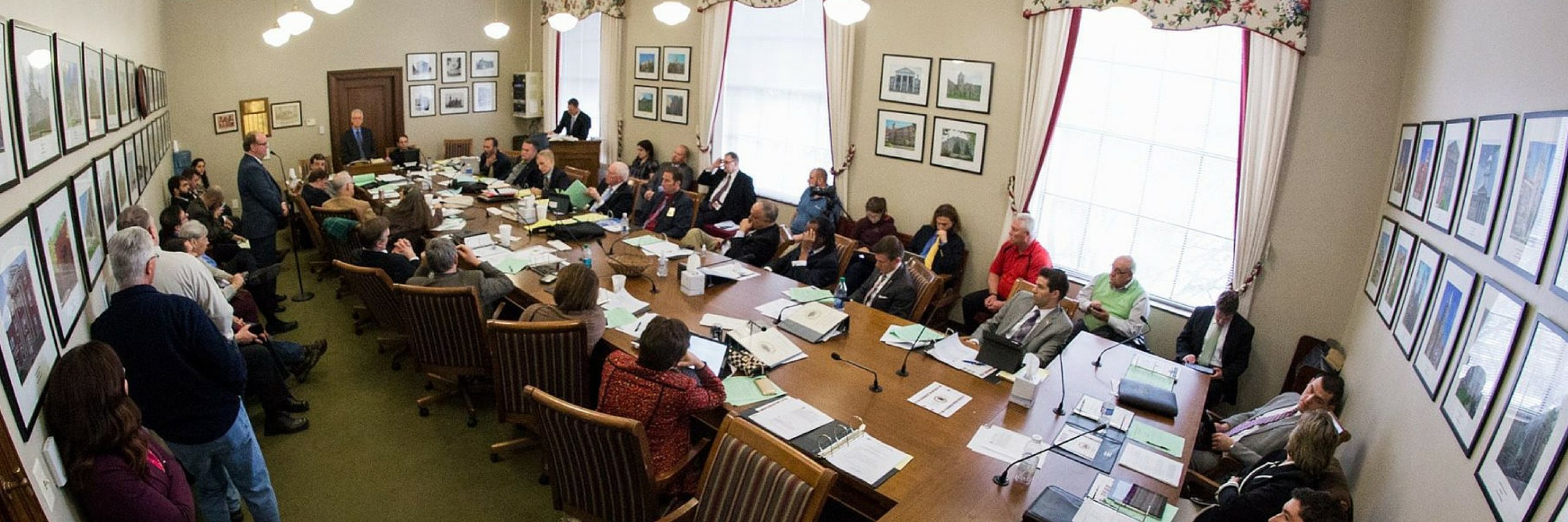
Watching the House Education Committee discuss the Homeschool Modernization Bill was both a fascinating and frustrating glimpse into the democratic process. For much of the hour-long meeting, Monongalia Delegate Brian Kurcaba, the bill’s lead sponsor, along with the committee’s legal counsel, explained the purpose of the bill and fielded questions from other legislators. By the end of the meeting, we drew three lessons:
It’s important to show up. Woody Allen famously said that 80 percent of life is showing up. In the state legislature, at least, showing up has an impact. At the House Education Committee meeting, homeschooling families filled every available seat for the public and stood along the walls, overflowing out of the room. After the meeting, families expressed their gratitude to supportive legislators, and respectfully addressed misconceptions by opposing legislators. Our presence was impossible to ignore, and it sent a message.
We still have work to do. Despite a growing and uncontroverted body of empirical research showing the holistic merits of homeschooling, many legislators expressed remarkable ignorance about our constitutionally protected educational choice. We heard tired stereotypes about socialization, irrational fears about truancy, and unsupported claims about teacher qualifications, among other disappointing comments. Thankfully, within the committee itself, these views represented the minority position. The minority, however, was vocal, and it reminded us that we all must stay engaged in the democratic process by communicating our views to legislators and making well-informed decisions about voting.
CHEWV is making a difference. Apart from the legislators and the committee’s counsel, only one other person was recognized to speak at the House Education Committee meeting: John Carey, CHEWV’s legislative liaison. John, representing CHEWV and the state homeschooling community with great poise and effectiveness, has played a significant role in advancing pro-homeschool legislation for over 15 years. CHEWV’s active involvement in Homeschool Day at the Capitol has also bolstered support from other legislators. For example, at last year’s event, we joined fellow Harrison County CHEWV members to meet one of our local Delegates, Patsy Trecost. We introduced ourselves, took pictures and encouraged Delegate Trecost, a Democrat, to support our pro-homeschool legislation. Delegate Trecost voted for our legislation in 2015. This year, he not only co-sponsored the modernization bill but also enthusiastically greeted homeschool families at the rotunda during our afternoon event.
Overall, Homeschool Day at the Capitol was, once again, a memorable and worthwhile experience. We all enjoyed observing the legislative process and fellowshipping with other homeschool families throughout the day. It reminded us of both the blessing and responsibility of living in America. It also made us look forward to the day when, God willing, some of the seats in the legislative chambers will be filled by homeschool graduates!
-
Time Out for Tim Tebow Bill
February 4, 2016
SB 105 (Tim Tebow Bill) was discussed today in the Senate Education Committee. Members of the committee heard homeschooler, Beth Penn, speak on behalf of WV homeschoolers and then the Executive Director of the SSAC gave his reasons for opposition of the bill. The SSAC voiced two main concerns: assuring that the homeschoolers would meet the 2.0 eligibility rule and the lack of public school funding.The SSAC did not believe that homeschoolers would be able to convincingly prove students were eligible based on a homeschool transcript. The Executive Director was joined by a representative from the WVDOE who affirmed that public schools only get funding for students who attend. Therefore, providing equipment, transportation, etc. for a homeschool student would be a financial burden on the school.
Senator Plymale asked for recommendations to be presented that would enable the home school student to participate in public school athletics using the same criteria as public school students. He stated that homeschoolers are WV citizens and should be given the chance to participate.
The Chair, Senator Sypolt, agreed with Senator Plymale’s recommendation and requested that criteria be presented at the next Senate Education meeting. Senator Karnes made the point that home school parents pay not only for the education of their children but also for the sports program of their local high school, although they are prevented from participating in it.
No vote was taken. This was a very positive first meeting for the Tim Tebow bill.