Category: News

  • Thank you, Mr. Jefferson!

    Thank you, Mr. Jefferson!

    by John Carey, CHEWV’s Legislative Liaison

    We hold these truths to be self-evident, that all men are created equal, that they are endowed by their Creator with certain unalienable Rights, that among these are Life, Liberty and the pursuit of Happiness.

    The Declaration of Independence

    When the Founders of our nation claimed our rights to be inalienable, they thought it was settled.  After all, what is bigger than nature and nature’s God?  Clearly the Founders embraced the idea that transcendent, or absolute, truth can be known and lived out in the world.  They were not cultural relativists. They knew that all theories of government did not take us to the same place nor have equal value.  They had over 1000 years of English history to know that this was true.  They constantly made it their mission to seek out the best ideas – and, boy!  Did they make a difference!  They created the Bill of Rights, the U.S. Constitution, and nearly 200 years of freedom – a track record never equaled in the world.

    It’s important that we remember that Thomas Jefferson was not a relativist, either.  He did not believe in the equal validity of all ideas.  Whatever else you believe about him, this fact cannot be denied.  His efforts to embrace the best ideas eventually led to what he believed were the three greatest achievements of his life:  the establishment of the University of Virginia, the Declaration of Independence, and the Statute of Virginia for Religious Freedom. 

    In January of 1777, in Fredericksburg, Virginia, thirty-four-year-old Thomas Jefferson met with a small group of friends to draft what would become the Bill to Establish Religious Freedom in Virginia.  First introduced into the Virginia General Assembly by Jefferson in 1779, the bill became law in 1786.  A portion of this bill was extracted verbatim and inserted into the Religious Freedom clause of the West Virginia State Constitution.  Thus it is no exaggeration to say that Thomas Jefferson authored West Virginia’s religious freedoms.

    Here are the words of Thomas Jefferson as recorded in the WV State Constitution:

    “No man shall be compelled to frequent or support any religious worship, place or ministry whatsoever; nor shall any man be enforced, restrained, molested or burthened, in his body or goods, or otherwise suffer, on account of his religious opinions or belief, but all men shall be free to profess and by argument, to maintain their opinions in matters of religion; and the same shall, in nowise, affect, diminish or enlarge their civil capacities.”

    So what impact have Jefferson’s writings had on Religious Freedom in West Virginia? 

    Jefferson’s writings were cited by WV Circuit Judge J. Harold Brennan in the 1940’s to rule contrary to a U.S. Supreme Court decision previously used to force parents to comply with a West Virginia School Board regulation. In other words, the West Virginia court found greater support for religious liberty embedded in West Virginia’s State Constitution than in the U.S. Bill of Rights. (The details of this case can be found here.)

    WV Protections Stronger than the Bill of Rights – Judge Brennan’s comments

    The West Virginia Constitution provides that “no man shall be compelled to frequent or support any religious worship, place of ministry whatsoever; nor shall any man be forced, restrained, molested or burthened, in his body or goods, or otherwise suffer, on account of his religious opinions or beliefs….”  Citing this provision, Judge Brennan held that, “it would be difficult to maintain that a court has the right to fine or imprison a man because he will not force his child to do a positive act wholly inconsistent with the religious beliefs of them both.”  Judge Brennan relied on the West Virginia Constitution to safeguard religious liberties that were not protected by the Bill of Rights.

    Conclusion

    We can be thankful that Jefferson was not a cultural relativist. His courageous and uncompromising commitment to truth is blessing West Virginians even today.

    In 1789 Thomas Jefferson wrote to his friend David Humphreys, “There are rights which it is useless to surrender to the government and which governments have yet always been found to invade.  These are the rights of thinking and publishing our thoughts by speaking or writing; the right of free commerce; the right of personal freedom.”

    Jefferson knew that besides securing a law to uphold religious liberty, protections would need to be put in place to limit the power of the state so that it could not “invade” the rights of the people.  Today, we have the freedom – even the duty – to not only acknowledge and exercise our religious liberty, but to do all we can to secure that liberty for our children and their children.  Clearly, our Founding Fathers not only embraced the idea that absolute truth can be known and can be lived out in the world, but they spent their life choosing to do so. We must now do the same.


  • The Changing Face of Testing

    The Changing Face of Testing

    Stanford Publisher Among Those Providing
    Common Core Materials

    No Child Left Behind (NCLB) legislation precipitated a major shift in testing when it was signed by President Bush in 2002.  Prior, annual testing was primarily via standardized achievement tests, which were designed to measure a student’s academic knowledge compared with other students nationwide. Achievement tests were also nationally-normed so that a particular curriculum or student background would not statistically affect the comparison scores.

    In stark contrast, the stated purpose of NCLB testing was to assess mastery of specific curriculum content.  NCLB required states to develop standards – i.e., specific subject content – for teaching, then assess by means of content-based exams such as the WESTEST whether those standards had been met.  Although in and of itself this was not bad, tests like the WESTEST were far different from previous achievement tests because they intentionally tested the specific material covered in a given state’s public school classrooms.

    Since these new tests were directly tied to receiving federal funds, they inadvertently drew attention and funds away from the traditional and reliable nationally-normed standardized tests.  Educators knew the value of achievement tests, but federal funding largely dwarfed their use.

    As a result, the publishers of these expensive-to-produce nationally-normed tests suffered a shrinking market and published fewer updated versions. The combination of our state law’s assessment requirement and its ten-year publishing/norm date stipulation made this turn of events a WV homeschool issue. 

    For example, Pearson, publisher of the Stanford test, announced last year that they would no longer provide and support the Stanford 10 test. While Pearson subsequently changed its mind, the most recent Stanford version was normed in 2007, which means this is the last school year it can be used by WV homeschoolers. Pearson could choose to re-norm it or publish a newer version, but that doesn’t seem likely.

    For the economic reasons described, test publishers must decide whether to continue offering the expensive-to-produce achievement tests or to compete in the Common Core market instead. Pearson was awarded a contract in 2014 to administer tests aligned with the Common Core Standards, a project described as being of “unprecedented scale” in the U.S. testing arena. The contract is associated with the Partnership for Assessment of Readiness for Colleges and Careers, one of two main consortia of states creating exams to match Common Core State Standards (the other being Smarter Balanced, in which WV participates). Under the contract, Pearson will develop test items, paper-and-pencil tests, and computerized tests that align with CCSS. Pearson appears focused on Common Core rather than the traditional achievement testing that gave rise to their Stanford test. Pearson has recently lost some state contracts; whether this development keeps the traditional Stanford on their radar screen is still to be determined.

    What does all this mean?  It appears that most publishers of standardized tests are caving in to the Common Core market.  Besides the difficulty of finding a recently normed standardized test, homeschoolers now have to work hard to find one that isn’t aligned with the Common Core Standards. Yet the landscape could change as a result of a growing, credible back-lash from dissatisfied educators, informed parents, and Constitutional conservatives against Common Core.  Nevertheless, because federal money continues to drive and fund Common core, the state-by-state pushback is slow to regain ground.  

    We expect that once the Stanford 10 is too old to use (after this year), the highly respected Stanford option will be gone for WV homeschoolers.  We do expect Pearson to soon offer an alternative standardized test, but it will likely be similar to WV’s new General Summative Assessment – which is basically a Common Core test rather than a traditional achievement test.  

    Right now, CHEWV is pleased that Riverside Publishing has decided to take a risk and keep their newest IOWA only partially aligned to CCSS and looking much like the traditional tests that have been trusted through the years.  CHEWV will continue to stay abreast, as much as possible, with what is happening in testing.  Among the tests available which satisfy our state law, we are committed to providing the best testing option possible to West Virginia homeschooling families.

  • Common Core’s Effect On Homeschoolers

    Common Core’s Effect On Homeschoolers

    While the federal regulation leading to Common Core started way back in 2001, the actual Common Core State Standards were birthed by the Gates Foundation in 2008.  Since then, Common Core has changed education, elicited backlash, and sparked controversy.  Still, the Common Core State Standards have continued to progress.

    Education was largely reserved for local municipalities and states from the inception of our nation – explaining why homeschool laws differ from state to state. But the federal government became more involved with education in 1953 when President Eisenhower organized a new Cabinet department: Health, Education and Welfare.  Federal involvement again leapt forward when Jimmy Carter established the US Department of Education in 1979.

    Federal education bills date back to the 60’s.  The Elementary and Secondary Education Act (ESEA) of 1965 has been re-authorized by Congress about every five years since its inception.  When the act was reauthorized in 2001 under George W. Bush, it was dubbed No Child Left Behind (NCLB). Striving to ensure that all children in America would be educated equitably (none “left behind”), NCLB required each state to establish clear educational standards, ensure that those standards were taught, and then annually test students to demonstrate certain levels of student mastery.  Tests like the WESTEST were produced to demonstrate mastery of individual states’ standards.

    The percent of students mastering the material was expected to rise each year or federal funding would decrease. Suddenly, individual children’s needs took a back seat to meeting federal requirements; within a few years, several states were poised to lose their funding because not enough students were testing at mastery levels. These tended to be the poorest states, West Virginia included. They frantically scrambled to improve test scores, only to realize there was too much to accomplish in too little time.  As a result, West Virginia and other states hoped to either get new federal legislation with fewer requirements, or else standardize requirements in such a way that mastery requirements were attainable.  This need, common to several states, set the stage for a massive change – and a massive marketing strategy.

    In 2008, the Gates Foundation began development of the Common Core State Standards Initiative (CCSSI).  With universal state standards, a common test and corresponding curriculum could be marketed across many, if not all, states.  Every state would need and want the same things.  West Virginia adopted the Common Core State Standards (CCSS) in 2010 with full implementation to occur by the 2014-15 school year.  The WESTEST was subsequently replaced with a Common Core test (General Summative Assessment) developed by one of two national consortia.

    The CCSS Initiative proved to be incredibly profitable when in 2009 President Obama embedded a new program, Race to the Top, into the Stimulus Bill.  Race to the Top provided several billion dollars that poorer states could compete for if they would commit to adopting the Common Core State Standards.  This notable, frightening change in education essentially allowed the federal government to pay states to participate in a private enterprise. West Virginia, as a participant in RTT, is one of thirty-one states receiving federal grant money to replace paper tests with computer adaptive technology.

    This shift is a game changer on several levels. Whether the increasing amount of federal initiative in education is an improvement over the education previously driven by local concern and local teachers is hotly debated.  By all accounts it is changing the face of education nationwide by creating a national “one size fits all” scenario. Indeed, curriculum providers have since rushed to align their books with standards mandated by Common Core.  Since mastery of Common Core State Standards is the goal, the marketable curriculum must teach those same standards.  College entrance exams are following suit.  For example, Pearson, arguably the largest book publisher in the world, nearly retired its long-standing Stanford standardized test last year in order to focus funds on tests aligned with Common Core.

    Back in 2012, CHEWV voiced concern over whether the Common Core State Standards would affect curriculum, standardized tests, and college expectations. Common Core has in fact affected at least two of those three in the interim. Homeschooling parents now ponder how CCSS may impact how homeschoolers are accepted into and flourish in college.  Some worry that if they teach traditional and Christian curriculum that does not align with CCSS, their children may be disadvantaged when CCSS drive college admission. Still, there is no evidence thus far that homeschoolers are scoring lower on college entrance exams since these changes began.  To the contrary, homeschooled students scored higher on the SAT college entrance exam in 2014 compared with the national average.

    Although CCSS have not negatively affected college-bound homeschool students to date, will Common Core adversely affect homeschoolers in the future?  We suspect that the superior education that homeschoolers receive (on statistical average) compared with public education will prove to insulate them.  Some homeschool leaders indeed project that homeschool students will do even better by comparison in this environment. Although that’s yet to be determined, it seems safe to assume that as we educate our children for God’s glory, the Lord will provide!

    For more information about Common Core, visit http://www.hslda.org/commoncore/. For how WV homeschoolers are faring compared with their public school counterparts, see CHEWV’s report at https://new.chewv.org/Study_Brochure5.pdf.

  • On Socialization, Elections, and Religious Freedom

    On Socialization, Elections, and Religious Freedom

    By John Carey, CHEWV’s Legislative Liaison/Lobbyist

    As you consider the upcoming election, it is important to support those who not only stood up for your freedoms by advancing positive home school legislation but also promoted bills that strengthen parental rights and religious liberty.

    Legal protection of homeschooling is built upon two pillars:  parental rights and religious liberty.  If we ever lose the fight for religious freedom, we will find ourselves unable to stop laws which wrest control of home education away from parents and place it in the hands of government agents.  We must consider the actions of officials at the local, as well as national level, as they relate to religious liberty.

    During the 2016 regular legislative session, as many of you will recall, Delegate Hornbuckle proposed an amendment that would have required homeschool students to undergo diversity instruction by periodically requiring “public school visits and activities” to “enhance social skills and tolerance for others with different beliefs or backgrounds.” 

    But it does not stop at one WV legislator.  Recently HSLDA reported that U.S. Department of Education Secretary King has also expressed his concerns about the social development of homeschool students.  King worries that “students who are homeschooled are not getting the kind of rapid instructional experience they would get in school” unless parents are “very intentional about it.”  King said the school experience includes building relationships with peers, teachers, and mentors—elements which he believes are difficult to achieve in homeschooling.

    If that is true, if students get an excellent social development experience in public school, where is the proof of it?  Are America’s public school students known around the world for excellent social development?  How happy, content and self-assured are they?  Consider this:

    • Suicide is the SECOND leading cause of death for college-age youth and ages 12-181.
    • More teenagers and young adults die from suicide than from cancer, heart disease, AIDS, birth defects, stroke, pneumonia, influenza, and chronic lung disease COMBINED2.
    • Each day in our nation on average, over 5000 young people grades 7-12 attempt suicide3.

    Tragically, a child in a West Virginia elementary school recently committed suicide, and perhaps because of bullying4.

    It has been my observation that many parents homeschool primarily because they are concerned about proper social development.  They want their kids to grow up with a solid self-image and gain essential social skills.

    It would seem that there is another reason that King and Hornbuckle want our kids exposed to public school.  This can be seen in the second justification that Delegate Hornbuckle gave for his committee amendment: “tolerance for others with different beliefs or backgrounds.”  Secularists who share the worldview of Secretary King and Delegate Hornbuckle do not want parents, especially Christian parents, directing the education of their own children because these parents teach that homosexual marriage is wrong and traditional marriage is right.  In their minds, to teach that this is the only way to look at life is to be intolerant. 

    Stepping back to view our culture, we can see that it is not Christians but the godless society around us that is becoming intolerant of those who believe that objective truth can be known and lived out in the world.  The traditional view of absolute truth is being replaced with “Cultural Relativism,” which says all cultural beliefs are good and must be appreciated.  Those who believe that there is a best way or a right way to live are quickly being defined as bigots.  This is why our children must be exposed to “different beliefs and backgrounds” as the Hornbuckle amendment mandated.  Yet Christian parents know this is not true.  Some ways of looking at life are very harmful, even destructive.

    Some ways of looking at life are very harmful, even destructive.

    On the floor of the Senate during the 2016 regular session, Senator Mitch Carmichael, in a tearful speech, gutted the West Virginia religious freedom bill in the final moments of the debate by, in effect, mandating that Christians who bake cakes or take wedding pictures be legally required to use those talents to affirm homosexual marriage – “or else.”  Consider if this proposal had been made law.  It clearly would have set a precedent for limiting religious freedoms in other areas as well.  Why not eventually homeschooling?

    A battle is raging all around the country, even in West Virginia, over religious liberty. For those of us who have chosen God’s Word as the sure foundation of our lives and families, the religious liberty purchased for us by America’s forefathers should be precious to us.  We must rise up to protect that liberty if we want to keep the right to direct the education of our children.

    If ideas which are counter to the Bible gain momentum in society, parents will eventually have no legal means to prevent their children from being indoctrinated in the name of the “greater good” of society.  And what is the greater good?  That all ways are equally acceptable.  To think otherwise is to be one who hates and is intolerant.  Instead, students in school should be encouraged to discover what is true and right, and what will enable them to be successful in life, just as homeschool students are already doing.  True success is never found in placing equal value on all ideas as Cultural Relativism mandates, but by embracing the best ideas – God’s ideas!  The LORD our Maker says, “For as the heavens are higher than the earth, so are My ways higher than your ways and My thoughts than your thoughts.”  (Isaiah 55:9)

    Anything contrary to the ways and thoughts of God puts men and women, girls and boys, in bondage.  Only the knowledge of the Truth of God’s Word will set us – and these children – free.

    Jesus said, “If ye continue in my word, then are ye my disciples indeed; and ye shall know the truth, and the truth shall make your free.”  – John 8:31-32

    It is for freedom that Christ has set us free.  Stand firm, then, and do not let yourselves be burdened again by a yoke of slavery.  – Galatians 5:1

    _______________

    1 https://www.jasonfoundation.com/prp/facts/youth-suicide-statistics
    2 Ibid
    3 Ibid
    4 https://www.washingtonpost.com/news/education/wp/2016/09/16/bullies-tormented-a-9-year-old-boy-relatives-say-it-may-have-driven-the-child-to-suicide/


    1. https://www.jasonfoundation.com/prp/facts/youth-suicide-statistics []
    2. Ibid []
    3. Ibid []
    4. https://www.washingtonpost.com/news/education/wp/2016/09/16/bullies-tormented-a-9-year-old-boy-relatives-say-it-may-have-driven-the-child-to-suicide/ []
  • Academy Nominations

    Academy Nominations

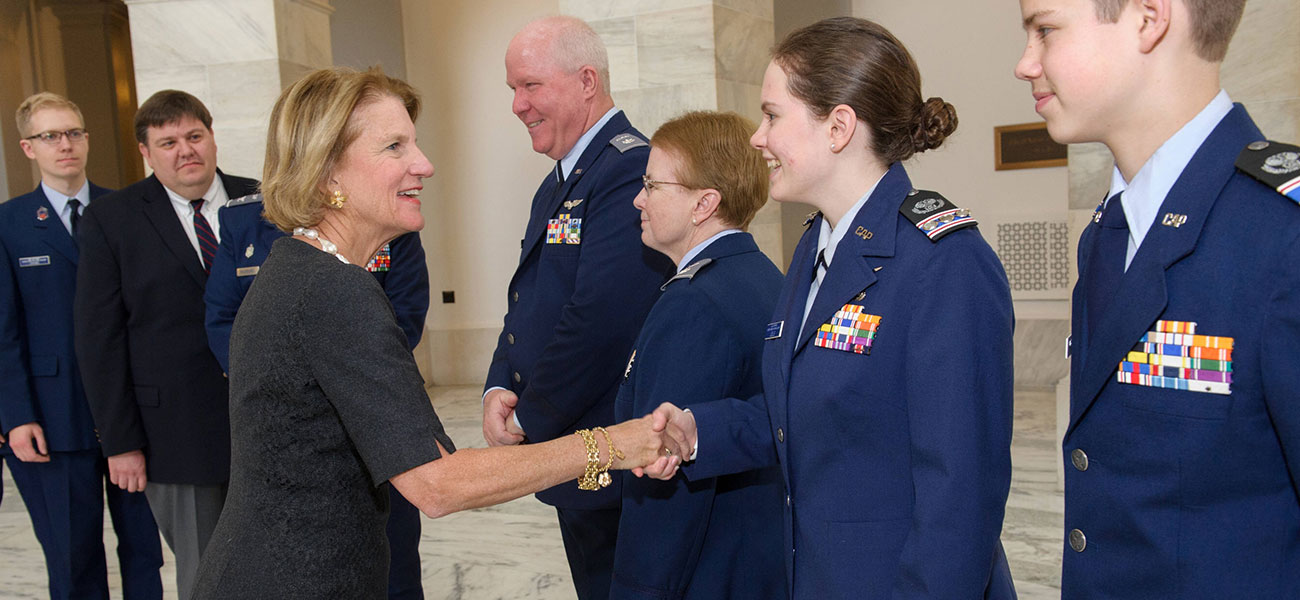
    Each year, one of my most important responsibilities as your Senator is nominating young men and women for admission to our country’s service academies.

    To be eligible, you must be:

    • A US citizen
    • A legal resident of the state of West Virginia (or a dependent of military members who are West Virginia residents)
    • Single; not pregnant, and without legal obligation to support children or other dependents
    • At least 17 years of age and not yet 23 years old on July 1 of the year you would enter an academy (25 years old for USMMA).

    Service academy applicants are eligible for nomination by both United States Senators in the state of their legal residence and the United States Representative for the District in which they reside as well as the Vice President. Applicants should apply for nomination to all applicable nominating sources.

    Admission to a service academy is a two-tiered process. First, the candidate must apply through the Academy directly. There are five (5) service academies that offer appointments to highly qualified individuals who meet eligibility requirements and are the most competitive in academic performance, physical fitness, medical standards, extracurricular involvement, leadership traits, motivation and aptitude for military service. You are encouraged to apply early to any and all service academies for which you have a sincere interest. You may apply online at the respective service academy web site. If you meet the minimum eligibility and entrance requirements, the academy will forward a formal application package. You should return all requested materials as directed by the academy as quickly as possible. If you are considered an “official” candidate by the academy, you will be scheduled for a medical examination by the Department of Defense Medical Review Board (DODMERB). You will also complete a Candidate Fitness Assessment (CFA).

    The second tier in pursuing admission is the Congressional Nominations process. An individual must meet the admissions requirements of the Academy as well as receive a nomination in order to be offered an appointment to the Academy. You do not need a Congressional Nomination for the United States Coast Guard Academy.

    The application for applying for a nomination from my office can be found HERE or the Application button below. The deadline for submitting completed applications is Tuesday, October 25, 2016 at 5 p.m. Postmarks are not sufficient.

    Senator Capito will host four Academy Days this fall for West Virginia students interested in learning more about admission to U.S. service academies and available ROTC scholarships. Members of Senator Capito’s staff will be available at each event to provide information on academy nominations.

    Senator Capito’s Academy Days are scheduled for the following dates:

    Charleston Area
    Date: Saturday, September 17, 2016
    Time: 2:00 – 4:00 p.m.
    Location: South Charleston High School
    Address: 1 Eagle Way, South Charleston, WV 25309

    Eastern Panhandle
    Date: Saturday, September 24, 2016
    Time: 2:00 – 4:00 p.m.
    Location: Spring Mills High School
    Address: 499 Campus Drive, Martinsburg, WV 25404

    Southern West Virginia
    Date: Sunday, October 2, 2016
    Time: 2:00 – 4:00 p.m.
    Location: Woodrow Wilson High School
    Address: 400 Stanaford Road, Beckley, WV 25801

    Northern West Virginia
    Date: Saturday, October 8, 2016
    Time: 2:00 – 4:00 p.m.
    Location: University High School
    Address: 131 Bakers Ridge Road, Morgantown, WV 26508
    Note: Larry Mullen, Deputy Chief of the Department of Defense Medical Examination Review Board (DoDMERB), is scheduled to attend this event.

  • Do Not Pass Go – Until You Enroll

    School officials in Hardy County, West Virginia, informed a Home School Legal Defense Association member family moving into the district that before they could begin homeschooling they had to first enroll their kids in public school.

     Although West Virginia homeschool law has historically been behind the times—it was not modernized by the legislature until this year—homeschooling families have never had to enroll their kids in public schools to be in compliance with the law.

    HSLDA has informed public school staff in Hardy County that they should update their communications with homeschooling families to accurately reflect West Virginia law.

    The idea that the public schools are the “default” institution for education remains deeply embedded in state institutions, however. The fight to modernize West Virginia’s homeschool law encountered fierce opposition from public education associations as well as from both Democratic and Republican lawmakers who held outdated, stereotyped and patronizing conceptions of homeschooling families.

    Ultimately the Republican-controlled legislature passed the legislation, and Democratic Governor Earl Ray Tomblin signed it.

    Much More Reasonable

    Before last year’s legislation, West Virginia’s homeschool law was among the more burdensome in the country. It required annual notification and annual standardized testing; each student was expected to score above the 50th percentile. The new law lowers this unreasonable requirement to the 23rd percentile.

    The new law also institutes a commonsense notification procedure: Families must notify the local public school district when they begin homeschooling, when they stop homeschooling, and when they move to a different county. And although annual assessments are still required, they must now only be submitted in grades 3, 5, 8, and 11 instead of every year. In pushing for this new law, HSLDA had argued that parents constantly assess their children and should not be required to submit results to the local authorities just because they are homeschooling.

    A majority of states require no submission of assessment results at all

    When laws change, there is always a certain amount of confusion among those who must enforce the law. However, school officials have a duty to be informed about their regulatory oversight and should not misinform those they serve.

    HSLDA is here to protect your freedom, defend you from unfair treatment, and help you homeschool with success. If you have questions or concerns about a local school official’s interpretation of the law, please give us a call at (540) 338-5600. Our staff of expert homeschool law attorneys and legal assistants are ready to help you understand what exactly is required to homeschool legally in your state.

  • Confused Counties Confusing Homeschoolers

    Confused Counties Confusing Homeschoolers

    Recently, CHEWV has been reporting on several counties’ attempt to “interpret” the revised law due to take effect on May 23.  HSLDA has been working to contact these counties and help them understand what the new requirements entail.  Here, HSLDA attorney, Mike Donnelly addresses the issue.

    Parents cannot assess their own children. If you turn in a late assessment, you can’t homeschool anymore. You must send us an outline of your plan of instruction.
    Mike Donnelly   Mike Donnelly, Contact attorney for West Virginia

    These are just a few of the more egregious errors contained in a Berkeley County policy recently released to homeschooling families there.

    With one of the largest reported populations of homeschooled students in the state, Berkeley County has had a reputation of being generally friendly towards homeschooling families. However, this new policy may indicate problems ahead—and not just for Berkeley County families. HSLDA has received reports from families in several other counties of school officials stating that they will not follow West Virginia’s new homeschool law or that they will enact their own policies based on their own preferences.

    West Virginia homeschool families have been anticipating many important changes scheduled to take effect on May 23. These changes are the result of years of effort to modernize the state’s homeschool law. Passed by the legislature in February and then signed by the governor, the new law removes burdensome requirements placed on homeschool parents. Among other things, the law now permits parents to administer standardized tests to their children and eliminates the requirement to outline a plan of instruction.

    Berkeley County’s “updated” policy, however, directly contradicts these specific changes to the law. Berkeley County’s “recommended” notice of intent form also requests much more information from families than the law requires.

    Discrepancies

    After obtaining a copy of the widely circulated documents from member families, HSLDA’s West Virginia legal team—staff attorney Michael Donnelly and legal assistant Jill Burcham—wrote to Berkeley County’s new assistant superintendent in charge of home education compliance. Among the policy discrepancies we listed was a “recommendation” that families continue to submit an annual assessment, despite the new law’s requirement that assessments only be sent to the superintendent’s office for grades 3, 5, 8, and 11. The district requested that homeschool notices be sent by July—a stipulation that does not appear in the law. The “recommended” notification also requested dates of birth and grades for each child, information explicitly not required by the new law. HSLDA requested that the assistant superintendent revise the policy and send out a corrected copy. We invited her to contact us if we could be of assistance.

    HSLDA expects more problems like this as school officials grapple with the new law. We have been informed that the State Board of Education has been working to educate local boards of education and attendance officers about the new law. Based on documents we have seen, we believe that the state board has been objectively and fairly characterizing the new law. However, because there are 50 individual counties, many of which are coping with staff change, we expect more counties either to send out incorrect or outdated information to homeschool families or to enforce the new law incorrectly.

    How can you help smooth this process? If you have any concerns about new policies that appear to be inconsistent with the new law, let us know immediately. We are prepared to take swift corrective action to assist in resolving confusion or concern relating to any issues between the county education authorities and our member families!

    HSLDA has been defending homeschooling freedoms for individual families and the entire movement since 1983. Our lawyers and legal assistants are all homeschooling parents or graduates, and our entire staff is devoted to serving and supporting homeschooling families. We are passionate about your freedom and are standing by to serve you. We have created a publicly available resource outlining all of the changes to the homeschool law and we encourage you to become familiar with this reference and to let others know about it. As always, we welcome members to contact us with any questions related to homeschooling.

  • Are WV Colleges Accepting Homeschool Diplomas?

    Despite the incredibly successful results of homeschooling, some employers, government agencies, and colleges have continued to discriminate against homeschool graduates by refusing to accept a parent-issued diploma and instead require a GED/TASC.

    Because of this homeschool diploma discrimination, CHEWV worked closely with several legislators in 2015 to pass the Diploma Fairness Bill. The law now states:

    “A person who administers a program of secondary education at a public, private or home school that meets the requirements of this chapter may issue a diploma or other appropriate credential to a person who has completed the program of secondary education. Such diploma or credential is legally sufficient to demonstrate that the person meets the definition of having a high school diploma or its equivalent.”

    This law ensures that a person who homeschools his child and is in compliance with the homeschool exemption may issue a diploma upon completion of graduation requirements. And students who have thus earned a homeschool diploma should be considered equally for acceptance by a college or for employment. In fact, the Diploma Fairness law further states:

    “No state agency or institution of higher learning in this state may reject or otherwise treat a person differently solely on the grounds of the source of such a diploma or credential.”

    Recently we have heard concern that WVU, Glenville, and Marshall are still requiring homeschoolers to provide GED/TASC results for admission. So CHEWV did a little sleuthing.

    The WVU website states that a GED is only required if students are applying for a WV PROMISE scholarship or a WV Higher Education Grant. The Glenville and Marshall websites seem less clear, but it is not evident that either of them require a GED/TASC just for admission. (Neither college has answered a recent CHEWV inquiry regarding this issue.)

    It’s important for homeschool parents to differentiate admission requirements from PROMISE or financial aid requirements. The PROMISE scholarship still requires a GED/TASC for application. Although CHEWV and others are working with both legislators and the Higher Education Committee to address that, the requirement still remains at this point.

    In addition to a diploma, all students, public or homeschooled, should be ready to provide documentation of their high school education’s content.  The Diploma Fairness law states,

    “Nothing in this section prevents any agency or institution of higher learning from inquiring into the substance or content of the program to assess the content thereof for the purposes of determining whether a person meets other specific requirements.”

    The usual documentation of the high school education is a transcript.

    Since the law now recognizes homeschool diplomas and permits colleges to inquire into curriculum content, it seems prudent to provide both a diploma and transcript to graduated homeschool students.  The diploma indicates that homeschool students have met graduation requirements, and the official transcript describes credits and GPA earned. If a parent cannot produce a diploma and transcript, the school or other entity may require a GED or equivalent–either because a diploma was not supported by a transcript or not awarded at all.

    Diploma and transcript help is available on CHEWV’s website under Helps/High School. We have also sponsored comprehensive high school symposiums to specifically help parents with these topics. A third symposium is scheduled for May 21st. Registration can be found here.

    For further information on diploma discrimination, read this 2015 article from HSLDA. For further reading about the GED/TASC related to homeschoolers, read  this article.

  • Discount on Noah Conference

    Discount on Noah Conference

    Are a crazy schedule and a hostile but enticing culture making it hard to stay connected to your kids?


    Join families from across the country for the Noah Conference in Cincinnati on August 19 & 20 — just a short drive from the new life-size Ark Encounter and the Creation Museum. Based on lessons from the life of Noah, the Noah Conference will prepare you to Engage your kids, Disciple them in an ungodly generation, Launch them into life as ambassadors of Jesus Christ!

    Watch the Noah Conference Trailer


    Friends of CHEWV registering by June 15th will receive a special discount of over 30% off full-price admission. (Use discount code CHEWV)


    Noah Conference Speakers

    Ken Ham, Kevin Swanson, David & Jason Benham and their father, Flip Benham, Scott Brown, Erik Weir, Steve Riddell, Dave Tucker, and more!


    Event Features

    • LifeLaunch Track: How to launch into life NOW with clear vision, through one-on-one mentoring relationships and real-life application.
    • Dinner with the Benhams: Share a mouth-watering barbecue dinner with the Benhams as they share how they were prepared to thrive like Daniel in today’s Babylon.
    • Creation Museum: Attend the Creation Museum for only $10 per person for a 2-day pass!
    • Live Entertainment: Ready for some good old-fashioned toe-tappin’ family fun? Enjoy live music from the award-winning Stockdale Family Band and other musicians.
    • Free Pizza Party! Don’t miss out on the Saturday Evening Pizza Party – everyone’s invited!


    View the full conference schedule:  Noah Conference Schedule


    Pricing

    Remember to use coupon code CHEWV and register by June 15th to receive over 30% off!

    Individual Tickets: $139 $85 (Includes Ark Encounter Admission*)

    Family Tickets: $349 $239 (Includes Ark Encounter Admission*)


    * Normal Ark Encounter Pricing: $40/adult & $28/child (ages 5+)

  • Legislative Session Wrap-Up

    Legislative Session Wrap-Up

    A Brief Overview of the 2016 Legislative Session

    HB 4175 created a positive change in the West Virginia homeschool exemption.
    Considerable effort was needed to secure passage. HB 4175 was deliberated extensively in both the House and the Senate before the “Modernization Bill” was passed by both Houses and sent to the Governor for his signature.

    The Tim Tebow Bill was passed by the Senate early in the session. SB 105 was not taken up in the House because it lacked support in the House Education Committee. Instead, a Resolution was passed by the House Education Committee which called for a study during the Interim session. This study could result in a recommendation that the legislature support the Tim Tebow during the 2017 Regular Session.

    HB 4014, the Stop Common Core Bill, was passed on the last day of the session. HB 4014 was a positive step forward by removing West Virginia from the testing consortium which currently governs testing in West Virginia.  The Governor has 15 days in which to decide if he will veto HB 4014.

    HB 4012 – The Religious Freedom Restoration Act passed overwhelmingly in the House.  Then on the Senate floor, Senator Palumbo introduced an amendment, supported by the Majority leader Mitch Carmichael, that gutted the legislation. Supporters of Religious Freedoms could no longer support the bill and it was killed. What was learned from this effort will be discussed in a soon-to-be-released report.

    The following bills did not gain consideration by a committee in either legislative body.

    HB 4215 and SB 316 – Which would remove the GED requirement in order to receive the Promise Scholarship.

    SB 292 and HB 4242 – Which would provide for a tax credit for homeschooling educational expenses.

    HB 2258- The Parent’s Bill of Rights which would define parental rights as a fundamental right.

    Thank you to everyone who communicated with their legislator to encourage passage of these bills supporting our freedoms. Thank you to Mike Donnelly of HSLDA for his tireless efforts and expertise on behalf of homeschooling families.

    Thank you to Delegate Brian Kurcaba and Senator Robert Karnes for all their hard work, as well as House Education Chairman Paul Espinosa and Senate Education Chairman Dave Sypolt.