Author:

  • PSAT For Your Junior High or High Schooler

    PSAT For Your Junior High or High Schooler

    Early summer is the perfect time to contact local schools about PSAT options in the fall. Both private and public schools may have options for homeschool testers. Don’t wait until the last minute to inquire and reserve a spot for your student!

    Find out information about the PSAT, including the PSAT 8/9, PSAT 10, and PSAT/NMSQT, at the College Board website.

  • Second Year to Struggle With Assessment Results?

    Second Year to Struggle With Assessment Results?

    Remember that the second consecutive year that a homeschooled student does not make “acceptable progress” on their annual homeschool assessment, the parent or instructor must submit “additional evidence” of appropriate instruction TO THE COUNTY.
    • What is “acceptable progress?”

    Acceptable progress is made when the average of the five required test scores (reading, language, math, science, and social studies) falls at or above the 23rd percentile or 4th stanine. Find additional details here.

    OR

    When a portfolio reviewer makes the statement that the child has progressed according to their abilities.
    Find a helpful flow chart here.


    • What is “additional evidence?”

    While the law does not give clear guidelines for what additional evidence means, it could include remedial plans, additional tutoring, or even evidence of progress. It might also include diagnostic information or statements by medical personnel that explains why low scores might be expected.

    This article should provide additional help.


    • Isn’t this requirement only for grades 3, 5, 8 and 11?

    NO. This is true no matter what grade level your student is in. However, it is only the second consecutive year that a child is below acceptable progress that this applies.

    Questions? Contact Becky at testing@chewv.org.


  • The Future of Homeschooling:

    The Future of Homeschooling:

    A Falling or Rising Star?

    Is child abuse more prevalent in the homeschooling community? That is just one of several questions being addressed in a 7-week online conference entitled Post-Pandemic Future of Homeschooling, sponsored by the Harvard Kennedy School Taubman Center for State and Local Government. The event began on May 6th and will run through June 17th.

    Each week panelists discuss aspects of homeschooling proposed by the Harvard Kennedy School, including questions like “Is it time for a change to homeschool law?” and “Are homeschoolers socially isolated?”

    A year ago in the Arizona Law Review, Harvard Law School Professor Elizabeth Bartholet drew nationwide censure when she called for a presumptive ban on homeschooling and organized an anti-homeschooling summit at Harvard. This year’s conference is a bit different – “packaged a little bit more moderate” – according to Tim Lambert, President of the Texas Home School Coalition. Some of the invited panelists are well-regarded homeschool leaders like Brian Ray of NHERI and Mike Donnelly of HSLDA. Still, it is fairly clear that the organizers and many of the panelists, which change each week, are not home education proponents.

    Why does this conference matter? As Tara Bentley, Executive Director of the Indiana Association of Home Education explains, “This is an academic event to present ideas… If you value homeschooling, then you need to be aware of these agendas.”
    (Starting at 22:15 Day 1 Alliance Response)

    Homeschool Freedom, a project of the Alliance of which CHEWV is part, has hosted a panel response to each week’s conference day. We encourage you to watch all of the Alliance responses, each of which is about half an hour.

    The Week 3 Alliance response features Dr. Jay Wile, who was won over to homeschooling when he realized that the best students enrolled in his college courses were homeschoolers (33:40 Day 3). Several notable college statistics included in that Day 3 response not only encourage those who take the educational road less traveled but prove the overwhelming effectiveness of home instruction.

    Other noteworthy excerpts from the Alliance panel responses:

    • The new homeschoolers are overwhelmed and focused on “how do I do this?” so they take for granted that where homeschooling is today is where we’ve always been and will always be. But we have to be vigilant and our state organizations are really focused on that…
    Tim Lambert, Texas homeschool leader
    Day 1 Alliance Response, 24:28

    • When you see articles in the news about homeschooling, look at it with an analytical eye… Follow the worldview – where is that person coming from when they address the question?
    Pam Lucashu, Connecticut homeschool leader
    Day 1 Alliance Response, 26:55

    • It was asserted today that our view of homeschooling might be skewed by dropouts who are hiding under the guise of homeschooling…a lot of time students who are struggling in school are pushed out and encouraged to pursue other methods of education, often in environments where they have no actual support…
    Copper Webb, homeschool graduate and leader
    Day 3 Alliance Response, 19:59

    • Don’t miss the reply by Yvonne Bunn, Virginia homeschool leader, to Copper’s question. Bunn connects this public school tendency to an agenda to increase public school graduation rates.
    Day 3 Alliance Response, 20:59-21:44

    Ideas have consequences: these ideas and discussions are no different. What is talked about today seems natural and expected tomorrow. Assertions in the news and social media eventually find themselves embedded in legislation that affects all of us.

    CALL TO ACTION: Join CHEWV at any of 5 membership levels
    and help us defend WV freedoms!

    As with other trends in the culture which are attacking our parental and religious rights and other Constitutional liberties, it’s time to push back! A powerful way to do that is to support your state organization as we work to stay abreast of dangers to our freedom. For as little as $15 per year, we invite you to stand with CHEWV financially as we defend homeschooling freedom for all West Virginians.

  • Homeschooling Doubles in WV

    Homeschooling Doubles in WV

    Homeschooling in West Virginia has more than doubled this past year according to a report by the U.S. Census Bureau. In fact, West Virginia is one of nine states with double digit growth!

    Last spring, 5.4% of West Virginian households with school-aged children reported homeschooling. By October, that number had risen to 16.6% – an 11.2 point increase!

    Nationwide increase is an impressive 5.6% overall, with only two states showing negative growth. The report also clarified that these were households reporting “true homeschooling rather than virtual learning through a public or private school.”

    To better serve this influx of new homeschoolers, CHEWV has worked diligently to create new resources. Check out our new virtual course, curriculum ebook, and planning materials.

  • Where Are My CHEWV Test Scores?

    Where Are My CHEWV Test Scores?

    UPDATE 5/31/2021:

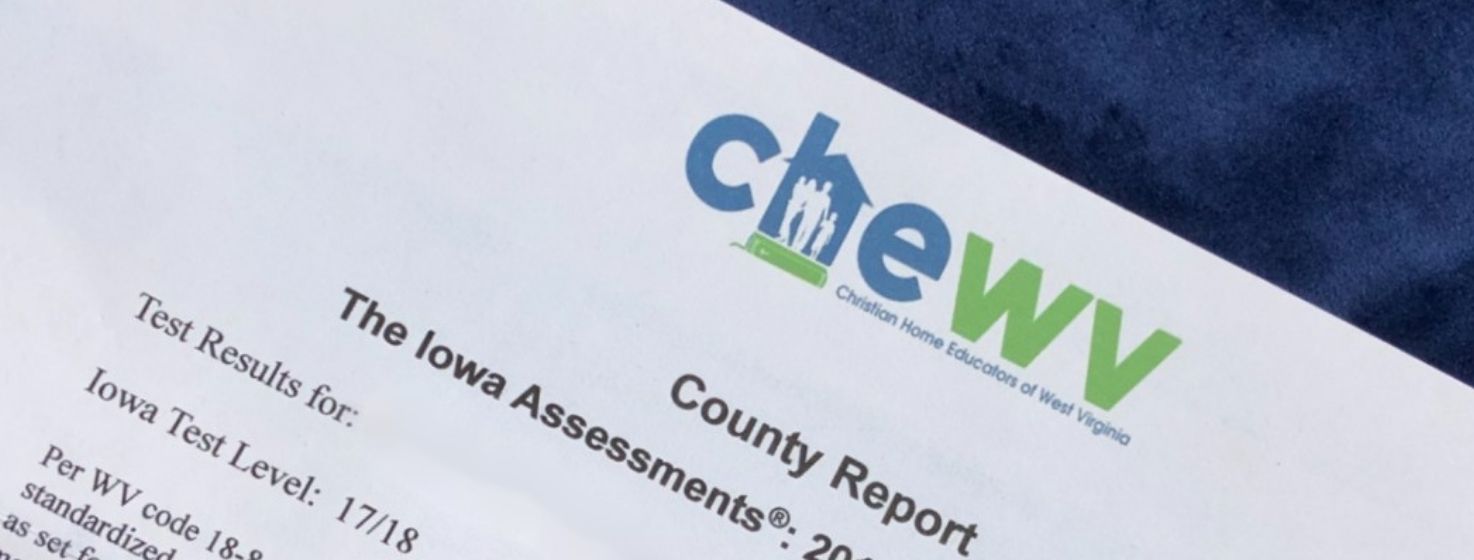
    Electronic scores have been released (via email) to parents of students who tested with CHEWV. County/Progress Reports will be coming in the mail within the next few days.

    If you tested with CHEWV but have not received your electronic score email, contact Becky at testing@chewv.org.


    Test Centers and private testers use paper tests that must be scored by machine or hand. To keep costs as low as possible, all CHEWV paper tests are scored together. This year, in an effort to please, we extended our testing window to include later date options. This means that the last of CHEWV’s paper tests (a record number of them) have been to our scoring service only a couple weeks. That time delay for sorting and scoring a large batch of tests is neither surprising nor unexpected. Scores should be released any time. And when they are, all test center and private families will receive an email from BJU Press Testing & Evaluation and will have immediate access to their official reports online.

    Conversely, online tests can be scored separately because the answers are – online. That would by be why online testers get their scores more quickly. While this might seem an advantage, there are pros and cons to both online and paper testing.

    All CHEWV County Reports (3rd, 5th, 8th, 11th) and Progress Reports will be processed at once. These will be mailed to parents in time to submit County Reports by June 30. Unlike the publisher score reports, these will be physically mailed. Parents should wait to receive these before submitting scores to the county for the four required grade levels.

    While we realize that many testing families are new to homeschooling, it was not so many years ago that online testing and even electronic scores were unavailable to homeschoolers. Then, all test scores were received in late May or early June. Next year we may return to an earlier testing window, but for this year, we were able to help many more new families who weren’t expecting to test so early in the year.

    CHEWV is pleased to provide a testing option that not only satisfies all the criteria of the WV law, but also gives parents assessment results that go beyond the law’s requirements. Used properly, test results can be one of many measures of a child’s progress. CHEWV’s multiple reports together provide parents with valuable insight.

    Finally, testing with CHEWV is a small but important way to help keep homeschooling free and legal. Group scores (without personal identifiers) help our legislative effort substantially. Thank you!

  • Learn How To Homeschool – Anytime!

    Learn How To Homeschool – Anytime!

    [et_pb_section fb_built=”1″ admin_label=”section” _builder_version=”3.22″ global_colors_info=”{}”][et_pb_row admin_label=”row” _builder_version=”3.25″ background_size=”initial” background_position=”top_left” background_repeat=”repeat” global_colors_info=”{}”][et_pb_column type=”4_4″ _builder_version=”3.25″ custom_padding=”|||” global_colors_info=”{}” custom_padding__hover=”|||”][et_pb_text admin_label=”Text” _builder_version=”3.27.4″ background_size=”initial” background_position=”top_left” background_repeat=”repeat” global_colors_info=”{}”]CHEWV is pleased to offer Start Strong West Virginia, a 14-day online course that covers just about everything you need to know to homeschool successfully!  Best of all, it’s totally self-paced – and you have lifetime access. Want the details?  Click here.[/et_pb_text][/et_pb_column][/et_pb_row][/et_pb_section]

  • A Short Primer on the Homeschool “Exemption”

    A Short Primer on the Homeschool “Exemption”

    If you’ve attended CHEWV’s Homeschooling 101 classes, you’ve heard us emphasize something: WV homeschool law 18-8-1(c)(2) is an exemption to WV’s compulsory attendance law.

    WV children who turn 6 before July 1st of any calendar year are required to attend public school the following school year UNLESS they satisfy one of a few exemptions found in the law. 18-8-1 (c)(2) is one of those exemptions.

    Why bring this up? Several bills currently in the legislature provide for new exemptions. In their present form, they do not affect 18-8-1(c), but rather are intended to add other exemption options.

    CHEWV’s primary legislative purpose is to defend the freedoms we have worked so hard to gain back. (Homeschooling was totally legal before 1897.) If you are inclined to read bills carefully, the section of the law that is affected matters.

    If you refer to the annotated law that CHEWV provides, you will see that we homeschool under Article 8 Compulsory Attendance, Chapter 18 Education, Section 1 Compulsory school attendance; exemptions. The exemptions follow and homeschooling options currently fall under (c). CHEWV defends 18-8-1 (c), while we closely monitor other parts of the law that affect homeschooling.

    Of course, additional exemptions have the potential to change homeschooling as we know it, but those waters can be muddy. That’s one of the reasons we call you to prayer during the legislative session.

    By God’s grace, WV parents already have the legal option to homeschool. Thousands have taken advantage of that freedom – with great success! May thousands more find the beauty of the individualized approach that homeschooling makes possible!

  • Legislative Update March 10, 2021

    Legislative Update March 10, 2021

    When families flourish, communities flourish. For families to flourish, parents must have the freedom to do what they believe before God to be best for their children.

    Homeschool-related bills progressing this year include vocational school enrollment as well as alternate college testing.

    CHEWV and HSLDA have worked diligently over the years to ensure that the homeschool exemption has not been modified or combined with other legislative efforts meant to improve the public school system. These efforts have enabled freedoms to be maintained for those of us who simply want to homeschool and do what we know to be best for our children.

    Legislative Overview of Homeschool-Related Bills

    HB 2529 – Prohibiting West Virginia institutions of higher education from discriminating against graduates of private, nonpublic or home schools by requiring them to submit to alternative testing.

    LEAD SPONSOR: Fast
    SPONSORS: Pack, L.

    Passed the House of Delegates and has been sent to the Senate.
    “State institutions of higher education may not require a person who has obtained a diploma or other appropriate credentialing from private, nonpublic, or home schooling, and who has acceptable test results on ACT, SAT or other tests recognized by the institution of higher education which would qualify the person for admission, to submit to alternate testing as a condition of admission.”

    HB2791 – Relating to enrollment and costs of homeschooled or private school students at vocational schools

    LEAD SPONSOR: Kessinger
    SPONSORS: Higginbotham, Kelly, J., Wamsley, Longanacre, Horst, Clark, Griffith, Kimble, Tully

    Passed the House of Delegates and has been sent to the Senate.
    County boards of education shall permit students who are homeschooled or attend private schools to enroll and take classes at the county’s vocational schools, if any are provided and as capacity allows, at no expense or cost greater than expenses or costs normally charged to public school students: Provided, That if a homeschool or private school student is not permitted to enroll in a county vocational school, the county shall notify the parent or guardian of the student in writing and a copy of the written notification shall also be sent to the West Virginia Department of Education.

    Other Educational Bills

    HB 2012 – Related to public charter schools

    LEAD SPONSOR: Smith
    SPONSORS: Clark, Kimble, Higginbotham, Wamsley, Espinosa

    Passed both Houses and has been sent to the Governor.
    House Bill 2012 would allow 10 charter schools to be approved in a three-year period in West Virginia. The legislation also lays the groundwork for two virtual charters that would each be allowed to enroll up to 5 percent of the state’s student population. Added together, that could potentially amount to 10 percent of public-school enrollment, roughly 26,000 students.

    HB 2013 – The Hope Scholarship

    LEAD SPONSOR: Ellington
    SPONSORS: Higginbotham, Summers, Hanna, Pinson, Wamsley, Kimble, Jeffries, D., Espinosa, Clark, Horst

    Passed the House of Delegates and has been sent to the Senate.
    House Bill 2013 provides funds to eligible recipients for personal education accounts (ESA’s) to be used for qualifying education expenses which all must be approved by a board of 9 individuals, including three parents. Up to $4,600 would be placed in an ESA account controlled by the State Treasurer to be used for approved educational expenses, such as for private schools, or other approved programs, such as tuition, textbooks, and other services. Funds are not given directly to parents but only to approved providers.


    The success of homeschooling in West Virginia and throughout the country, has demonstrated the educational and societal benefits of parents who invest in their children. God’s model for society is the one that works best! We should be thankful that there are those in public office that understand this.

    Since we are only halfway through the session, let us remain vigilant and pray for state legislators as they seek to protect our freedoms. Click here for legislative resources to assist you in both understanding legislation and contacting your state representatives.