Author: CHEWV

  • Thank you, Mr. Jefferson!

    Thank you, Mr. Jefferson!

    by John Carey, CHEWV’s Legislative Liaison

    We hold these truths to be self-evident, that all men are created equal, that they are endowed by their Creator with certain unalienable Rights, that among these are Life, Liberty and the pursuit of Happiness.

    The Declaration of Independence

    When the Founders of our nation claimed our rights to be inalienable, they thought it was settled.  After all, what is bigger than nature and nature’s God?  Clearly the Founders embraced the idea that transcendent, or absolute, truth can be known and lived out in the world.  They were not cultural relativists. They knew that all theories of government did not take us to the same place nor have equal value.  They had over 1000 years of English history to know that this was true.  They constantly made it their mission to seek out the best ideas – and, boy!  Did they make a difference!  They created the Bill of Rights, the U.S. Constitution, and nearly 200 years of freedom – a track record never equaled in the world.

    It’s important that we remember that Thomas Jefferson was not a relativist, either.  He did not believe in the equal validity of all ideas.  Whatever else you believe about him, this fact cannot be denied.  His efforts to embrace the best ideas eventually led to what he believed were the three greatest achievements of his life:  the establishment of the University of Virginia, the Declaration of Independence, and the Statute of Virginia for Religious Freedom. 

    In January of 1777, in Fredericksburg, Virginia, thirty-four-year-old Thomas Jefferson met with a small group of friends to draft what would become the Bill to Establish Religious Freedom in Virginia.  First introduced into the Virginia General Assembly by Jefferson in 1779, the bill became law in 1786.  A portion of this bill was extracted verbatim and inserted into the Religious Freedom clause of the West Virginia State Constitution.  Thus it is no exaggeration to say that Thomas Jefferson authored West Virginia’s religious freedoms.

    Here are the words of Thomas Jefferson as recorded in the WV State Constitution:

    “No man shall be compelled to frequent or support any religious worship, place or ministry whatsoever; nor shall any man be enforced, restrained, molested or burthened, in his body or goods, or otherwise suffer, on account of his religious opinions or belief, but all men shall be free to profess and by argument, to maintain their opinions in matters of religion; and the same shall, in nowise, affect, diminish or enlarge their civil capacities.”

    So what impact have Jefferson’s writings had on Religious Freedom in West Virginia? 

    Jefferson’s writings were cited by WV Circuit Judge J. Harold Brennan in the 1940’s to rule contrary to a U.S. Supreme Court decision previously used to force parents to comply with a West Virginia School Board regulation. In other words, the West Virginia court found greater support for religious liberty embedded in West Virginia’s State Constitution than in the U.S. Bill of Rights. (The details of this case can be found here.)

    WV Protections Stronger than the Bill of Rights – Judge Brennan’s comments

    The West Virginia Constitution provides that “no man shall be compelled to frequent or support any religious worship, place of ministry whatsoever; nor shall any man be forced, restrained, molested or burthened, in his body or goods, or otherwise suffer, on account of his religious opinions or beliefs….”  Citing this provision, Judge Brennan held that, “it would be difficult to maintain that a court has the right to fine or imprison a man because he will not force his child to do a positive act wholly inconsistent with the religious beliefs of them both.”  Judge Brennan relied on the West Virginia Constitution to safeguard religious liberties that were not protected by the Bill of Rights.

    Conclusion

    We can be thankful that Jefferson was not a cultural relativist. His courageous and uncompromising commitment to truth is blessing West Virginians even today.

    In 1789 Thomas Jefferson wrote to his friend David Humphreys, “There are rights which it is useless to surrender to the government and which governments have yet always been found to invade.  These are the rights of thinking and publishing our thoughts by speaking or writing; the right of free commerce; the right of personal freedom.”

    Jefferson knew that besides securing a law to uphold religious liberty, protections would need to be put in place to limit the power of the state so that it could not “invade” the rights of the people.  Today, we have the freedom – even the duty – to not only acknowledge and exercise our religious liberty, but to do all we can to secure that liberty for our children and their children.  Clearly, our Founding Fathers not only embraced the idea that absolute truth can be known and can be lived out in the world, but they spent their life choosing to do so. We must now do the same.

  • The Changing Face of Testing

    The Changing Face of Testing

    Stanford Publisher Among Those Providing
    Common Core Materials

    No Child Left Behind (NCLB) legislation precipitated a major shift in testing when it was signed by President Bush in 2002.  Prior, annual testing was primarily via standardized achievement tests, which were designed to measure a student’s academic knowledge compared with other students nationwide. Achievement tests were also nationally-normed so that a particular curriculum or student background would not statistically affect the comparison scores.

    In stark contrast, the stated purpose of NCLB testing was to assess mastery of specific curriculum content.  NCLB required states to develop standards – i.e., specific subject content – for teaching, then assess by means of content-based exams such as the WESTEST whether those standards had been met.  Although in and of itself this was not bad, tests like the WESTEST were far different from previous achievement tests because they intentionally tested the specific material covered in a given state’s public school classrooms.

    Since these new tests were directly tied to receiving federal funds, they inadvertently drew attention and funds away from the traditional and reliable nationally-normed standardized tests.  Educators knew the value of achievement tests, but federal funding largely dwarfed their use.

    As a result, the publishers of these expensive-to-produce nationally-normed tests suffered a shrinking market and published fewer updated versions. The combination of our state law’s assessment requirement and its ten-year publishing/norm date stipulation made this turn of events a WV homeschool issue. 

    For example, Pearson, publisher of the Stanford test, announced last year that they would no longer provide and support the Stanford 10 test. While Pearson subsequently changed its mind, the most recent Stanford version was normed in 2007, which means this is the last school year it can be used by WV homeschoolers. Pearson could choose to re-norm it or publish a newer version, but that doesn’t seem likely.

    For the economic reasons described, test publishers must decide whether to continue offering the expensive-to-produce achievement tests or to compete in the Common Core market instead. Pearson was awarded a contract in 2014 to administer tests aligned with the Common Core Standards, a project described as being of “unprecedented scale” in the U.S. testing arena. The contract is associated with the Partnership for Assessment of Readiness for Colleges and Careers, one of two main consortia of states creating exams to match Common Core State Standards (the other being Smarter Balanced, in which WV participates). Under the contract, Pearson will develop test items, paper-and-pencil tests, and computerized tests that align with CCSS. Pearson appears focused on Common Core rather than the traditional achievement testing that gave rise to their Stanford test. Pearson has recently lost some state contracts; whether this development keeps the traditional Stanford on their radar screen is still to be determined.

    What does all this mean?  It appears that most publishers of standardized tests are caving in to the Common Core market.  Besides the difficulty of finding a recently normed standardized test, homeschoolers now have to work hard to find one that isn’t aligned with the Common Core Standards. Yet the landscape could change as a result of a growing, credible back-lash from dissatisfied educators, informed parents, and Constitutional conservatives against Common Core.  Nevertheless, because federal money continues to drive and fund Common core, the state-by-state pushback is slow to regain ground.  

    We expect that once the Stanford 10 is too old to use (after this year), the highly respected Stanford option will be gone for WV homeschoolers.  We do expect Pearson to soon offer an alternative standardized test, but it will likely be similar to WV’s new General Summative Assessment – which is basically a Common Core test rather than a traditional achievement test.  

    Right now, CHEWV is pleased that Riverside Publishing has decided to take a risk and keep their newest IOWA only partially aligned to CCSS and looking much like the traditional tests that have been trusted through the years.  CHEWV will continue to stay abreast, as much as possible, with what is happening in testing.  Among the tests available which satisfy our state law, we are committed to providing the best testing option possible to West Virginia homeschooling families.

  • On Socialization, Elections, and Religious Freedom

    On Socialization, Elections, and Religious Freedom

    By John Carey, CHEWV’s Legislative Liaison/Lobbyist

    As you consider the upcoming election, it is important to support those who not only stood up for your freedoms by advancing positive home school legislation but also promoted bills that strengthen parental rights and religious liberty.

    Legal protection of homeschooling is built upon two pillars:  parental rights and religious liberty.  If we ever lose the fight for religious freedom, we will find ourselves unable to stop laws which wrest control of home education away from parents and place it in the hands of government agents.  We must consider the actions of officials at the local, as well as national level, as they relate to religious liberty.

    During the 2016 regular legislative session, as many of you will recall, Delegate Hornbuckle proposed an amendment that would have required homeschool students to undergo diversity instruction by periodically requiring “public school visits and activities” to “enhance social skills and tolerance for others with different beliefs or backgrounds.” 

    But it does not stop at one WV legislator.  Recently HSLDA reported that U.S. Department of Education Secretary King has also expressed his concerns about the social development of homeschool students.  King worries that “students who are homeschooled are not getting the kind of rapid instructional experience they would get in school” unless parents are “very intentional about it.”  King said the school experience includes building relationships with peers, teachers, and mentors—elements which he believes are difficult to achieve in homeschooling.

    If that is true, if students get an excellent social development experience in public school, where is the proof of it?  Are America’s public school students known around the world for excellent social development?  How happy, content and self-assured are they?  Consider this:

    • Suicide is the SECOND leading cause of death for college-age youth and ages 12-181.
    • More teenagers and young adults die from suicide than from cancer, heart disease, AIDS, birth defects, stroke, pneumonia, influenza, and chronic lung disease COMBINED2.
    • Each day in our nation on average, over 5000 young people grades 7-12 attempt suicide3.

    Tragically, a child in a West Virginia elementary school recently committed suicide, and perhaps because of bullying4.

    It has been my observation that many parents homeschool primarily because they are concerned about proper social development.  They want their kids to grow up with a solid self-image and gain essential social skills.

    It would seem that there is another reason that King and Hornbuckle want our kids exposed to public school.  This can be seen in the second justification that Delegate Hornbuckle gave for his committee amendment: “tolerance for others with different beliefs or backgrounds.”  Secularists who share the worldview of Secretary King and Delegate Hornbuckle do not want parents, especially Christian parents, directing the education of their own children because these parents teach that homosexual marriage is wrong and traditional marriage is right.  In their minds, to teach that this is the only way to look at life is to be intolerant. 

    Stepping back to view our culture, we can see that it is not Christians but the godless society around us that is becoming intolerant of those who believe that objective truth can be known and lived out in the world.  The traditional view of absolute truth is being replaced with “Cultural Relativism,” which says all cultural beliefs are good and must be appreciated.  Those who believe that there is a best way or a right way to live are quickly being defined as bigots.  This is why our children must be exposed to “different beliefs and backgrounds” as the Hornbuckle amendment mandated.  Yet Christian parents know this is not true.  Some ways of looking at life are very harmful, even destructive.

    Some ways of looking at life are very harmful, even destructive.

    On the floor of the Senate during the 2016 regular session, Senator Mitch Carmichael, in a tearful speech, gutted the West Virginia religious freedom bill in the final moments of the debate by, in effect, mandating that Christians who bake cakes or take wedding pictures be legally required to use those talents to affirm homosexual marriage – “or else.”  Consider if this proposal had been made law.  It clearly would have set a precedent for limiting religious freedoms in other areas as well.  Why not eventually homeschooling?

    A battle is raging all around the country, even in West Virginia, over religious liberty. For those of us who have chosen God’s Word as the sure foundation of our lives and families, the religious liberty purchased for us by America’s forefathers should be precious to us.  We must rise up to protect that liberty if we want to keep the right to direct the education of our children.

    If ideas which are counter to the Bible gain momentum in society, parents will eventually have no legal means to prevent their children from being indoctrinated in the name of the “greater good” of society.  And what is the greater good?  That all ways are equally acceptable.  To think otherwise is to be one who hates and is intolerant.  Instead, students in school should be encouraged to discover what is true and right, and what will enable them to be successful in life, just as homeschool students are already doing.  True success is never found in placing equal value on all ideas as Cultural Relativism mandates, but by embracing the best ideas – God’s ideas!  The LORD our Maker says, “For as the heavens are higher than the earth, so are My ways higher than your ways and My thoughts than your thoughts.”  (Isaiah 55:9)

    Anything contrary to the ways and thoughts of God puts men and women, girls and boys, in bondage.  Only the knowledge of the Truth of God’s Word will set us – and these children – free.

    Jesus said, “If ye continue in my word, then are ye my disciples indeed; and ye shall know the truth, and the truth shall make your free.”  – John 8:31-32

    It is for freedom that Christ has set us free.  Stand firm, then, and do not let yourselves be burdened again by a yoke of slavery.  – Galatians 5:1

    _______________

    1 https://www.jasonfoundation.com/prp/facts/youth-suicide-statistics
    2 Ibid
    3 Ibid
    4 https://www.washingtonpost.com/news/education/wp/2016/09/16/bullies-tormented-a-9-year-old-boy-relatives-say-it-may-have-driven-the-child-to-suicide/


    1. https://www.jasonfoundation.com/prp/facts/youth-suicide-statistics []
    2. Ibid []
    3. Ibid []
    4. https://www.washingtonpost.com/news/education/wp/2016/09/16/bullies-tormented-a-9-year-old-boy-relatives-say-it-may-have-driven-the-child-to-suicide/ []
  • Athletes and Homeschooling

    Athletes and Homeschooling

    Simone Biles, the homeschooled gymnast who won the world over in the recent Olympics, may be the “poster child” for homeschool athletics; Simone and her family pursued homeschooling because of its flexible schedule. Homeschoolers can and do utilize daytime opportunities unavailable to traditionally-schooled students, but they can also more easily pursue their sport without sacrificing their academic pursuits.

    Homeschooled students in West Virginia are finding their places in a number of sports. Lauren Cox of Morgantown is following her own dream in shooting sports. Mentored by gold medal air rifle shooter Ginny Thrasher and Nicco Campriani from WVU, she herself has participated in the National Junior Olympics in the Olympic Training Center in Colorado Springs in 2015 and 16. “I have found my passion, am working to pursue it, and encourage others to do the same. I have friends who swim competitively and others on a regional soccer team. Several homeschool friends are part of my junior rifle team,” encourages Lauren.

    Sam Sheppard, who is a high power shooter on the WV state junior team, concurs. “My team presently has five homeschoolers on our team of ten representing WV in state and national competitions. Those shooters who excel are recruited by colleges and the armed services for their teams.” Sam’s sports also include karate, where he’s earned a black belt. “Those who apply themselves to the sport of martial arts have many opportunities to compete on state, national and international levels and go on to try out for Junior Olympics and Olympics.”

    Lauren’s sister Rachel Cox competes in barrel racing. She has placed in several events over the past year on her instructor’s horses. She now has her own horse and has placed first in her division. Their dad, Aaron, was active in traditional sports through school. “My sports of basketball and football aren’t available to my kids in the same way they were to me. I’m proud to see my daughters participate in sports that interest them and work toward their goals. They have become team players and competitive, which will serve them later in life. While we did not choose homeschooling because of the flexibility to practice, travel, and attend competitions, it is a benefit.”

    Isaac Massie, homeschool high schooler in Charleston, has been interested in basketball since he was old enough to say “ball.” He first played in his church Upward league which his father helped coach, and later had many opportunities to join local teams in the Nitro and Poca Youth Basketball leagues, as well as several travel teams. More recently he has played for Cross Lanes Christian School and then Covenant School in Huntington, where his dad will be this year’s assistant coach. “The Covenant families and players have welcomed homeschoolers with open arms. We immediately felt like we were part of their family, and these fellow players and coaches have become such good friends and influences,” explains Isaac’s mom.

    Elijah and Joshua McDonald also started playing basketball in the nationwide Upward church-based program. Their dad, Mike, explains, “Upward is Christian-based and has a healthy emphasis on learning both good basketball principles as well as good character.” But since the local Upward program ended at 5th grade, they began searching for other opportunities. A two-year stint playing in the public school recreational league during the summer months was the boys’ first exposure to a secular sports environment. Mike says, “It was definitely good to do Upward first – which set a good foundation.” Following that experience, the McDonalds reached out to local Christian schools, but were limited by the WVSSAC rules which prevent homeschool participation. They found their niche across the Ohio border. Ohio Valley Christian School (55 miles away) allowed homeschoolers to play, and soon Elijah and Joshua both made the team. OVCC plays against public and Christian school teams, and won the Ohio Christian School Sports Association championships last year. With over 30 schools participating in the OCSSA, public schools in WV took notice. Elijah, a senior this year, has been contacted by WV public school coaches who want him to play for them. Elijah hopes to garner the same attention from college coaches.

    As “out of the box” thinkers, homeschoolers find numerous opportunities in both academics and athletics. They discover ways to succeed in the areas that interest them, even when the opportunities don’t seem obvious. And sometimes the character and leadership developed in the process are just as valuable as playing their sport.

    ~~~

    Interesting tidbit: According to Mark Kantrowitz and FinAid.org, approximately 1% to 2% of undergraduate students in Bachelor’s degree programs receive athletic scholarships, equaling a total of about $1 billion a year. While that monetary amount is growing at a rate of 4.5% year over year, the percentage of those that actually receive athletic scholarships has not risen higher than 1.8% since 1995-1996.

  • Everyday Learning for Littles – Birth to Age 5

    Everyday Learning for Littles – Birth to Age 5

    By Shannon Messenger, Early Learning Specialist

    Some of the best learning your child does occurs everyday in his/her home environment. By talking to and with them, doing chores with them, reading to them, explaining things to them and allowing them to have free exploration time, you are setting a foundation for your child’s learning that can last a lifetime. Before I list some of my tried-and-true methods for teaching early reading, language, math, music, and science concepts (without buying special curriculum or even altering your everyday schedule!), let me first address the giant push for early childhood learning and academics that has occurred in the past decade.

    Twenty years ago babies and toddlers were not really considered when it came to meaningful learning activities. New research has shown, however, that there is a window from birth to age 3 when children have the ability to learn more than they do for the rest of their lives! Connections in brain synapses are occurring at an astonishing rate – and sometimes just by exposure to something. Because of this research, more and more schools are making an effort to provide professional schooling for toddlers. Programs that promise to teach your baby to read, or teach your child a second language, are advertised on infomercials. Kindermusic classes are popping up in every neighborhood. Is this bad? Not necessarily, as long as we remember that children have been learning in the toddler/preschool stage of life since the beginning of time. They have been learning from their parents and families many concepts that were just taken for granted. After completing a Bachelors degree in Elementary Education, I went on to pursue a Masters in Early Childhood Education as well as becoming certified in teaching birth through age 3. During this time (and after becoming a parent to three beautiful children), I became very passionate about everyday learning – learning through play and natural experiences. Many of the things we do every day have an amazing impact on even the youngest of children. So below are the things I recommend in these early years. May God richly bless you as you mother and teach your children and make your home and family a priority!

    Language Concepts:

    Infant stage: Talk to your baby. It may sound simple, but they will learn all about language and sounds by listening to your voice. Talk in “parentese,” the high-pitched cooing way parents talk to their babies. Babies love it – there’s a reason we naturally talk that way – it’s what they respond to best! When they start to coo, coo back and then pause and wait for them to respond. This way they learn about pauses and taking turns in conversation. Talk to them about what you are doing throughout the day. “I am making some lunch for mommy. Then we will eat.” The more they hear – the more they absorb. Some people even teach their older infants sign language for a few simple words like eat, milk, more, all done, please, and no. I will stress, though, that you must use the spoken word with the signed word and make sure that they are learning to speak and not just use the sign.

    Toddler stage: Toddlers are just developing their language skills. They are starting to put words together to make simple sentences and thoughts. It takes much patience when trying to decipher toddler speak, but the reward is worth it. You are showing them that words matter and that what they say is important. Repeat what they say back to them. Although some of their mispronunciations are cute, try to correct what they say. Don’t tell them they are wrong; repeat back using the proper pronunciation. (Your child says “I want anana” and you say “You want a banana?”)

    Preschool stage: At this stage they can start to learn the importance of their words. They learn that words are not only used to get what they want, but they are used for interaction. You can teach them to use their words to express how they feel (sad, mad, angry, happy, excited, etc.) This expands their vocabulary and helps them learn to use language instead of actions to convey meaning. Model for them by stating how you feel, or describe something using different words: “This food is delicious – delicious means it tastes good!” They can also begin to understand written words and language. Here they begin to recognize the alphabet (starting with letters in their name) and then learn that those letters put together make words. Make simple grocery lists with a picture as well as a word and let them check off items in the store. (This also helps keep little hands busy with constructive work.) Use environmental print – the words and logos from cereal boxes, restaurants, TV shows, etc. Cut out pictures of items from catalogs and fliers and let them glue them into a “book” that they can “read.” They can recognize far more things than we usually give them credit for.

    Early Reading Concepts

    The best thing you can do for your child is to read to him or her every day. Starting in infancy, reading DAILY to your child teaches many things.

    Infant stage: Babies respond to the “sing song” of your voice. They begin to sense the patterns and rhymes of stories. Holding them on your lap and looking at the pictures strengthens their bond with you as well as teaching them that books are important.

    Toddler stage: Again they learn about rhyming and meanings of words. They learn that we read left to right, we turn the page, and that the words on the page have meaning. You can also begin to leave familiar words out and let them help “read” the story. Nursery rhymes in particular are proven to teach many important rhythms in reading. This is the stage when children want to read the same book over and over and over. Although this can seem boring – the children are actually learning quite a lot. By rereading something familiar, they are free to build on concepts and learn new things (much the same way we see new things after viewing a movie more than once). You can also have them point to objects in the pictures to help them learn colors, shapes, animals, and other visual vocabulary. Reading before naps or bedtime helps establish routines that are so very important to toddlers.

    Preschool stage: Preschoolers build on the idea that words have meaning. Begin pointing along the words as you read them. Point out or have them find letters, especially letters from their name. You can have them sequence the events of a story – ask what happened first, second, next and last. Read fables or fairy tales and discuss consequences, cause & effect, right & wrong, and ask why. Children will also have a lot of “why” questions at this age and books can provide the answers to many questions. Books can also be used to allay their new-found fears. There are plenty of books about visiting the doctor, dentist, hospital, having a new sibling, thunderstorms & weather, monsters or other scary creatures. This age is full of learning opportunities, and books can be one of your best allies. Science, math, social and religious concepts can all be taught through books. Reading together reinforces loving bonds and shows your child that they are important to you because you stop what you are doing and read with them.

    Math

    When people hear the term “math” they automatically think of numbers and computation, but there are MANY equally important math concepts formed in early childhood that don’t involve memorizing numerals or learning to count.

    Infant stage: Count their toes and fingers (while kissing of course!) and sing songs like “One little, two little, three little fingers, four little, five little, six little fingers, seven little, eight little, nine little fingers, ten fingers on your hands!” (or toes!) Use foam shapes in the bath tub and identify colors and shapes.

    Toddler stage: There are many things you can use to teach math concepts to toddlers. Continue using bath shapes and colors but you can also add letters and numbers. Wooden blocks or LEGOs can be a very important tool in counting, making patterns, sorting, and grouping. Sorting and making patterns are two very important concepts. Toddlers can sort laundry, sort socks by color, sort silverware and put it away, and sort their toys into different toy bins. They can count their toys, count their goldfish crackers, count the stuffed animals on their beds, count their cars or dolls. They can line toys, blocks or household items from shortest to tallest. You can talk about small, medium and large.

    Preschool stage: Preschoolers will continue to build on the concepts of patterns and sequence. They can play matching games with magazine pictures, socks, playing cards, blocks and more. They can do more complex pattern activities. Have them start finding what would come next in a pattern you have made, then transition to them making their own patterns (use toy animals, blocks, beads, foam shapes etc.). At this stage they can also begin to identify numerals and count. Learning one-to-one correspondence (counting one time for each object) is easily learned using egg cartons. They can count almost anything and even though it may take time- they WILL be learning the concept that a number represents something. Games like Candyland, Chutes & Ladders and Dominoes help with counting. Keep track of the date on the calendar together. They can sort and graph Gummi bears or M&Ms. You can measure things – let them help measure laundry detergent or ingredients for cooking. You can also measure their feet, hands, heads and height. Give them rulers or measuring tapes and let them experiment. Cooking is one of the best things to do with children. They can begin to read certain words or ingredients, help measure, understand time concepts using a timer, and follow the sequence of the directions. Talk about what happens first, second & last. These may seem meaningless, but they are laying many important foundations for math problems and equations in the future.

    Science

    Infant stage: Babies learn a lot about the physical world they live in. They learn very early about day/night, cold/hot and cause/effect. They learn about their bodies. Read simple stories that talk about their body parts (Here Are My Hands is my personal favorite). Wash their body, kiss their body parts and name them. Sing “This is the way we wash our feet (hair, hands, belly, face, etc.) when we take a tubby!”

    Toddler stage: Toddlers can learn anywhere! The bath tub is a great place to learn science and math. Give them lots of cups, containers and toys. They will learn about things that float and things that do not. They will learn that bigger containers hold more water. Containers with holes lose their water. Don’t rush bath time – let them splash and experiment and play. Play with plastic animals and name them. Sort them. Play farm and zoo. Talk about what the animals eat, where they live, what they look like. Toddlers LOVE animals and there is so much they can learn. Let them play outside as much as possible and let them explore dirt, insects, leaves, streams (with supervision), weather, sand, rocks and more! They will be constantly absorbing things through their senses.

    Preschool stage: Preschoolers again expand on earlier concepts. You can let them keep track of the weather every day. Help them observe the seasons and identify the signs of changing seasons. They will learn more about their bodies and can learn to identify more complex body parts and what they do (shin, elbow, eyebrows, wrist, etc.). They will still learn best through play and exploration. Water and sand play continue to teach measurement concepts. Let them observe what happens to an ice cube in the sun, construction paper in the sun, water in the freezer and more! Show them life cycles of animals – butterflies, spiders, chickens. Let them use all five senses and compare and contrast.

    Music

    Music is one of the most universal teaching methods available. You can invent songs to teach everything from washing hands, cleaning up toys, counting, opposites and more! I use music and songs every day. My toddler responds much better to the clean-up song than to a direct command to “clean up your toys.” Music helps make connections in the brain that even scientists don’t fully understand. People of all ages respond to music.

    Infant stage: Sing to your baby often. Soothe them with a hymn or lullaby. The repetition of a song or melody is soothing to a child and helps establish rhythms and patterns that are so important in early development. Use an electronic device or attach a music machine to the crib. This can teach even a small baby that when a certain song plays or the music is turned on, it’s time for sleep. Plus the music that you sing attunes them to your voice and increases the bond between parent and child. (Singing is for dads too!)

    Toddler stage: Toddlers love music. Period. Not only do they enjoy hearing music, they enjoy making music too! This is the perfect time to teach them the classic songs of childhood such as Old MacDonald, The Wheels on the Bus, Twinkle Little Star, etc. They love the easy rhymes and repetition. Again, this helps form connections in the brain so they can better remember. Allow them to play instruments. These do not have to be store-bought. They can be coffee can drums with wooden spoons or rice in plastic eggs for shakers. Put on music and let them march, play and keep the beat.

    Preschool stage: Preschoolers can sing many songs. They can combine movement with their music: hopping, skipping, galloping. They can move slowly or quickly. They can work on concepts like soft and loud, higher and lower, and learn a musical scale. Choose a tune to help them learn their address or telephone number as well the months of the year, the days of the week or the letters in their name.


  • Speech Development – Preschool

    Speech Development – Preschool

    by Randi Horst, Speech Language Pathologist and Homeschool Mom

    Babble business is not just for babies! It takes two to communicate. How we react to our lil’ ones’ interests and babbling is the groundwork for brain growth and communication. A recent article describes in detail the importance of parents “talking-through” their day, creating a language-rich environment for their young children.  

    The surgeon highlighted in the article has researched the correlation between IQ and the words used in a home. His explanation of the impact parents have, and his mission to educate parents on their role in development, is encouraging to this homeschooling speech language pathologist!

    Talking to your new nugget from day one is a very important, powerful way to foster development beyond eye contact and smiles. When your infant is having time on a blanket and he doesn’t have his pacifier or bottle, he will be more likely to make a new sound. When he does, go to him and imitate him. By taking turns in this conversation, you’re helping to connect neurons in his rapidly growing brain. Talking and singing to your baby throughout the day might seem to go unnoticed, but his brain is responding and growing as you bond with that blessing.

    With an older baby or toddler, “talking through” your day would include explaining to her what you’re doing as you unload the dishwasher or fold clothes. For example, laundry time could sound like this: “Mommy’s shirt, sock … where is the other sock? Oh, there it is! Daddy’s pants, big sock, little sock, sock, sock, sock!” If your toddler starts to imitate those words and you’re having a hard time understanding him or her, don’t be alarmed; there’s a wide range of normal sound development for our new talkers. Consider that God made our mouths to help us eat as well as communicate, and we can build strength and coordination for speech sounds by encouraging mature eating and drinking. An easy strength builder is having your toddler drink from an open cup with assistance during meals. She’ll be excited about the “big girl” cup and won’t even know she’s building jaw strength and control, both necessary for tongue mobility used in those sounds you’d like to hear.

    In the meantime, continue to talk! Normal language development involves understanding what is heard around us before we use words ourselves, so don’t be discouraged if you’re the only one making noises or words. This is not a one-way business. Her little brain is responding, whether you can see it or not.

    Randi is a homeschool mom of 6 and speech pathologist in the Birth to Three early intervention program. She has a heart to help homeschool mamas who have speech questions.   

  • Stanines, Percentiles, and Freedom

    Stanines, Percentiles, and Freedom

    Learning. It’s not just for our students!  There is certainly a learning curve for the newly revised law.  This is a good thing, however, for through this law we have gained freedom!  Nevertheless, with freedom comes responsibility – the responsibility to learn.

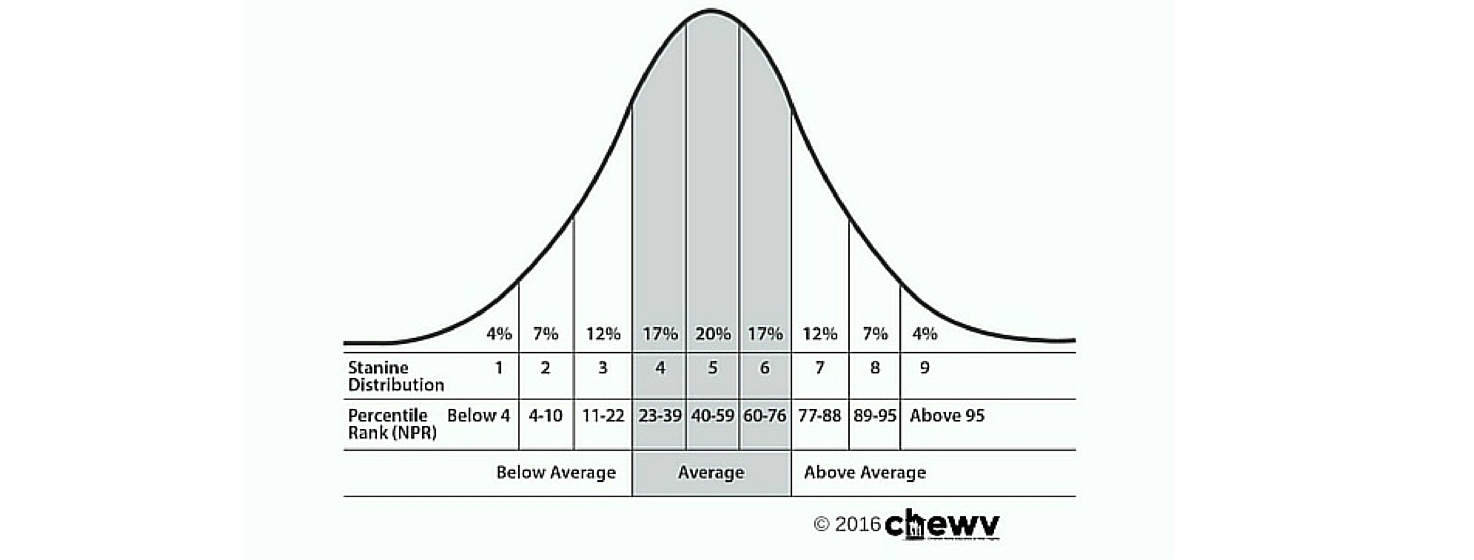
    Those parents who have chosen testing for the annual assessment are beginning to realize that stanines are quite different from percentiles.  Although stanines are less precise than percentiles, in many ways they reflect the bell curve much more.  If you recall, the purpose of a standardized test’s norm group is to plot the scores on a bell curve and then draw comparison scores thereafter.  The normal bell curve with its distribution can be referenced above.

    Looking closely at the bell curve distribution, you will notice that the 4th, 5th and 6th stanines include a large range of percentile scores.  This reflects the fact that the bell curve is tallest in that middle range:  that those ranges represent the most students.  The 5th stanine contains the most scores – from the 40th to the 59th NPR (Normed Percentile Rank).  A stanine score of 5 is not very precise, but reflects that the student falls right where the largest group of other students do.

    In comparison, the 9th stanine includes only 4 NPR scores: 96-99. The 9th stanine is much more discriminating than any other except the 1st. Only 4% of students are expected to score in that stanine distribution.

    Be cautious that you don’t assume that the 1st digit of an NPR is reflected in the corresponding stanine rank because that just isn’t true. For example, an NPR of 93 falls in the 8th, not 9th, stanine rank. A 23 percentile rank falls in the 4th stanine, not the 2nd. For those with high scoring students, you’ll want to realize that both the 8th and 9th stanines cover NPR’s in the 90’s: the 8th stanine for scores from 89 to 95 and the 9th stanine for scores from 96 to 99.

    Conversely, scores in the 1st or 2nd stanines are particularly low. Only 11% of the student population scores as low. This is why the articles in the scoring section of our website have been changed to help parents whose children are scoring in those low ranges. We highly recommend that parents identify why their students are struggling and search for strategies to help them reach their full potential.

    Perhaps you’ve never aspired to understand statistics or bell curves, and you shudder when you see a percent sign! Although we want to help you understand these things, what is truly important is educating our children. The law is definitely a hoop we must jump through to get that privilege, and CHEWV is here, in part, to help you make that jump as painlessly as possible. You must know how to satisfy the law’s requirements and to do so with integrity. While a rudimentary understanding of stanines and percentiles is needful, understanding our own children and educating them to their God-given potential is the higher goal!

  • Getting Ready to Test: K, 1st & 2nd

    Getting Ready to Test: K, 1st & 2nd

    Aha! Testing time! Moms may worry about how their littles are going to do and so may head over to Barnes and Noble for the Test Prep workbook, but there are actually many (and perhaps even better) ways to prepare.

    In the earliest grades, many of the questions are read aloud and the choices are shown in picture form.  Exposure to many different environments and situations can actually help these students figure out what the picture choices represent.  Besides, these are good foundational learning experiences.

    For example, going to the library together and picking out books about animals, their habitats, and their young for read-aloud and discussion is a great way to learn and prepare. Measuring things (the length of a toy, the weight of the dog, the height of the doorway) and discussing how to do it and perhaps making a nice list of comparison sizes (dog versus elephant) can help. Which is longer? Heavier? Observe things in everyday life – how ice cubes are bigger than the water before it is frozen, or how it’s more difficult to walk uphill the steeper it is.

    Just gradually teaching your child to attend to his or her daily work is also a big help. Can they sit and follow directions for a couple hours? Usually that means that you’ve taken a few weeks to gradually increase the amount of time that they can sit and work. Start with ten minutes of read-aloud time with a couple questions afterward. Slowly increase that time, watching for their ability to attend. When their mind wanders, stop for the day. Then see if they can work for one or two additional minutes tomorrow.

    In these years, children are not well designed to sit for extended periods of time and usually do not yet have the ability to stay focused on book work for all that time. Even if they’ve been taught to sit politely and not cause trouble, that still doesn’t mean that they can keep their minds focused after two hours of testing. If you know your child is not developmentally ready to do that, perhaps you should consider private testing so you can lengthen administration over more days. Or, switch to a portfolio review until about 3rd grade. At the very least, you should hold the test scores lightly. And remember, a child who is unable to attend for that long at these ages is not a “bad” child nor necessarily a “slow”child. Perhaps he is just not developmentally ready for this type of testing environment. The experience may help him become more familiar with testing, but the scores may not accurately reflect his knowledge.

    To hold the test scores lightly, you and your spouse must put the scores in perspective. For instance, if the math score is lower than you would expect, you know that this may or may not actually reflect the math that your child knows. Therefore, it doesn’t necessarily reflect what you will see in later testing. Encourage your child to do his best, but don’t put undo pressure or value on testing, especially in these years.

    What should you tell your child about testing? We think it’s important to be firm about behavior expectations, but light about results. In other words, it may not be wise to talk about how they should do their best so that they won’t fail. It can be very counter-productive to say things such as if they don’t do well they might have to repeat a grade, or worse, flunk, or especially that they need to do well so that the county thinks they are doing okay. All of those types of statements put too much pressure on a young child – placing the responsibility for the success of his schooling on his testing performance. No wonder such a child might be nervous before testing, learn to dread it, and not then feel well enough to really do his best. Instead, put the emphasis on sitting quietly, listening carefully, and doing his best. “Sweetheart, you will have to work hard today to listen carefully to what the teacher says and do your best to follow the instructions.” Remind him that there will be questions that he does not know the answer to, and that it’s okay. A second-grader might be able to understand how to eliminate some answers and then guess between the ones left. But don’t stress if your child does not yet understand that concept.

    If testing time is not dreaded by your child, he or she will tend to do better. For our family, we calmly talked about how it would be nice to see our friends and we did not do additional school when we got home. Between those two things, it was a welcome break for everyone! In fact, we purposely did fun things in the afternoons after testing!

    Think of these years as setting a solid foundation for later testing. If your child learns to like testing and to be comfortable in testing situations, that will go a long way in helping him later on.

    Below are a few developmental milestones and the usual ages that children attain them. Notice that several of these could affect test performance. Note, too, that although children usually progress through the same order of milestones, each child grows and gains skills at his own pace. Therefore, milestone ages (such as the ones given below) are just averages. At this age, being behind or ahead of these averages does not usually indicate anything about intelligence because normal rates of development vary so greatly.

    1. Uses future tense: 5 years old
    2. Speaks sentences with more than five words – 5 years old
    3. Better understands the concept of time – 5 years old
    4. Can ignore minor distractions and if alone, will focus on an interesting activity for 10-15 minutes or an assigned task for 4-6 minutes – 5 years old
    5. Personal interest is the most important motivation for a 5-year-old. It will double their attention span.
    6. A normal attention span is sometimes said to be 3-5 minutes per year of age.
    7. Directions should be given in chronological order. They can’t turn them around at age 5-6.
    8. Pictorial directions are better understood than verbal directions at age 5-6.
    9. By age 6 most children understand the concept of “10.” For example, they can count 10 objects (which is harder than rote, verbal counting to 10 or beyond).
    10. By around age 6, children are beginning to understand cause and effect relationships.
    11. By around age 6 they can read simple words and can describe a story.
    12. Can follow 2- to 3-part commands by around age 5. For instance, “Put your book down, brush your teeth and get in bed.”

    For more information about learning during the preschool years through about age 5, see our preschool section under “Helps.”

    For parents who want to use test prep materials, workbooks can be purchased at many bookstores such as Barnes & Noble or Books-A-Million.  Or they can be purchased from our test distributor, BJU Press Testing, here.  Materials are also available from Amazon via our Amazon Smile (see right sidebar).  Once at Amazon, search for “standardized test practice.”

  • Preparing for Testing

    Preparing for Testing

    It can be tempting to think that a test will accurately assess how we are doing as teachers and how our children are doing as students.  But it can do neither.  Standardized testing is only a tool to determine how our children compare academically with other students in the same grade level at the same time of the school year.  The resultant scores are percentile rankings.

    On the other hand, nationally normed tests can help us find relative strengths, weaknesses and learning gaps.  For many families, they can be a wake-up call when busyness has pushed schoolwork into the background, for we want to be faithful with our God-given role of educating our children.  Besides, testing can hone our children’s skills in group situations, as well as in test-taking strategies, both of which are necessary for future endeavors like college.

    So what are practical ways to prepare? Simply learning a little strategy and becoming familiar with the format can make a big difference.

    Understand the Directions

    Children need to understand the directions before they begin the test.  Although they feel free to ask for repetition at home, they may be less likely to do so in an unfamiliar situation.  The administrator can restate the directions and clarify as long as no answers are implied, so encourage your child to ask if he doesn’t understand the directions.

    Choose the Best Answer

    *Good guesses
    *No penalty for wrong answers
    *First hunches are usually best

    Your child will thoroughly understand and readily know the answer to many of the questions. He will be hesitant and confused by others.  Prepare him for this and teach him to make good, but not wild, guesses. Teach him to eliminate obviously wrong answers and make reasonable guesses from the others.  Since there is no penalty for wrong answers, so encourage him to answer all questions as best he can, and avoid leaving any blank if there’s time to finish.  Unless he has confidence that his choice was not a good one, discourage him from switching answers.  First hunches are often best.

    Make Good Use of Time

    *Easy questions first
    *Mark skipped questions
    *Don’t dally over bubbles
    *Practice time constraints
    *Dull lead for bubbles, sharp for math

    If a question or problem is particularly difficult, it should be skipped and worked after easier questions are answered.  There is a hazard, however:  students must insure that they do not get off sequence on the answer sheet.  Help them work out a system for staying on number sequence and flagging the skipped questions.

    Marking the answer bubbles can also waste time.  Perfectionistic marking is not necessary for the scoring machine to read the answer – although marking way outside the circles is not wise.  Dull pencils are actually better for marking bubbles quickly; math problems are worked more quickly with sharp pencils.

    We are not typically bound by time constraints at home, so practicing with time limits might prove helpful.  Math is a good subject for timed practice.  Math subtests generally allow 20-40 minutes, so within this time frame, have your child see how many problems he can work with attention to accuracy.  Children who are meticulous or slow workers will need some training to work within time constraints.  Younger children will also need help transcribing horizontally given math problems into vertical form to work. Giving them regular practice on a skill as straightforward as this can be a big boost. And they must learn to sit quietly and not distract others.

    (IMPORTANT NOTE: grade 3, level 9, is the first level with a separate answer sheet.  In the early grades, most of the test is read aloud by the administrator, and students move along together in their individual, self-contained booklets. The child, then, cannot skip answers and go back on most of the early levels.)

    Become Familiar with the Test Format

    Completing worksheets with a test format will give your child some practice and help him feel more secure at the onset of the testing session.  For example, prepare groups of math problems with possible answers including a “not given” or “not here” choice.  Language mechanics requires finding errors in punctuation or capitalization, so sample sentences can be made for practice.

    Maps, charts and graphs are included on most levels of the Iowa and are now embedded in the subject tests rather than being a separate subtest. Learning how to read and interpret information presented in these formats is not only an academic requirement but an invaluable life skill. Help your children become familiar with directions on a map, types of legends, and different symbols and labels. Teach them how to make sense of pie charts, bar graphs, and other kinds of graphic representations of data.

    Test levels through the third grade contain a listening subtest.  Prepare for this by reading short paragraphs and asking questions afterward. Include simple inferences, drawing conclusions, and retention of meanings and details. For example, read a simple paragraph and follow with questions such as, “Which of these was done first,” “What color was the horse,” or “What do you think the child will probably do next?”  Offer four choices. On the actual test, these readings cannot be repeated; teach your child to listen and attend the first time.

    Finally, practice tests may help many students, especially if they have not tested previously.  Practice booklets are widely available online or at bookstores.

    Don’t Expect to Know it All

    Remind your child (and yourself) that he is not expected to know everything on the test.  Some of the test items will be beyond the grade level to accurately cap the higher scores.  Students can answer several questions incorrectly or not at all and still do well on their scores because they are comparison scores.  Your child’s score will be determined in comparison with other students who also got some answers wrong.

    Even the academic subsections can vary from our specific curriculum’s scope and sequence.  For instance, Christian homeschoolers often study history and geography intensively.  But the IOWA, Stanford and Terra Nova cover only “social studies”.  While this may include history and geography, it often centers more on social concepts like community service, minority group progress, recycling, and government and political issues.  If we emphasize subjects differently from mainstream educators, we should adjust our expectations and view test results accordingly.

    Finally, remember that your work is unto the Lord.

    What happens throughout the entire year is a better indication of your faithfulness than what happens during testing week.  And your child’s heart condition is vastly more important than his academic performance.

    “Do not be anxious about anything, but in everything, by prayer and petition, with thanksgiving, present your requests to God.  And the peace of God, which transcends all understanding, will guard your hearts and your minds in Christ Jesus.”           Philippians 4:6-7

    Rather than worrying, make testing week something to look forward to – with afternoons off or pizza at the end! Wise preparation can help make this a pleasant change of pace!


    Note: For parents who want to use test prep materials, workbooks can be purchased at many bookstores such as Barnes & Noble or Books-A-Million.  They can also be purchased from our test distributor, BJU Press Testing, here.  Materials are available from Amazon via our Amazon Smile (see right sidebar).  Once at Amazon, search for “standardized test practice.”

  • New Iowa – What’s Ahead?

    What to Expect From the New Iowa Assessments™ Test

    CHEWV’s annual testing program is in full swing. Registration is open until February 5, and tests will be administered between March 7 and April 1. This year, we have been given the opportunity to begin using the newest version of the Iowa Assessments: Form E. While this is still considered a traditional achievement test, there are a few changes from Form C, the previous version we have been using.

    The first thing your child will notice is that the new test booklet is more colorful, which should engage our students better. The format has been altered slightly to make it more readable and easier for the child to keep his place. As usual, grades K-2 will mark directly in a consumable booklet, while grades 3-12 will have separate answer sheets. The answer sheets will look a little bit different, but they use the same basic format – the student will still fill in a bubble for each answer.

    The sequence of sub-tests has moved around a bit. Here is an idea of what to expect; for Grades 3-8 (Levels 9-14) the sequence is as follows: 

    • Reading
    • Written Expression
    • Mathematics
    • Science
    • Social Studies
    • Vocabulary
    • Spelling
    • Capitalization
    • Punctuation
    • Math Computation
    • Level 9: Word Analysis
    •  Level 9: Listening

    Note that there are no separate sub-tests for Maps and Diagrams or Reference Materials. These subjects are now absorbed within the other sub-tests instead.

    The total number of questions is very similar to Form C, and it will all be multiple-choice as usual. The total amount of time needed is just about the same, and the same guidelines for accommodations apply. When registering a child for 1st grade, you will see that the levels have been changed to make it more like all the other grades. Levels 5 and 6 are now combined into Level 5/6. Level 5/6 will be normed as Kindergarten by default. Level 7 is the standard 1st grade level. This article will be helpful in determining the best level to choose.

    The score reports will also be a bit different this year. The old Performance Profile is not included with Form E, but has been replaced with the Student Profile. The Profile Narrative will be included as before. Both reports will look a bit different, but they will still have the same scores (NPR, SS, GE, etc.). CHEWV will continue to generate a WV-specific report containing the legally required information. The specific changes in the score reports will be detailed later this spring when scores are released.

    CHEWV’s testing program exists to satisfy the homeschool law’s assessment requirement and its testing conditions. Form C, published in 2007, uses norms from 2005. Under current law, this means that next year (2017) would be the last year Form C can be used for WV assessments. Form E, however, was published in 2012 and uses norms from 2011, affording us several more years of use. As federal mandates and Common Core are changing the look of nationwide testing, we have secured what we believe to be the most traditional, while current, test available that is in full compliance with our WV law – and which is usable for the next half-dozen years. While this version is only available to public and private schools right now, CHEWV has been given special permission from the publisher, and through BJU Press Testing and Evaluation, to use Form E this year. We will be leading the way with the latest and the greatest! It’s a privilege to be the first and to be exclusive with a newer—and much prettier—edition!

    As always, if you have questions or concerns about testing, please contact testing@chewv.org. We are happy to help!