Author: CHEWV

  • Educating Your Kids –

    Educating Your Kids –

    4 Things You Can’t Afford to Miss

    By Kevin Swanson

    How do I fit everything into my schedule?

    This is one of the biggest challenges Christian homeschooling parents face. Fitting in parenting, academics, work, family, church, etc. into one person’s schedule, and doing them all well, is not easy (some would ask if it’s even possible).

    In a nutshell though, here is the answer to the question:

    You don’t fit everything into your schedule. You can’t. It ís not possible. God has only given us 24 hours in a day, so that means we have to make choices on how we spend time.

    So here’s the more important question to be asking: Am I spending time where it REALLY counts when it comes to the education and discipleship of my children?

    A tragic thought

    As a parent, what if one day you woke up to realize that all the time and effort you had put into the education of your children was focused on the wrong things? And now your kids are grown up, aren’t ready to engage in real life, and aren’t heading towards an eternity with Jesus Christ in Heaven? It gets worse…this is actually happening for many Christian parents. The Barna Group reports that 95% of teens from American, Christian homes abandon a biblical worldview.1 Considering that America is labeled as a Christian nation, this is quite an alarming statistic. Are your kids going to be ready to persevere in the faith? What can you do as a parent to help them?

    If you’re getting disturbed…good! Now is when we get to the good part.

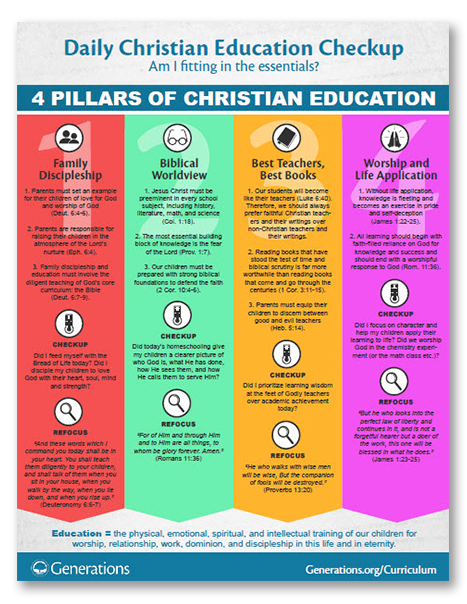
    Preparing our kids for life and eternity is more than we can accomplish as parents. It ís a miracle. It ís an act of God. The first step to seeing your kids become a counter-statistic is to cry out to God to do what He ís so good at…working miracles. But God has also called you as a parent to be purposeful in the education of your children. That means we need to ask, “How can I get on board with what He is doing and make sure that I’m focusing on what’s truly the most important every day?” Below I’ve outlined four “pillars” of a Christian education, based on the Word of God, that I believe are keys to successful kids. If these pillars aren’t in place, the whole thing comes down. (If you’d like a way to get a fast refresher of these four pillars every day and stay on track with what ís most important, download this 1-page, PDF summary,. perfect for posting on your fridge.)

    Pillar #1 – Family Discipleship

    “And you, fathers, do not provoke your children to wrath, but bring them up in the training and admonition of the Lord.” (Ephesians 6:4) Fathers and mothers are responsible for raising their children in the atmosphere of the Lord’s nurture (Deuteronomy 6:7, Ephesians 6:4). Fathers and mothers should teach God’s words in the context of daily life. God calls fathers as leaders of their homes, to be involved in this discipleship at key, strategic points. Family discipleship must involve the consistent and diligent teaching of God’s recommended curriculum: the Bible. Teaching your children the Psalms, Proverbs, and Gospels is essential and basic to a Christian education. Fathers and mothers must keep a careful eye on their children’s spiritual condition, faith, and character.

    Pillar #2 – Biblical Worldview

    “The fear of the Lord is the beginning of knowledge, But fools despise wisdom and instruction.” (Proverbs 1:7) What will it look like to teach your children with a biblical worldview? First, Jesus Christ must be preeminent in history, literature, and science (Colossians 1:18). Christ’s kingdom and His church must become more important in the student’s mind than the work of men’s hands in building their own kingdoms. Secondly, the most essential building block of knowledge (above and beyond every other component) is the fear of God (Proverbs 1:7). The materialism and anti-supernaturalism assumed in modern evolutionary science cannot be tolerated by any Christian family. Thirdly, our children must be prepared with strong biblical foundations and a robust apologetics methodology (2 Corinthians 10:4-6).

    Pillar #3 – Best Teachers, Best Books

    “A disciple is not above his teacher, but everyone who is perfectly trained will be like his teacher.” (Luke 6:40) Our students will become like their teachers (Luke 6:40). Therefore, we should always prefer faithful Christian teachers and their writings over non-Christian teachers and their writings. The great Christian writings are the compendium of the pastors and teachers God has given the church over 2000 years (Ephesians 4:11). These are the teachers that God has given us. Abiding and enduring books are a thousand times worth reading over the books that come and go through the centuries. The pagan teachers and writers have become one of the most influential tools of the devil to cause Christian students to stumble. It is wise to set your children at the feet of the best teachers by reading the greatest Christian books.

    Pillar #4 – Worship and Life Application

    “But be doers of the word, and not hearers only, deceiving yourselves. For if anyone is a hearer of the word and not a doer, he is like a man observing his natural face in a mirror; for he observes himself, goes away, and immediately forgets what kind of man he was.” (James 1:22-24) Without life application, knowledge is fleeting and becomes an exercise in pride and self-deception. Discipleship and mentorship must include life application. The fear of God is the beginning of wisdom, and real reverence will result in worship. Our children must be trained to praise and worship God in the chemistry laboratory. Worship is the great purpose and end of all of life for the Christian.

    Post these pillars on your refrigerator

    Here is a downloadable summary version of these 4 pillars that you can print off and post on your fridge so you can review these on a daily basis. Click here to download.
    The bottom line.

    At then end of the day, the key to godly family discipleship and education is heeding Jesus instructions and promise in Matthew 7: Whoever hears these sayings of Mine, and does them, I will liken him to a wise man who built his house on the rock: and the rain descended, the floods came, and it did not fall, for it was founded on the rock. e the Bible in every area of your family life.   1. http://www.christianitytoday.com/edstetzer/2009/march/barna-how-many-have-biblical-worldview.html,https://www.barna.com/research/barna-survey-examines-changes-in-worldview-among-christians-over-the-past-13-years/


    Kevin Swanson speaks across the nation about homeschooling.  Homeschooled himself in the 1960’s-70’s, he and his wife Brenda now homeschool their five children. Kevin has 43 years of experience in the homeschooling movement and serves as the Director of Generations– a ministry he founded to strengthen homeschool families. He also serves as Executive Director of Christian Home Educators of Colorado.

  • College Fair: Like Mother, Like Son?

    College Fair: Like Mother, Like Son?

    by Wendy Summers

    Little did I realize when I decided to attend a college fair as a high school junior, that it would become a God-ordained pivot point in my life.  I had thought my college path was already determined. I was from Maryland, and by default, I would attend the University of Maryland.  My only real choice was which campus.

    The fair was packed with colleges and students. At some point, I ended up walking over to a table where a college counselor sat alone. We chatted a few minutes, and I learned that the school had an art camp that summer. I took the information home and spoke with my mother about the possibility of going to the camp. To my surprise, she said “yes.” A week into that camp at Alfred University in New York, I knew that I was meant to go there.

    Thirty years later my husband and I are helping our son choose a college or university, praying for God’s perfect will for his life. We have done hours of research and visited some schools. Our mailbox has been crammed with information and literature from schools all across the country, and some have even called! There is so much to consider: distance from home, campus environment, number of students, price, scholarships, available majors, worldview, and on and on. How will he know which school to choose?

    Some of the best advice that I have for him I learned many years ago. The first step to finding God’s will in a big decision is seeking to be neutral.  Pray that your feelings and opinions will be okay with whatever God wants. Before our son was even conceived, for example, I began to pray that my husband and I would be willing to raise our kids the way God wanted us to raise them, even if that meant swimming against the flow of culture. When all our friends automatically began registering their kids for pre-K, I was still praying that my feelings and wishes be aligned with God’s will.  Ultimately, He led us to homeschooling. 

    Now, as our son’s homeschooling journey nears an end and he seeks to discern God’s leading in his own life, the best advice I can give him is to seek God’s heart first and be open to any surprise directions that our Lord may ordain.

    In that context, we are greatly anticipating CHEWV’s College Fair and Financial Aid workshop on the 19th. The fair will be a great opportunity to speak with college counselors from across the state about the schools and their admission process. After visiting a few colleges already, we’re looking forward to talking with many colleges in just one afternoon! 

    Still, my mind goes back to my own college fair thirty years ago, an event that turned out to be pivotal in my life.  I wonder if God will use CHEWV’s College Fair in some big way in our son’s life. If so, we’re open to however God leads!

    Wendy and her husband James serve on the CHEWV board and are directing the CHEWV College Fair and Financial Aid Workshop.  She hopes and prays that God uses it in the lives of many homeschooling families to direct students to the college of His choice. 

  • Perfect Opportunity for High School Students

    Perfect Opportunity for High School Students

    CHEWV’s College Fair and CFWV Financial Aid Workshop on May 19th is a great opportunity for your high school student!  Besides the CFWV focal point workshop, multiple college admissions counselors will be available in one room at one time.  It’s like making multiple college visits without the travel!

    With multiple college admissions counselors on hand, your students can practice making eye contact, shaking hands, and introducing themselves with both their first and last names – as well as ask a lot of questions:

    • When should I start my college prep?
    • How do I find a college or university that is best for me?
    • Should I take the ACT or SAT?
    • Do I need SAT Subject Tests and AP Exams? Which ones should I take?
    • Does your school accept CLEP credits?
    • How do admissions officers view extracurricular activities on an application?
    • What do admissions officers look for in an application essay?
    • Who should I ask to write my letters of recommendation?
    • What should I expect in a college interview?
    • Will applying Early Decision or Early Action give me a leg up?
    • What should I do when I visit campuses?
    • How does the financial aid application process differ from the admission process?
    • Do you offer summer opportunities/camps for high school students?

    What if you’re not interested in any of the attending colleges/universities?  It’s still a great chance to practice – before it “counts.”  Besides, college admission counselors are some of the most important people to meet when choosing a college. Your application goes through their office first and they have a say in whether you get into their school. They can also help you understand the demands of your chosen major, outline high school course requirements for a particular area of study, help you find financial aid, and generally take some of the anxiety out of the admission process.  Don’t hesitate to tap into their knowledge and experience.

    And remember, simply speaking with an admission counselor does not mean you are obligated to apply to that school. Students often compare several schools before making a decision, so do your research to make sure your chosen school will be a good fit for you. It’s even okay to discuss the school you’re more interested in while talking with a counselor from a different school.  This helps them understand what you’re looking for and gives them a chance to argue that they can (or admit they can’t) offer something similar or even better. 

    Don’t close off opportunities. You never know whom God may put in your path, or what doors He might open!

    To sign your family up for the day’s events, click here.

  • Am I A Nag?

    Am I A Nag?

    by Lorrie Young

    As mothers, there are many ways in which we hope our children will remember us after they are grown and gone. Perhaps they’ll recall us being the best neighborhood mom because we passed out popsicles to their friends and had Band-Aids for everyone’s boo-boos. Maybe they’ll remember the cold snowy mornings when they snuggled with us in bed, or the cinnamon rolls we made on Saturday mornings. Possibly, they’ll reminisce about the great birthday parties we threw, or the sweet notes that filled their lunchboxes.  Our children might recollect our love of literature and learning, or the forts we made and the fun we had. One day they might tell their children how our home was a warm and safe haven during tough times.

    As varied and unique mothers, we will all leave different legacies behind us one day. However, I’d wager that we all want to be remembered and cherished by our children for the way we loved them fully and gave all that we had to the best of our abilities. We hope that whatever mistakes we’ve made will be covered with a big dose of grace, right?

    But not one of us would want the legacy of being considered a Nag.

    Yet, in all honesty, sometimes that’s what I feel I am – a nag of the worst kind. There are days when I annoy myself!

    Don’t forget to clean your room, return your books and hang up your bath towel.”

    “Don’t eat too much junk food!”

    “Quit fighting with your brother, and close your mouth when you chew!”

    “Why can’t you pick up the French fries on the floor of the mini-van instead of stepping on them?”

    “Did you notice the basket of clothes in the middle of the steps that you almost killed yourself to avoid?”

    “How much TV have you watched today?  Have you started writing the paper that was due yesterday?”

    “I noticed you didn’t say thank you when you opened that gift!”

    Is it just me, or does it seem sometimes that all we mothers do is nag our children? We don’t necessarily mean to, but then again, if we didn’t help them grow in responsibility, character, and behavior, then who would?  Furthermore, is it really nagging or is it training?  Where is the fine line between the two, and how do we know if we have crossed it? I frequently find myself asking that question—not wanting to let everything go, but not wanting to make a big deal out of everything either.

    I’ve found this general rule of thumb: Nagging is for our good, to get what we want…

    Training is for their good, letting them know we are on their side, with a desire to help them grow.

    While they may sound the same at times, the defining line between training and nagging lies in our heart motivation. Here are some pointers as we walk that fine line.

    Two or three: Chances are there are dozens of things we could harp on in a day, but to avoid nagging, pick just two or three per child at a time, such as responsibility with chores and respect toward siblings. Sit down with each child and explain that these are the things to work on this month. Identify offenses in these areas along with the measured consequences for crossing the line. This doesn’t mean you will ignore everything else, but that other things will be dealt with at a later time.

    Isolate: This is admittedly the most difficult for me. Multiple children sharing close quarters makes it difficult to isolate a child in order to discipline him in private. Having a heart-to-heart discussion pays dividends, though. I, too, know how different it is when a friend gently and privately brings an offense to my attention rather than sharing it in front of others. Instead of embarrassment leading to defensive anger, my heart is primed for repentance and growth.  How much more so for our children?

    Meaningful and measurable goals: Our oldest was having issues leaving his water bottle, jacket, and ball at gym class and soccer practice. Often, we would be half-way home when he would remember that he had left his belongings. It was becoming a bad habit, so for a few weeks we disciplined EVERY SINGLE INCIDENT. The most meaningful consequence was to take away the thing he loved most, which was nicely tied to the area that needed addressed.  He had to sit on the sidelines during gym class, practices, or games for every item left behind. I admit this was painful to carry out and at first seemed futile. But after about six weeks, he finally figured out if he was going to play, he needed to behave differently. He began to put steps in place to help him remember to take the time to think through what he brought and ensure it all came home with him. I am proud to say he is 95% better than he was a few months ago!

    Encouragement: Celebrate the wins. Notice when your child improves, even in the slightest, on a goal you set together. Leave him a note, take her for ice cream, and publicly praise them when they can hear you (even if it’s just at the dinner table).

    Notice that the acronym spells TIME. Learning to become a trainer of our kids is more difficult than being a NAG. It takes TIME to be consistent and intentional. But it pays off. One day our kids just might thank us for taking the time to help them become better citizens, students, spouses, siblings, and friends. And what a legacy that will be!


    Lorrie Young is a former nurse turned homeschooling mom of three busy kids! She adamantly declares that the two best decisions she has ever made were accepting the Lord as her Savior and marrying her best friend and husband Ben. She is passionate about writing, family, flowers and Jesus.  She primarily spends her time teaching and managing the home, but in her spare moments you might find her scouring garage sales for good deals, reading a book on the porch, or enjoying a long walk with a friend.  She is a volunteer leader at her local co-op, and blogs about her life at  lifeandlessonslearned.blogspot.com.

  • Comparing With Finland’s 1st Graders

    Comparing With Finland’s 1st Graders

    According to the Stanford News, 65 countries/economies were ranked in the Program for International Student Assessment in 2009.  Finland ranked high: 6th in math, 2nd in science, and 3rd in reading.  In the same year, U.S. students ranked 30th, 23rd, and 17th, respectively.

    Clearly, Finnish students are out-performing American ones.  Is this because they are getting an earlier start? 

    Actually, no. Finnish children do not begin first grade until they turn 7.  Many Finnish first graders begin school without any formal reading instruction at all.  Yet they appear to excel beyond our students, despite our decades of HeadStart, preschool, and kindergarten.  While our first grade students are usually 6, theirs are 7. 

    According to this article, researchers at the University of Virginia analyzed survey responses from American kindergarten teachers between 1998 and 2010. “Almost every dimension that we examined,” noted the leading researcher, “had major shifts over this period towards a heightened focus on academics, and particularly a heightened focus on literacy, and within literacy, a focus on more advanced skills than what had been taught before.”

    Not so for 6-year-old Finnish kindergartners!  They spend the majority of their day playing!  Primarily exposed to just pre-reading, they learn through play, thus developing a love for learning.  And it works!

    While most Americans are scrambling to have fluent readers by age 5, homeschool parents have the freedom to teach their children differently – and to follow the example of Finland should they so choose.  They can use the early years to instill a love of learning!  Rather than studying butterflies, homeschooled preschoolers can observe them outdoors or in a conservatory.  Rather than studying about plants, they can help care for their own. They can be taught to notice the weather, the seasons, and the length of daylight throughout the year.  These are all science concepts – taught naturally through fun observation.  Delaying formal academics does not mean the absence of learning!  On the contrary, natural and relaxed learning has the potential to set a solid foundation for all the education to follow.

    For ideas about natural learning in the early years, including ideas for individual subjects, see our article here.

  • Wait!  Does That Test Meet WV Code?

    Wait! Does That Test Meet WV Code?

    While the myriad of testing choices available to parents may offer more flexibility, they come with an equal dose of responsibility.  Recent ads to WV families have promoted online and traditional versions of the Stanford test – some of which do not meet state code.  The Comprehensive Testing Program (CTP) is also advertised, but appears not to offer the five required subjects.

    The testing assessment option in the state code requires a nationally-normed standardized test published or normed within the previous 10 years.  It must provide scores for five subjects:  reading, language, mathematics, science and social studies.  Further, it must be administered under the standardized instructions given by the publisher.

    Though it is the parent’s responsibility to ensure that any assessment they use meets WV code, CHEWV is here to help!  Not only do we provide a testing service and do all the work to ensure the tests meet WV requirements, but we’re also here to answer questions about other assessment options. 

    Our testing program is  a non-profit service, so we have no reason to discourage you from using other options. However, we do have an interest in educating families to ensure they choose tests that meet state code – both to protect individual families and to protect the homeschool freedom of all.

    Even if a county does not notice the first year a test doesn’t meet code, it’s still a hazard to all homeschoolers if families mistakenly test using outdated materials.  When a test’s obsolescence becomes known, it immediately casts negative attention on homeschooling and is fodder to call for greater regulation.  Please help us pass the word so that everyone is compliant!

    Remember that your state organizations exist to serve homeschoolers and help them meet the legal requirements to homeschool in WV.  Contact testing@chewv.org with any questions.  Click to read about assessment options or to read over the WV code.  To support CHEWV by joining, click here.

    Defending freedom, serving families…together.

  • Our First Home School Day at the Capitol

    Our First Home School Day at the Capitol

    And What We Have Learned From the 2018 Legislative Session

    by Kelli Allen

    Our family participated in Home School Day at the Capitol (HSDC) for the first time this year. As rookies, we weren’t quite sure what to expect so we were grateful that CHEWV organized it so that our trip would run smoother. Legislation pertaining to homeschooling was what motivated us to make our four-hour trek to Charleston.

    It was a privilege to meet with two out of our three legislators to discuss homeschooling issues that concerned us.  They were friendly and welcoming, though one in particular was evasive when it came to discussing these issues. We also visited with another representative who has been a supporter of homeschooling, and we were able to express our gratitude.  

    What we learned from our trip is that the winds of change in Charleston are constant and quite unpredictable. Last year’s Tim Tebow bill, for example, which passed the House and Senate but was vetoed by our governor, didn’t even make it out of the House Education Committee this year. The Senate’s version remains stalled in the Senate Finance Committee as I write this, and the session is coming to a close. Disappointed? Absolutely, and probably just as much as our kids. Word was that this bill was expected to become law this year. I hear that the Senate’s version won’t likely get out of the Finance Committee since the House killed their proposal. Phone calls to the Finance Committee seem to go unnoticed. 

    Through my disappointment though, I’m reminded of a truth: “We make our own plans, but the Lord decides where we will go.” (Contemporary English Version, Proverbs 16:9).  I believe that we must do what we can to debunk myths about homeschooling, contact our legislators, vote, even run for office if that is where the Lord is leading, while at the same time realizing our plans may not be what the Lord would have for us, at least not for now.  His timing is perfect and although I don’t understand the whys and why nots, I know I can trust Him to work out His plan – which is better than mine. Does this mean that we should always quit when things don’t go as we expect? No, even though we may feel like it. I believe that we can be His instruments for change as we diligently seek to secure opportunities for homeschooling families, rid discrimination, and loosen the restrictions so we may “train up our children in the way they should go” with less red tape.

    I would be amiss, however, if I didn’t mention the other opportunities that this day afforded: our kids paged during the House session, participated in the showcase at the Rotunda, toured the Governor’s Mansion, and met the wonderful folks from CHEWV who organized the day for us. Getting involved in the political process has been an eye-opening experience, but overall I can say it has been a good one. We are learning, first-hand, by engagement. I’m reminded of all the proactive homeschoolers who have been in that Capitol fighting for our freedoms for many years before I came along, and I’m sure their path wasn’t an easy one. We are the beneficiaries of their diligent efforts. It is easy for me to take that for granted. It’s given me a different perspective about how we have the liberties that we do today—through their endless efforts, battle after battle, until the sweet victory was won. 

    As a homeschooling parent, it’s easy to just be caught up in the daily demands of our schedules.  But I would highly encourage everyone to attend next year’s Home School Day at the Capitol.  I had never been to our capitol before this visit; it was a unique opportunity that I was happy to share with our kids. We all came away with a better understanding, albeit to a small degree, of how things operate in Charleston. Your presence at HSDC would speak volumes. 

    But if you can’t make the trip, there is always the phone or e-mail. It only takes minutes to contact our legislators to let them know our concerns.  Helen Keller is quoted as saying, “Alone we can do so little; together we can do so much.” With the Lord’s help, I believe this to be true.

    Kelli grew up in Romney, WV and graduated from the local high school where she was quite involved in sports and various clubs. She had never even heard of homeschooling until marrying her husband Walt – who had always wanted to homeschool his kids. So now they are in their 10th year of homeschooling four kiddos, and what a learning adventure it has been for all! Kelli says that the Lord is using homeschooling to teach her humility, patience, discipline, flexibility, and great literature – among many other things! She thanks the Lord for this opportunity to spend time with her kids and prays they will grow to love, honor, and serve Him with their lives.

  • SB 319:  A Little More Background…

    SB 319: A Little More Background…

    …A Little More To Do

    by Edie Carey, wife of CHEWV’s Legislative Liaison, John Carey, and active homeschool mom

    SB 319, the Senate bill that removes the GED requirement for homeschool applicants, was in the Senate Finance Committee this past Monday and Tuesday.

    Clearly, homeschooling was under attack during the committee’s deliberations, and for a while Senator Palumbo led the charge. Senator Palumbo’s concern — that removing the GED requirement is dumbing down education — has no basis in fact.  If you can pass the ACT and show you are ready for college, certainly you can get a passing score on the GED.  We appreciate Senator Palumbo’s willingness to hear the truth and change his position.  

    Yet there have been additional challenges of which you need to be aware.  Last week when the Senate Education Committee considered the removal of the GED testing requirement, Vice Chancellor of the West Virginia Higher Education Policy Commission Matt Turner implied that a homeschool diploma and transcript are subpar.  Turner stated if the GED testing requirement was removed, “What we’ll do is monitor the cohorts. If this changes and this becomes a problem, we can come back and report it (to the legislature) and say, ‘We need to make some adjustments again. . . You could start to see the erosion of the merit level of the Promise.”

    Senators and state education bureaucrats, regretfully, are not aware of an empirical fact:  both nationally and in the state of West Virginiathe data is in on the performance of homeeducated students as it relates to the ACT and the SAT.  Homeschool graduates in West Virginia score higher, on average, than public students on the ACT and SAT.  Statistically, this has proven true year after year.  In 2016, homeschool graduates enrolled as freshmen in WV four-year and two-year colleges scored, on average, 23.8 (70th percentile ranking) on the ACT.  The average score of WV public school graduates enrolled as freshmen in the same colleges was 21.5 (59th percentile ranking).  

    Enrolled as freshmen in 2 & 4-year WV colleges:

    Homeschool Graduates

    Public School Graduates

    2016 ACT Score

    23.8

    21.5

    2016 ACT Percentile Rank

    70

    59

    Click here to read the NHERI study on the ACT nationallyLikewise, homeschoolers excel on the SAT as demonstrated in this study.

    Homeschooling father and CHEWV member Senator Karnes confronted these arguments in Committee, providing support for the passage of SB 319 and its advancement to Senate Finance this week.  Others helped advance the bill once in the Finance Committee; read my husband’s report from earlier today here.

    Yet the job is not done.

    Again, we remind all of our members and friends that more calls are needed.  Even better, show up in person!  The bill is now on the floor of the Senate.  Its Second Reading, the amendment stage, is on Thursday.

    • Action needed:  Contact your senator early (they go into Session at 11:00 a.m.) and ask him/her to please support SB319 as it came out of Senate Finance.
    • Those of you with senators on the Finance Committee, take the time to thank them for their unanimous support of the amendment to drop the GED requirement!

    Then it’s up for final passage on Friday.  If approved, it goes to the House Education Committee.

    My husband, John, spends hours at the Capitol as part of his service to CHEWV homeschoolers – like our own family!  I can testify to the fact that he is genuinely encouraged when CHEWV families all across the state participate with their support.  Thank you for continued prayers and ready action on SB 319 as it moves through the legislative process!

    One Last Request:  A thankyou to the Finance Committee senators who finally passed SB 319 and sent it to the Senate floor would be a great idea.  Acknowledging their pro-homeschool choices is highly effective.  Remember, legislators typically receive more complaints than compliments.  Put yourself in their place and take a few moments to be a blessing!

  • A Report on SB 319

    A Report on SB 319

    God Works All Things Together For Our Good

    by John Carey, CHEWV’s Legislative Liaison

    SB 319, the Homeschool Promise Bill, has made it all the way to the Senate floor!  Your calls have been effective and more calls are now needed.  It is on First Reading today (Wednesday, February 14), Second Reading on Thursday – which is the amendment stage, and then up for final Senate passage on Friday.

    On Monday, the Senate Finance Committee took SB 319 up for consideration. The meeting was contentious as Democratic legislators called the removal of the GED requirement as “Dumbing Down” the requirements to obtain the Promise Scholarship.  This made absolutely no sense since the GED has nothing to do with qualifying for college entrance but rather is designed for those who drop out of high school!  Ultimately, the Promise bill was laid over for consideration on Tuesday at 3PM.

    On Tuesday, the first bill on the agenda was a gambling bill. The meeting, which was again very contentious, wore on for 90 minutes.  At 4:30 the committee members were worn out, and it looked like everyone was ready to go home for the day. SB 319 had not made it up for discussion. However, Senator Blair, the Finance Chair, asked who had come that day for the Promise Scholarship bill.  Fortunately, CHEWV members Paul and Donna Ludwinski and their 18-year-old son Aron had driven up from Welch. The Chair came to the back of the committee room to speak with them and asked if they could return the next day. Because they could not, he decided to run the bill. Without the Ludwinski family in attendance, the bill would not have been run that day.

    Senator Rucker, the lead sponsor of SB 319, then entered the committee room to speak. Senator Rucker, as a homeschool mom, was able to testify from personal experience. Her testimony in support of the bill created a visible change in the way legislators spoke of the bill; she was able to put a face on the issue.

    Senator Gaunch also spoke of his personal experience as a homeschool Grandfather. Not only did he share how homeschooling had helped his grandchildren, but he emphasized that to speak of homeschooling in a disparaging way, as was done in the Monday meeting, was not justified. Following the senator’s compelling and heartfelt testimony, Senator Boley spoke of her grandchildren and how one of them had to take the GED before he could go to college.

    It was at this point that Senator Sypolt spoke, in detail, of how this bill was an affirmation of what was already in state law. He referred to the 2015 law that precludes discrimination by the state of West Virginia against the homeschool diploma. Sypolt argued that requiring homeschoolers to take the GED was a violation of state law; SB 319 is simply an affirmation of current state law.

    Senator Palumbo went on to propose an amendment to remove the GPA requirement for all students equally – public, private and homeschooled – because it is the ACT/SAT score, not GPA, that is the final measure for the Promise. He was absolutely right!  Whereas about 45% of public school students receive a 3.0 GPA, only about half of those earn a sufficiently high score on the ACT to qualify for the Promise.

    Yes, God worked it out!  And He used all of us to do it.  It’s my pleasure to represent CHEWV at the Capitol and to head the lobbying effort.  But the Ludwinski family was present to help at the suggestion of Mike Donnelly, WV’s attorney with the HSLDA. HSLDA also provided the legal understanding so that supportive senators could articulate solid and compelling arguments. Both CHEWV and HSLDA asked all of you to help, and you did. Your phone calls and emails were felt yesterday. You may not have been in the room, but legislators knew that you cared about this issue and they responded accordingly.

    If the bill passes on the Senate floor, its next stop will be House Education. Please pray and act as we seek to make this change in the law together.  It is God who works all things for our good, but He clearly uses His people to accomplish His good pleasure. Please keep praying and be ready to act as SB 319 moves through the legislative process.

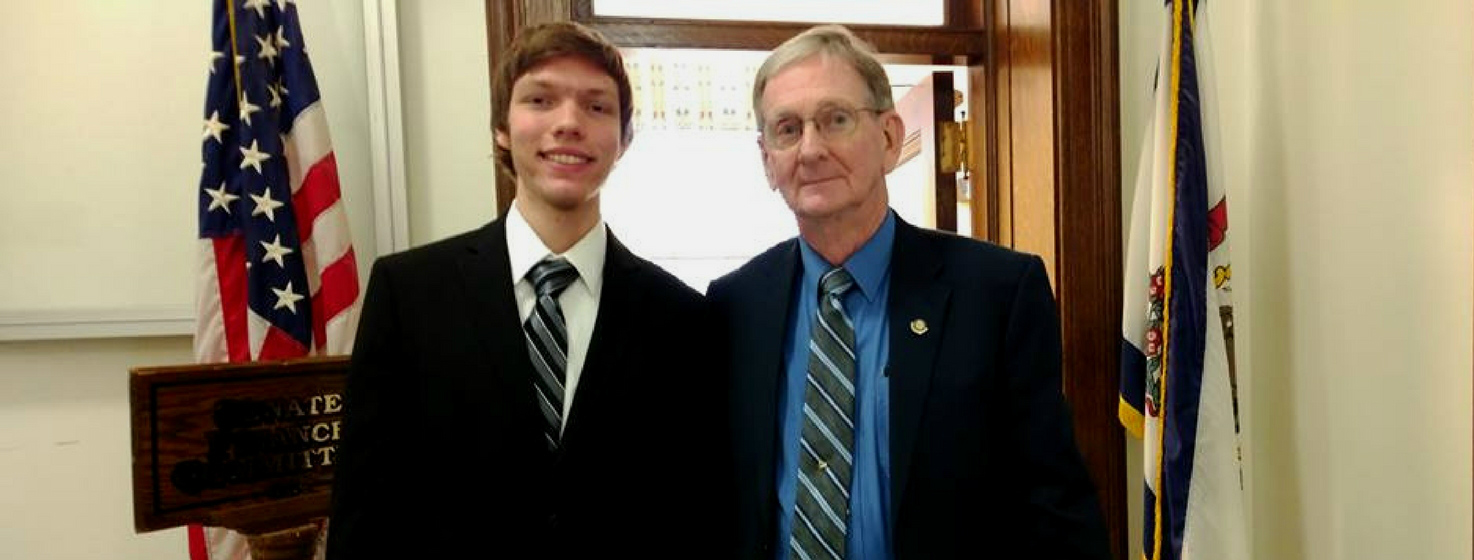
    Pictured in header:  Homeschool student Aron Ludwinski with Senator Chandler Swope of Mercer County.